Maha Vishuba Sankranti 2026: Traditions of the Odia New Year
Celebrate Maha Vishuba Sankranti 2026: Discover the rituals, the iconic Bela Pana, and the spiritual significance of the traditional Odia New Year.
Celebrate Maha Vishuba Sankranti 2026: Discover the rituals, the iconic Bela Pana, and the spiritual significance of the traditional Odia New Year.
Trending Now
Maha Vishuba Sankranti 2026: Traditions of the Odia New Year
Key Takeaways
- Maha Vishuba Sankranti 2026 falls on Tuesday, April 14th — a day celebrated as the Odia New Year across Odisha and by Odia communities worldwide
- The festival marks the sun's precise entry into Mesha Rashi (Aries) at 0° longitude in the sidereal zodiac
- Major rituals include Bela Pana (a cooling wood-apple drink), Basundhara Theki, Danda Nacha, and Jhaamu Yatra
- Danda Nacha rituals can begin anywhere from 13 to 21 days before Sankranti
- The Odia Panjika (almanac) plays a central role in determining auspicious timings for every ritual
- This is also the day Odisha observes Hanuman Jayanti, unlike most other Indian states
Introduction to Maha Vishuba Sankranti and the Odia New Year
So, you've probably heard about Baisakhi, Vishu, Ugadi, or Pohela Boishakh — all those vibrant New Year festivals that light up different corners of India every April. But if you haven't yet discovered Maha Vishuba Sankranti, you're genuinely missing out on one of the most culturally rich and spiritually layered celebrations the country has to offer.
Maha Vishuba Sankranti — also called Pana Sankranti or Maha Bisubha Sankranti — is the traditional New Year of the Odia people. It's a big deal. Like, really big. The name "Vishuba" comes from the Sanskrit term for the vernal equinox, and "Sankranti" refers to the solar transit, making this essentially a festival rooted in both astronomical precision and deep cultural tradition.
Celebrated primarily in Odisha, this festival brings together ancient rituals, ecological awareness, devotional intensity, and some seriously delicious food — all in the span of a single auspicious day (and the weeks surrounding it). Whether you're Odia by birth, curious about Indian festivals, or just looking for something genuinely fascinating to read about, this guide has got you covered.
In 2026, the festivities land on April 14th, and honestly, the preparation starts way earlier than that.
Astronomical Significance: The Sun's Ingress into Mesha Rashi
Here's where things get kind of mind-blowing. Maha Vishuba Sankranti isn't just a cultural or religious date picked at random. It's tied to a very specific astronomical event — the sun's entry into Mesha Rashi (Aries) in the sidereal zodiac.
📍 "The festival marks the sun's ingress into Mesha rashi at exactly 0 degrees longitude in the sidereal zodiac." — DharmaRenaissance
This is known as Mesha Sankranti, and it's the starting point of the Hindu solar calendar year. Think of it as a cosmic reset button — the sun begins a brand new cycle, and the Odia calendar follows suit. The Baisakha month begins on this day, ushering in a new chapter in the traditional almanac.
What makes this unique compared to lunar New Year celebrations is the precision involved. The exact moment of solar ingress — called the Sankranti Punya Kala — is calculated to the minute using Vedic astronomical methods. This is why the Odia Panjika (almanac) carries so much weight: it tells you exactly when the sacred window opens.
Key Astronomical Facts at a Glance
| Element | Detail |
|---|---|
| Solar Event | Sun enters Mesha Rashi (Aries) at 0° sidereal longitude |
| Traditional Name | Mesha Sankranti |
| Calendar System | Sidereal solar calendar |
| Month Begins | Baisakha (first month of Odia year) |
| 2026 Date | Tuesday, April 14th |
The sidereal system (used in Vedic astrology) is different from the tropical system used in Western astrology — it accounts for the precession of equinoxes, which is why this date often aligns with April 14th rather than March 20th (the actual astronomical equinox).
The Legend of Hanuman Jayanti: Why Odisha Celebrates Differently
Here's a fun fact to drop at your next dinner party: while most of India celebrates Hanuman Jayanti on the full moon day of Chaitra month, Odisha celebrates it on Maha Vishuba Sankranti itself. Yep — same day as the New Year.
According to Odia religious tradition, Lord Hanuman was born on the day of Mesha Sankranti. This belief is strongly rooted in the Odia Panjika and is distinct from pan-Indian practices. As a result, Hanuman temples across Odisha — from neighborhood shrines to major mandirs — are packed with devotees on this day.
This dual celebration creates a beautifully layered atmosphere. You've got the New Year energy buzzing on one side, and deeply devotional Hanuman worship on the other. Temples organize special abhisheka (ritual bathing of the deity), recitations of the Hanuman Chalisa, and community prayers. The whole day feels like the universe conspired to make April 14th extra auspicious.
It's also why you'll often hear people in Odisha saying "Nua Barsha ra Shubhecha" (Happy New Year) and "Jai Bajrangbali" almost in the same breath on this day.
Basundhara Theki: A Ritual of Ecological and Spiritual Balance
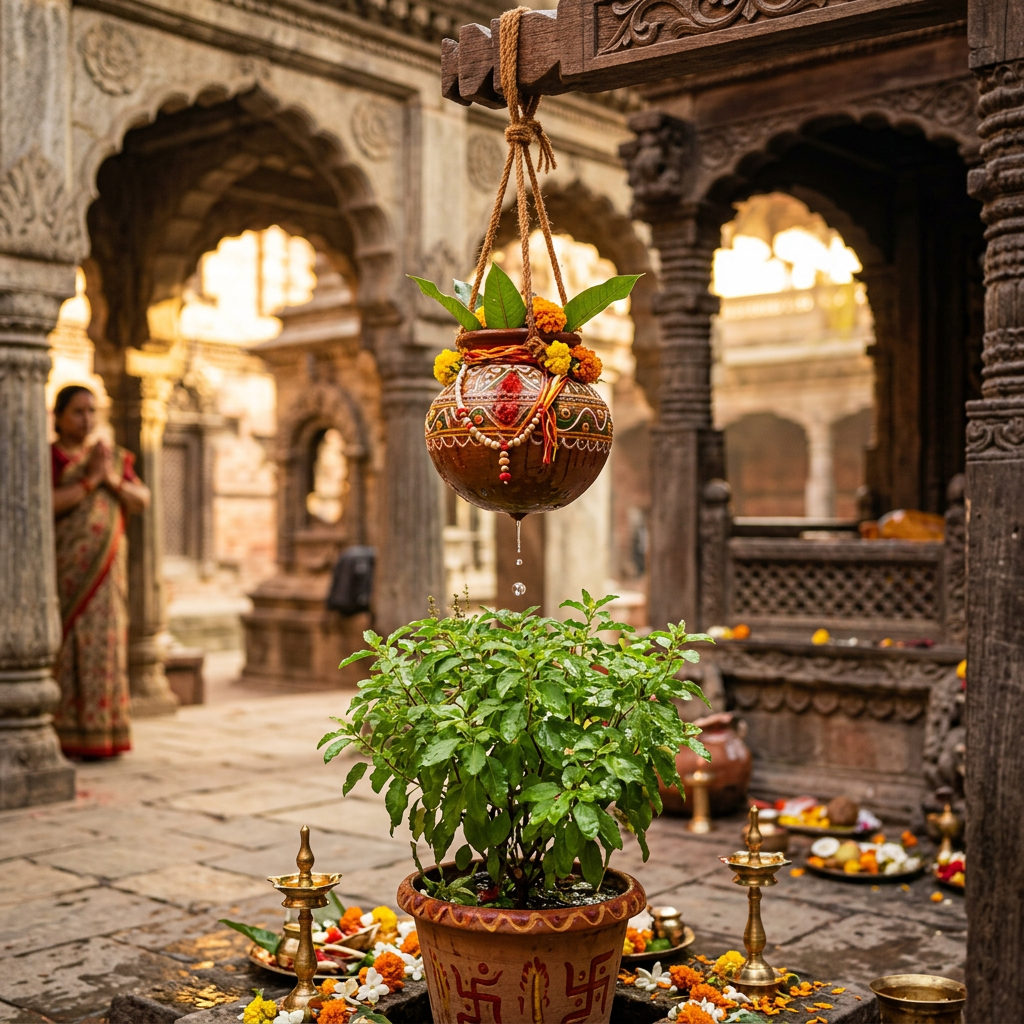
Now this is one of those traditions that genuinely deserves more attention outside of Odisha. Basundhara Theki — literally translating to "the earthen pot of the earth goddess" — is a ritual that honors the Earth (Basundhara, or Dharitri Mata) on the day of Sankranti.
In this ritual, a pot filled with water and fresh mango leaves is placed near the Tulsi plant (holy basil) in the courtyard of homes. The earth is worshipped as a mother and provider. Women of the household perform prayers, draw traditional jhoti (floor art) patterns around the pot, and offer seasonal flowers and fruits.
What's beautiful about Basundhara Theki is how it subtly weaves ecological consciousness into spiritual practice. The ritual essentially says: before you celebrate, pause and thank the earth that sustains you. It's a mindfulness practice dressed in ritual form, and honestly, it's the kind of message that resonates just as much today as it did centuries ago.
This tradition also signals the importance of water conservation — because April in Odisha is hot, and this time of year has historically been associated with the anxious wait for the monsoon.
Bela Pana: The Cooling Science and Tradition of the Wood-Apple Drink
If Maha Vishuba Sankranti had an official beverage, it would be Bela Pana — hands down. This is probably the most beloved and universally recognized ritual of Pana Sankranti, and there's both science and soul behind it.
Bela Pana is a refreshing drink made from the pulp of bel (wood apple or Aegle marmelos), mixed with water, cane sugar or jaggery, milk, black pepper, chandan (sandalwood paste), camphor, and sometimes banana. It's offered first to Lord Jagannath and deity images at home, and then distributed as prasad to everyone.
Why Bela? The Science Bit
| Ingredient | Traditional Reason | Modern Science |
|---|---|---|
| Bel (Wood Apple) | Sacred to Lord Shiva, cooling | Rich in antioxidants, aids digestion |
| Black Pepper | Balances doshas | Anti-inflammatory properties |
| Jaggery | Cooling energy | Better iron absorption than sugar |
| Sandalwood | Purification | Antimicrobial, reduces body heat |
| Milk | Nourishment | Rich in calcium and protein |
The timing is no coincidence. April is peak summer in Odisha — temperatures often cross 40°C — and Bela Pana serves as a natural coolant that protects the body from heatstroke. Our ancestors knew exactly what they were doing. The wood-apple fruit has been used in Ayurvedic medicine for centuries for its cooling, digestive, and anti-inflammatory properties.
Vendors set up Bela Pana stalls all over towns and cities on this day, and it's common to see people offering the drink to passersby for free as an act of devotion. The ritual of Pana Daan (donating the drink) is considered highly meritorious.
Jhaamu Yatra and Danda Nacha: The Intense Path of Devotion
This section is for those who want to understand the truly intense, awe-inspiring side of Maha Vishuba Sankranti celebrations. We're talking about Jhaamu Yatra and Danda Nacha — two rituals that showcase devotion in its most visceral form.
Danda Nacha
Danda Nacha (Dance of the Staff) is a tantric ritual tradition practiced in Odisha, particularly in the coastal and southern districts. Devotees called Danduas take vows of severe austerity — abstaining from salt, sleeping on the ground, observing celibacy — and perform elaborate dances and rituals in honor of Lord Shiva and Goddess Kali.
📊 Danda Nacha rituals can begin anywhere from 13 to 21 days before Sankranti, building intensity as the festival approaches. — Nirab Alok
The performances involve fire-walking, body piercing with hooks, and spinning on iron spikes — acts of extreme devotion that the Danduas undergo in a trance-like state. It's simultaneously unsettling and deeply moving to witness, because the participants aren't performing for spectators — they're fulfilling sacred vows.
Jhaamu Yatra
Jhaamu Yatra is closely related — it involves walking over burning coals as an act of faith and purification. Devotees walk across beds of glowing embers, believing that divine protection shields them from harm. The ritual is typically associated with Shakti worship and draws huge crowds across Odisha.
Both Danda Nacha and Jhaamu Yatra are gradually being documented and recognized as intangible cultural heritage, though modernization has reduced their frequency in urban areas.
Comparison of Key Ritual Traditions
| Ritual | Duration | Deity | Practice Type |
|---|---|---|---|
| Danda Nacha | 13–21 days pre-Sankranti | Shiva/Kali | Austerity, dance, piercing |
| Jhaamu Yatra | Day of Sankranti | Shakti (Devi) | Fire-walking |
| Bela Pana Daan | Day of Sankranti | Jagannath/Shiva | Offering & distribution |
| Basundhara Theki | Morning of Sankranti | Earth Goddess | Home worship, offerings |
The Role of the Odia Panjika: Setting the Spiritual Calendar
You can't really understand Maha Vishuba Sankranti without understanding the Odia Panjika. Think of it as the spiritual operating system for Odia Hindus — a meticulously calculated almanac that governs everything from wedding dates to festival timings to auspicious hours for starting a new business.
The Odia Panjika is released each year and is based on the traditional solar-lunar calendar system. It specifies the exact punya kala (auspicious time) for Sankranti rituals, the muhurtas for prayers, and the positions of celestial bodies. In many Odia households, you won't find a smart home device, but you will almost certainly find the latest Panjika.
On Maha Vishuba Sankranti, the Panjika determines:
- The exact moment of Mesha Sankranti (solar ingress)
- The daan punya kala — the auspicious window for charitable activities and offerings
- Inauspicious periods (vishkambha) to be avoided
- Recommended rituals for the Baisakha month ahead
The Panjika is also released publicly — temples, astrologers, and cultural organizations publish it — and it's available in both print and, increasingly, digital formats.
Culinary Traditions: Chhatua, Pithas, and the Taste of Baisakha
Festivals in India are always about the food, and Maha Vishuba Sankranti absolutely delivers. Beyond the famous Bela Pana, the day features a whole spread of traditional Odia foods that are tied to both taste and seasonal wisdom.
Chhatua is a roasted grain flour preparation — made from barley, chickpeas, or puffed rice — mixed with banana, jaggery, and sometimes ghee. It's lightweight, nutritious, and filling in the summer heat. Eaten as a breakfast or offering on Sankranti morning, it's the kind of humble food that carries generations of memory.
Pithas (rice cakes) are another cornerstone — varieties like Enduri Pitha, Chakuli Pitha, and Arisa Pitha are prepared at home and offered to deities. Each region of Odisha has its own spin on which Pitha takes center stage.
There's also a tradition of preparing dishes from freshly available seasonal fruits and vegetables — raw mango, tamarind, and tender coconut all feature prominently in Sankranti cooking, creating a menu that's basically a love letter to Odisha's summer produce.
Celebrations at the Shree Jagannath Temple in Puri
No conversation about Odia festivals is complete without mentioning the Shree Jagannath Temple in Puri — the spiritual heart of Odisha and one of the four sacred Char Dhams of Hinduism.
On Maha Vishuba Sankranti, the temple conducts special sevas (ritual services) for Lord Jagannath, Lord Balabhadra, and Goddess Subhadra. The deities are offered Bela Pana as bhog (sacred food offering), and the event draws thousands of pilgrims from across the state and beyond.
The temple priests follow the timings specified in the Odia Panjika with remarkable precision. Special abadha (food offerings) are prepared for the occasion, and devotees throng the temple from early morning to receive prasad and blessings for the New Year.
Puri itself transforms into a festival hub — the beach town fills with pilgrims, cultural programs line the streets, and the entire atmosphere feels electric with that particular blend of devotion and celebration that only a place like Puri can conjure.
Regional Variations: Meru Yatra and Northern Odisha's Chadak Parva
One of the coolest things about Maha Vishuba Sankranti is that it doesn't look the same everywhere. Odisha is a state of incredible regional diversity, and the New Year celebrations reflect that beautifully.
In parts of northern and western Odisha, the period around Sankranti is marked by Chadak Parva — a festival connected to Lord Shiva, featuring rituals of devotion and austerity that parallel the Danda Nacha tradition of coastal Odisha but with distinct regional flavors.
Meru Yatra is observed in certain temple traditions where the meru (a symbolic representation of Mount Meru, the cosmic mountain) is ceremonially processed through the community. This is tied to cosmological beliefs about the new solar year and the renewal of the universe's spiritual axis.
In tribal regions of Odisha, the festival intersects with indigenous spring celebrations, creating hybrid traditions where Adivasi ritual elements blend with mainstream Odia Hindu practices in ways that are genuinely unique and worth documenting.
Modern Celebrations: Odia New Year in the Digital Age
Fast forward to 2026, and Maha Vishuba Sankranti isn't just a village affair anymore. The Odia diaspora — spread across cities like Bengaluru, Mumbai, Hyderabad, and internationally in the US, UK, and Gulf countries — celebrates the New Year with a lot of heart and a whole lot of WhatsApp.
The Times of India notes the massive surge in digital greetings, wishes, and cultural content shared around Pana Sankranti — from custom sticker packs to YouTube videos explaining the festival's significance to younger generations.
Cultural organizations in cities organize Sankranti events featuring:
- Bela Pana preparation workshops
- Traditional music and Odissi dance performances
- Odia cuisine showcases
- Children's storytelling sessions about the festival's myths and rituals
Social media has also played a huge role in reviving interest in rituals like Danda Nacha and Jhaamu Yatra among urban youth, with documentary-style reels and vlogs bringing these traditions to millions of viewers who'd never otherwise encounter them.
The Odia Panjika is now available as a mobile app. Traditional rangoli-style jhoti designs are shared as Instagram templates. And yes, people are absolutely posting their Bela Pana recipes on food blogs. Some things change, some things don't — and the spirit of the festival adapts beautifully.
Conclusion: The Enduring Legacy of Pana Sankranti
What makes Maha Vishuba Sankranti so compelling — so worth celebrating and understanding — is how it holds so many things at once. It's astronomically precise and spiritually warm. It's ancient tradition and living culture. It's a personal New Year prayer whispered at a home altar and thousands of people sharing a cold glass of Bela Pana in the April heat.
Whether you're waking up at dawn in Puri to catch the morning seva at the Jagannath Temple, watching Danda Nacha performers in a trance-state in a coastal village, or video-calling your Odia grandmother to wish her Nua Barsha ra Shubhecha from across the world — the festival connects you to something much larger than any single celebration.
In 2026, as the sun makes its precise, mathematically beautiful ingress into Mesha Rashi on April 14th, millions of Odia hearts will mark the moment the same way they have for centuries — with gratitude, devotion, a sweet drink made from wood apples, and genuine hope for the year ahead.
That's what Maha Vishuba Sankranti is, really. It's not just a calendar event. It's a reminder that time is cyclical, the earth is sacred, and every new year deserves to be welcomed with both joy and reverence.
Nua Barsha ra Shubhecha — Happy Odia New Year! 🌸
Sources
Advertisement
Frequently Asked Questions
When is Maha Vishuva Sankranti celebrated and what does it mark?
Maha Vishuva Sankranti, also known as Pana Sankranti, is the Odia New Year and typically falls on April 14th or 15th. It marks the day the sun enters the Mesha Rashi or the sidereal Aries zodiac sign, signifying the start of the Odia solar calendar.
What is the significance of the 'Pana' drink during this festival?
Pana is a traditional refreshing drink made from wood apple (Bela), curd, milk, honey, banana, and spices. It is offered to deities and distributed to the public to provide cooling relief as the festival occurs during the onset of the peak summer season in Odisha.
What is the 'Basundhara Theki' ritual?
In this ritual, an earthen pot called Basundhara Theki, filled with water and having a small hole at the bottom, is hung over a Tulsi (Holy Basil) plant. A straw is placed in the hole so water drips slowly, symbolizing the arrival of rain and keeping the sacred plant hydrated during the hot summer.
Why is Lord Hanuman worshipped on this day?
In Odisha, Maha Vishuva Sankranti is also observed as Hanuman Jayanti, the birthday of Lord Hanuman. Thousands of devotees visit temples and read the Hanuman Chalisa, as He is considered the guardian deity of many Odia villages.
How many people celebrate this festival globally?
The festival is the primary cultural and religious new year for over 45 million Odia-speaking people residing in the Indian state of Odisha and across various international diaspora communities.
Sponsored
You Might Also Like
Advertisement
Comments (0)
Sign in to join the conversation
No comments yet. Be the first to share your thoughts!