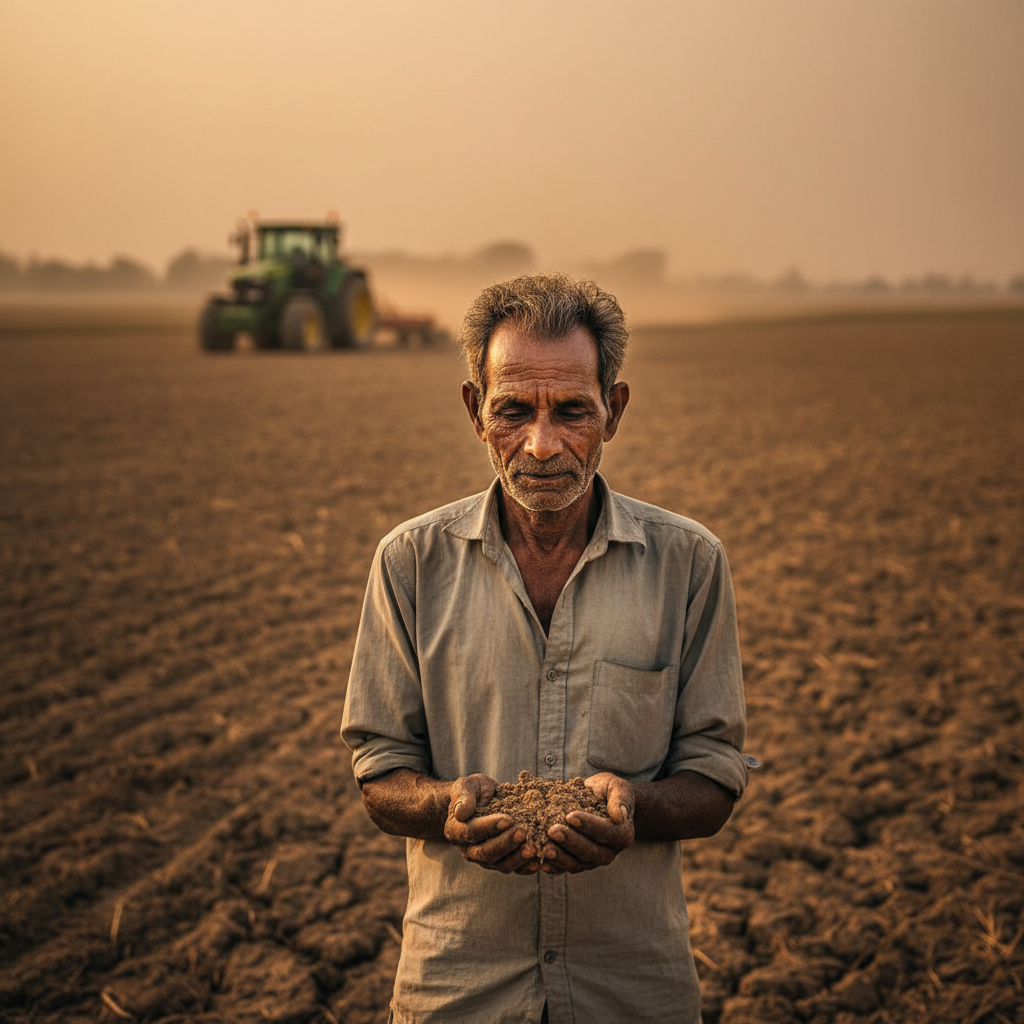
Raju J. Das and the Roots of Indian Agrarian Inequality | agrarian social structure
Explore the structural roots of rural poverty in India through the lens of agrarian class relations and modern economic shifts in this deep dive.

Explore the structural roots of rural poverty in India through the lens of agrarian class relations and modern economic shifts in this deep dive.
Trending Now
📌 Key Takeaways
- Raju J. Das's theoretical framework reveals that agrarian social structure — not individual behavior — is the root cause of persistent rural poverty in India.
- Historical land reforms post-Independence largely failed to dismantle entrenched feudal hierarchies, leaving caste and class dynamics intact.
- The Green Revolution widened intra-rural inequality by disproportionately benefiting large landowners.
- India's rural poverty rate has declined significantly — from 25.7% in 2011-12 to 4.86% in 2023-24 — yet structural inequalities in land access, gender, and caste persist.
- Multidimensional poverty metrics reveal that 83.7% of India's poor still reside in rural areas, underscoring the urgency of structurally informed policy interventions.
Raju J. Das and the Roots of Indian Agrarian Inequality
Few questions in development studies carry as much urgency — or complexity — as why poverty in rural India has proven so durable. Across decades of policy reform, technological intervention, and state-sponsored development programs, the countryside has remained disproportionately impoverished. The intellectual work of Raju J. Das, a geographer and political economist now affiliated with York University, offers one of the most rigorous scholarly frameworks for understanding this persistence. His central argument is deceptively simple but analytically powerful: to understand rural poverty, one must first understand agrarian social structure — the historically sedimented configuration of land ownership, class relations, labor arrangements, and state power that governs rural life.
This article examines Das's theoretical contributions alongside contemporary empirical data to trace the structural roots of Indian rural poverty. From colonial-era land tenure systems to the gendered dimensions of agricultural labor, from the contradictions of the Green Revolution to the fragmentation of landholdings in the present day, the evidence consistently points toward the same conclusion: without fundamentally restructuring agrarian social relations, poverty alleviation in rural India will remain partial and precarious.
1. The Concept of Agrarian Social Structure
The term agrarian social structure refers to the organized system of social relations through which agricultural production is organized, land is owned and controlled, and surplus is distributed. It encompasses not merely economic relations but also political hierarchies, cultural norms, and institutional frameworks that together determine who benefits from the land and who does not.
In the Indian context, agrarian social structure is distinguished by the intersection of class, caste, and gender — three axes of inequality that reinforce one another in ways that purely economic analyses tend to obscure. A landless laborer in rural Bihar, for instance, is not merely economically disadvantaged; she is simultaneously positioned at the bottom of a caste hierarchy that restricts her access to institutional credit, a gender order that renders her labor invisible in official statistics, and a class structure that extracts her labor for the benefit of larger landowners.
Das, drawing on a Marxist political economy tradition, insists that understanding these intersecting structures — rather than focusing narrowly on individual poverty metrics — is the epistemological prerequisite for any serious engagement with rural underdevelopment.
2. Raju J. Das: A Theoretical Framework for Rural Poverty
Raju J. Das's scholarly work, situated at the intersection of Marxist geography, agrarian studies, and South Asian political economy, provides a systematic account of how class relations in agriculture produce and reproduce poverty. His framework rests on several interrelated propositions.
First, Das argues that poverty is relational, not merely a condition of material insufficiency. The poverty of a landless laborer is structurally connected to the wealth of a landlord; these are not independent phenomena but two sides of the same exploitative relation. This relational conception contrasts sharply with mainstream development economics, which tends to treat poverty as a deficit to be filled rather than a relation to be transformed.
Second, Das foregrounds the role of the state as neither a neutral arbiter nor a simple instrument of the ruling class, but as a contested terrain through which class forces struggle over land, credit, wages, and market access. This nuanced understanding of state power allows him to explain why even ostensibly progressive policies — such as land reform legislation — have frequently failed to benefit the rural poor.
Third, Das's framework incorporates spatial analysis, recognizing that agrarian inequalities are not uniform but are differentiated across regions, ecological zones, and historical trajectories. The agrarian question in Punjab, shaped by the Green Revolution and mechanization, differs fundamentally from that in Bihar or Odisha, where semi-feudal relations persist with greater tenacity.
3. Historical Context: From Zamindari to Land Reforms
Any account of India's agrarian social structure must begin with the colonial period. The British introduction of the Zamindari system — a form of revenue extraction that vested land rights in a class of intermediary landlords — transformed what had been a complex, community-based system of land use into a hierarchical tenure structure characterized by absentee landlordism, rack-renting, and the systematic dispossession of peasant cultivators.
At Independence, the Indian state inherited this deeply unequal agrarian order. The constitutional commitment to land reform — abolishing intermediaries, imposing land ceilings, distributing surplus land to the landless — represented a political recognition of this injustice. Between the early 1950s and the 1970s, most Indian states enacted land ceiling legislation that theoretically limited the amount of land any individual could own.
In practice, however, these reforms were subverted through a combination of legal evasion, political capture, and administrative corruption. Large landowners transferred holdings to relatives, registered benami transactions, and exploited definitional ambiguities in the legislation. The result, as documented by Das and other agrarian scholars, was a partial restructuring that weakened the most extreme forms of feudal landlordism without fundamentally democratizing land ownership.
| Reform Measure | Intended Outcome | Actual Outcome |
|---|---|---|
| Zamindari Abolition | Eliminate intermediary landlords | Partial; landlords often reclassified as "self-cultivators" |
| Land Ceiling Acts | Redistribute surplus land to landless | Largely evaded through benami transfers |
| Tenancy Reforms | Security of tenure for tenant cultivators | Inconsistently enforced; led to mass evictions in some states |
| Bhoodan Movement | Voluntary land donation by wealthy landowners | Negligible redistribution; most donated land was unproductive |
4. Class Dynamics: Landlords, Tenants, and Wage Laborers
The rural class structure that emerged from this incomplete agrarian reform process is characterized by significant internal differentiation. Following Das's analytical categories — themselves indebted to the work of V.I. Lenin and Mao Zedong on agrarian class differentiation — we can identify at least four major agrarian classes in contemporary rural India.
Rich peasants and landlords control disproportionate shares of cultivable land, hire wage labor, and often derive additional income from moneylending, trade, or political office. Middle peasants own or control sufficient land to sustain household reproduction without consistently hiring out their labor, though they may both employ limited wage labor and occasionally work as laborers themselves. Poor peasants own minimal land and must supplement their income through casual wage labor. Landless agricultural laborers — the most economically vulnerable class — depend entirely on wage income from agricultural and non-agricultural employment.
This class differentiation intersects profoundly with caste hierarchy. As a general structural tendency across most of rural India, Scheduled Caste (Dalit) and Scheduled Tribe (Adivasi) households are significantly overrepresented among the landless and near-landless, while upper-caste households retain disproportionate control over productive land. This overlap of class and caste inequality is not coincidental but reflects the historical function of caste in allocating land rights and labor obligations.
5. How the State Influences Agrarian Inequality
Das's work is particularly attentive to the ways in which state policy — including agricultural price support, credit provisioning, input subsidization, and public investment in irrigation — mediates class relations in agriculture. His analysis reveals that ostensibly universal policies frequently operate in class-differentiated ways, delivering disproportionate benefits to better-positioned agricultural households.
Agricultural credit policy provides a telling example. Despite the nationalization of commercial banks in 1969 and the subsequent expansion of rural credit infrastructure, formal credit has remained structurally inaccessible to marginal farmers and landless laborers. Without adequate collateral — typically land — these households are excluded from institutional lending and driven to informal moneylenders who charge exploitative interest rates. The resulting debt bondage functions, in Das's terms, as a mechanism of surplus extraction that perpetuates class subordination.
Minimum wage legislation for agricultural laborers represents another arena of state-mediated class struggle. While legal minimum wages exist in all Indian states, enforcement is systematically weak in areas where labor-employer power asymmetries are most pronounced. Peasant movements and trade union organization have periodically succeeded in securing wage gains, demonstrating that the state is indeed a contested terrain rather than a fixed structure of domination.
6. The Impact of the Green Revolution on Rural Hierarchy
The Green Revolution of the late 1960s and 1970s — centered on the introduction of high-yielding variety (HYV) seeds, chemical fertilizers, pesticides, and expanded irrigation in regions such as Punjab, Haryana, and western Uttar Pradesh — dramatically increased agricultural productivity and ended India's dependence on food imports. Its social consequences, however, were profoundly unequal.
As Das and numerous agrarian scholars have documented, the Green Revolution's benefits were captured primarily by large and medium landowners who had the capital to invest in the required inputs, the land security to access institutional credit, and the market connections to profit from increased output. Marginal farmers and tenant cultivators frequently found themselves dispossessed as rising land values incentivized landlords to resume cultivation of previously tenanted land.
| Indicator | Pre-Green Revolution (1960s) | Post-Green Revolution (1980s) |
|---|---|---|
| Wheat yield (Punjab, kg/hectare) | ~1,000 | ~3,500+ |
| Income inequality (Gini, rural Punjab) | Moderate | Significantly increased |
| Tenancy rates | High | Sharply declined (through eviction) |
| Landless agricultural labor (%) | ~28% of rural workforce | ~35%+ (increasing dispossession) |
| Adoption of HYV seeds by marginal farmers | Very low | Limited (credit/access barriers) |
The Green Revolution also accelerated mechanization in better-endowed agricultural regions, reducing demand for human labor and depressing agricultural wages — effects that fell most heavily on landless Dalit laborers. This pattern exemplifies Das's broader argument that technological change in agriculture does not operate in a social vacuum but through existing class structures that shape who captures the gains and who bears the costs.
7. Modern Challenges: Land Fragmentation and Debt
Contemporary rural India faces a set of structural challenges that are in many ways the accumulated legacy of incomplete land reform and uneven capitalist development. Chief among these is land fragmentation — the progressive subdivision of agricultural holdings across generations that has produced an agricultural structure dominated by economically unviable small holdings.
According to data from Telangana's Socio Economic Outlook 2024, marginal and small farmers now account for 91.4% of total operational holdings — a figure that illustrates the dramatic compression of India's agrarian class structure toward its lower rungs.
This fragmentation undermines the economic viability of small-farm agriculture in multiple ways: it reduces the efficiency of mechanized cultivation, limits the collateral available for institutional borrowing, and diminishes bargaining power in input and output markets. The resulting financial vulnerability renders small farmers acutely susceptible to the cycles of debt that have driven tens of thousands to suicide — a crisis that Das and other scholars have situated within the broader context of agrarian distress under market liberalization.
8. Gender and Agriculture: The Invisible Workforce
The feminization of agriculture — a phenomenon in which women assume an increasing share of agricultural labor as men migrate to urban wage employment — is among the most significant yet analytically neglected transformations in contemporary Indian agriculture. Women constitute an estimated 60-80% of the agricultural labor force in many Indian states, yet they are systematically denied land ownership rights, access to institutional credit, and recognition in official agricultural censuses.
Das's theoretical framework, when extended to incorporate feminist political economy, reveals that this gendered invisibility is not a demographic accident but a structural feature of agrarian social structure that serves to depress the cost of agricultural reproduction. By defining women's agricultural work as an extension of domestic responsibility rather than productive labor, both households and the state are relieved of the obligation to compensate it adequately.
Legal instruments such as the Hindu Succession Act (amended in 2005) have formally extended women's land inheritance rights. The actual translation of these legal provisions into effective land control, however, remains deeply constrained by patriarchal family structures, community norms, and the administrative barriers that women — particularly Dalit and Adivasi women — face in asserting property claims.
9. The Role of Multidimensional Poverty in Rural Areas
A significant limitation of income-based poverty measurement is its failure to capture the multiple, intersecting deprivations that characterize rural poverty in India. Multidimensional poverty indices, which incorporate dimensions such as nutrition, child mortality, education, cooking fuel, sanitation, water, electricity, housing, and assets, provide a more comprehensive — and more structurally revealing — portrait.
India's multidimensional poverty rate fell from 29.17% in 2013-14 to 11.28% in 2022-23, lifting 24.82 crore people out of poverty, according to NITI Aayog's National MPI Review 2023.
This represents a significant policy achievement. Yet the spatial distribution of multidimensional deprivation remains strikingly skewed toward rural areas.
Approximately 83.7% of India's poor population resides in rural areas, according to the Global Multidimensional Poverty Index 2024 published by UNDP and OPHI.
| Poverty Measure | Metric | Year | Value |
|---|---|---|---|
| Rural Poverty Rate (Income) | % below poverty line | 2011-12 | 25.7% |
| Rural Poverty Rate (Income) | % below poverty line | 2023-24 | 4.86% |
| Multidimensional Poverty (National) | % of population | 2013-14 | 29.17% |
| Multidimensional Poverty (National) | % of population | 2022-23 | 11.28% |
| Share of Poor in Rural Areas | % of total poor | 2024 | 83.7% |
From the perspective Das offers, this geographic concentration of multidimensional poverty in rural areas is neither coincidental nor simply a reflection of differential service delivery. It is a structural outcome of unequal land distribution, inadequate rural wages, and the subordinate integration of rural producers into capitalist markets.
10. Caste-Based Disparities in Land Ownership
No account of Indian agrarian social structure would be complete without sustained engagement with caste-based land inequality. Caste — far from being a residual feudal remnant being dissolved by capitalist development — functions as an active mechanism of economic differentiation in contemporary rural India.
Studies of land distribution consistently reveal that Scheduled Caste households own dramatically less land per capita than upper-caste households — a disparity that compounds across generations through inheritance patterns, market exclusion, and the continued operation of caste-based discrimination in land transactions. In several Indian states, Dalits face violent resistance when they attempt to purchase land in traditionally upper-caste villages, demonstrating that caste operates not merely as a cultural hierarchy but as a mechanism of material exclusion enforced through social coercion.
Adivasi land rights present a similarly alarming picture. Despite constitutional protections under the Fifth and Sixth Schedules, and legislative frameworks such as the Forest Rights Act (2006), tribal communities across central and eastern India have suffered large-scale land dispossession through a combination of corporate mining operations, conservation-based displacement, and administrative neglect. Das's analytical framework frames this dispossession as a form of what geographer David Harvey has termed "accumulation by dispossession" — the transfer of commons-based assets to private capital through state-facilitated expropriation.
11. Government Interventions and the Digital Shift
India's policy response to rural poverty and agrarian distress has evolved considerably over the past two decades. Landmark interventions including the Mahatma Gandhi National Rural Employment Guarantee Act (MGNREGA), the Pradhan Mantri Kisan Samman Nidhi (PM-KISAN) direct benefit transfer scheme, and the Pradhan Mantri Fasal Bima Yojana crop insurance program represent meaningful, if incomplete, attempts to address the structural vulnerabilities of the rural poor.
The incorporation of digital technology into rural development — through biometric authentication, digital payment infrastructure, and satellite-based crop monitoring — has improved targeting efficiency and reduced leakage in some programs. The SBI Research finding that rural poverty declined to 4.86% in 2023-24 — compared with 25.7% in 2011-12 — reflects, in part, the cumulative impact of these redistributive interventions alongside broader economic growth.
However, from the structural perspective that Das's work invites, these interventions share a common limitation: they address symptoms of agrarian inequality without confronting its structural roots. MGNREGA, for instance, provides a valuable employment guarantee but does not alter the land distribution that makes such employment necessary. PM-KISAN transfers income to landowners but explicitly excludes the landless agricultural laborers who constitute the rural poor's most vulnerable stratum.
A structurally transformative approach to rural development would necessarily engage with the redistribution of land, the democratization of credit, the legislative enforcement of labor rights, and the substantive empowerment of peasant movements as agents of structural change — all elements present in Das's intellectual framework.
12. Conclusion: Reshaping the Agrarian Future
Raju J. Das's scholarship on poverty and agrarian social structure in rural India makes an indispensable contribution to our understanding of why rural poverty has proven so tenacious despite decades of economic growth and policy intervention. By insisting on the relational, structural, and spatially differentiated character of rural poverty, Das challenges the dominant development paradigm's tendency to treat poverty as an individual attribute amenable to technocratic solutions.
The empirical evidence reviewed in this article is broadly consistent with Das's structural diagnosis. India's rural poverty has declined significantly by income-based measures — a genuine achievement that reflects both economic growth and targeted state intervention. Yet 83.7% of India's poor remain rural dwellers, caste-based land inequalities persist with remarkable tenacity, women's agricultural labor continues to be systematically undervalued and undercompensated, and the fragmentation of agricultural holdings has produced a rural class structure in which over 91.4% of operational holdings are controlled by marginal and small farmers operating at the economic margins.
The agrarian question — who owns the land, who labors upon it, and who benefits from its surplus — remains, in the truest sense, unresolved in contemporary India. Reshaping the agrarian future will require not merely better-targeted welfare programs or more efficient digital delivery systems, but a fundamental reckoning with the structures of land distribution, class power, caste hierarchy, and gender inequality that Das has spent his career illuminating. In that sense, his theoretical framework is not merely an academic exercise but a guide to the most consequential political questions facing rural India in the twenty-first century.
Sources
- NITI Aayog – National Multidimensional Poverty Index Review Progress Report 2023
- World Bank – Poverty and Equity Brief: India
- State Bank of India (SBI) Research – Rural Poverty Declines to 4.86% in FY24
- Raju J. Das – Academic Profile, York University
- UNDP/OPHI – Global Multidimensional Poverty Index 2024
- The Hindu – Socio Economic Outlook 2024, Telangana: Agricultural Landholdings
Advertisement
Frequently Asked Questions
What is the relationship between land ownership and rural poverty in India?
Land ownership is a primary determinant of economic status in rural India; approximately 10% of rural households own over 50% of the land, while the bottom 50% own less than 1%. This structural inequality forces a large portion of the population into low-wage agricultural labor, which is a major driver of poverty.
How many small and marginal farmers exist within India's agrarian social structure?
Small and marginal farmers, defined as those holding less than 2 hectares of land, constitute about 86.2% of all farmers in India. Despite their large numbers, they operate only about 47.3% of the total agricultural land, making them highly vulnerable to economic shocks.
What role does debt play in the agrarian social structure and poverty?
Debt is a systemic feature of the Indian agrarian structure; over 50% of agricultural households in India are in debt, with an average outstanding loan of approximately 74,121 rupees. High-interest rates from informal moneylenders often lead to a debt trap that exacerbates rural poverty.
How does the class structure impact rural wages in India?
The agrarian social structure creates a power imbalance between large landowners and landless laborers. With over 144 million landless workers in India, the oversupply of labor and lack of alternative employment allows landowners to keep daily wages low, often below the national minimum wage standards.
What was the impact of the Green Revolution on India's agrarian social inequality?
While the Green Revolution increased food production, it often widened the gap between social classes. Capital-intensive farming favored wealthy landowners who could afford seeds and fertilizers, while many small farmers were unable to compete, leading to increased land alienation and a shift toward a more polarized class structure.
Sponsored
You Might Also Like



Advertisement
Comments (0)
Sign in to join the conversation
No comments yet. Be the first to share your thoughts!