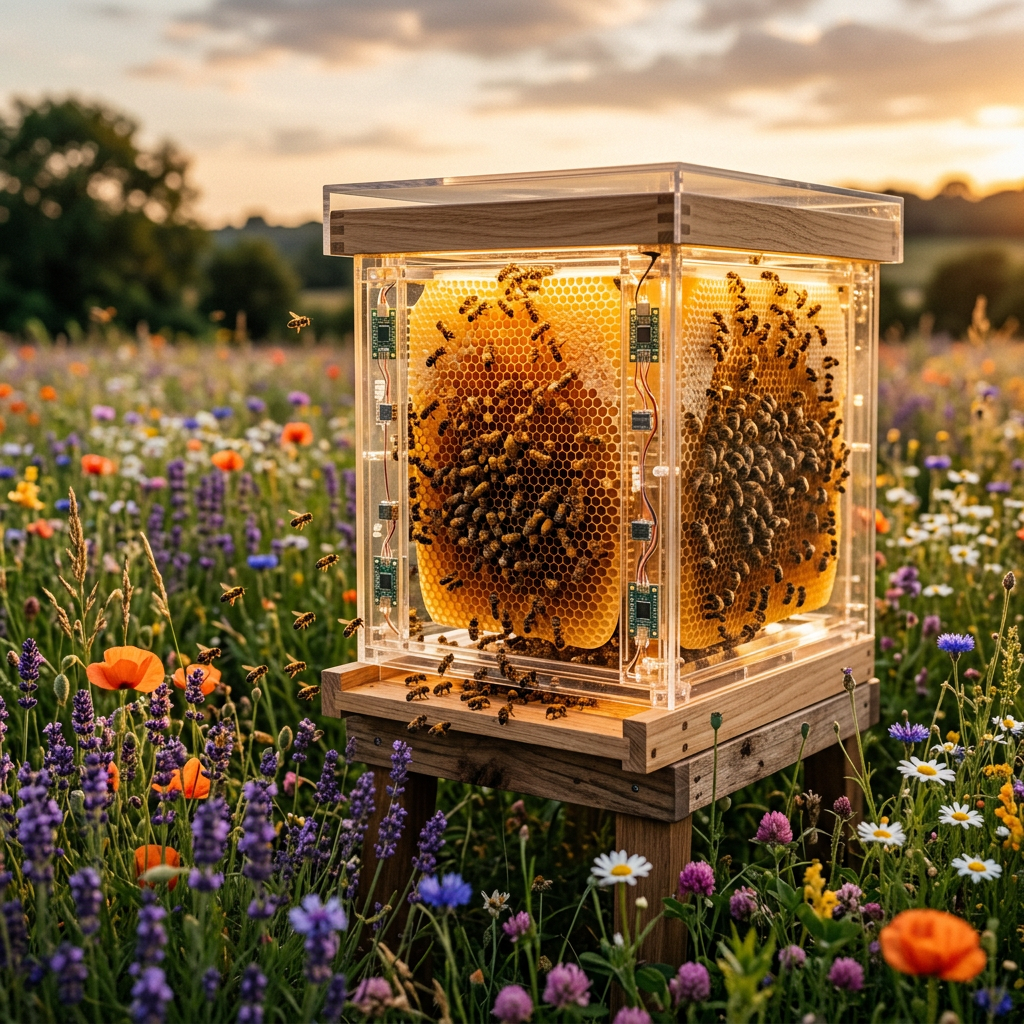
Inside the Hive: Advanced Honeybee Biology and Management | Honeybee management
Discover the latest scientific breakthroughs and high-tech management strategies saving honeybees from record-breaking colony losses in 2025.

Discover the latest scientific breakthroughs and high-tech management strategies saving honeybees from record-breaking colony losses in 2025.
Trending Now
📌 Key Takeaways
- U.S. beekeepers lost 55.6% of colonies in 2024–2025 — the highest annual loss rate since monitoring began in 2011.
- Apis mellifera is not just a honey producer; it is the economic backbone of $325.8 million in California almond pollination alone.
- Varroa destructor remains the single greatest biological threat to managed honeybee colonies worldwide.
- Emerging technologies — from smart hive sensors to RNA interference (RNAi) — are reshaping modern honeybee management.
- Climate change, pesticide exposure, and monoculture farming compound colony stress in ways science is only beginning to untangle.
Inside the Hive: Advanced Honeybee Biology and Management
The Superorganism: An Introduction to Apis mellifera and Honeybee Management
Picture this: a single wooden box sitting in the corner of an almond orchard in California's Central Valley. From the outside, it is unremarkable — weather-worn, painted white, humming faintly on a warm February morning. But step closer, and you begin to sense something extraordinary. The air vibrates. Thousands of golden bodies spiral upward in tight, purposeful arcs. Scouts return trailing pollen, guards hover at the entrance like bouncers at a velvet rope, and somewhere deep inside, a single queen is doing what she has done every day for the past three years — laying up to 2,000 eggs in a 24-hour period.
This is Apis mellifera, the Western honeybee — and it is far more than an insect. It is a superorganism, a colony so tightly integrated that scientists often treat the hive itself, not the individual bee, as the true biological unit. Understanding this creature — its biology, its social architecture, its vulnerabilities, and its extraordinary economic value — is not merely a scientific exercise. It is, increasingly, a matter of global food security.
Honeybee management sits at the intersection of ancient tradition and cutting-edge science. From Roman apiaries to AI-powered hive monitors, humanity's relationship with Apis mellifera has always been one of careful partnership. But that partnership is under unprecedented strain. And the stakes have never been higher.
The Three Castes: Queen, Drone, and Worker Social Structure
Every colony is a masterclass in biological efficiency, built around three distinct castes — each with a role so specialized it borders on the miraculous.
The queen is the colony's reproductive engine. Fertilized by up to 15 drones during her single nuptial flight, she stores millions of sperm in her spermatheca, drawing on them for years. Her pheromone cocktail — scientists call it queen substance — suppresses the reproductive capacity of every worker in the hive and signals colony health to the entire population. When her pheromone output wanes with age, the colony responds with ruthless efficiency: they raise a replacement, and the old queen is deposed.
Drones — the male bees — exist for one purpose alone: mating. They produce no wax, collect no pollen, and cannot sting. During late summer, as resources thin, workers unceremoniously evict them from the hive, leaving them to die in the cold. It is brutal, but biologically sound.
The real story, though, belongs to the worker bees — infertile females who perform every other function the colony requires. Their lives unfold in stages. As nurse bees, they feed larvae royal jelly and bee bread. As house bees, they build comb, regulate temperature, and process nectar. Finally, in their last two weeks of life, they become foragers — flying up to 5 miles in search of nectar, pollen, water, and propolis, navigating via a sophisticated sun compass and communicating precise floral coordinates through the iconic waggle dance.
This caste system, refined over 35 million years of evolution, is both the colony's greatest strength and, as we will see, one of its most profound vulnerabilities.
Economic Powerhouse: The Shift from Honey to Pollination Services
Ask most people what honeybees produce, and they will say honey. Ask an agricultural economist, and they will tell a different story.
📊 "One-third of the global human diet depends on insect pollination, primarily performed by managed and wild bee species." — United Nations Food and Agriculture Organization (FAO)
The commercial value of pollination services has quietly eclipsed that of honey in the modern agricultural economy. Nowhere is this more visible than in California's almond industry, where hundreds of thousands of acres bloom simultaneously in February — a floral window so brief and so critical that it has spawned an entire migratory economy.
📊 Pollination services for California almonds alone generated $325.8 million in 2024, accounting for 81% of total U.S. pollination receipts. — USDA Economic Research Service
The numbers are staggering. In 2024, the average rental price for a single honeybee colony for almond pollination reached $181 — nearly triple the average for any other crop, according to the USDA National Agricultural Statistics Service. Beekeepers from 49 states truck their hives to the Central Valley each winter, transforming Interstate 5 into a slow-moving river of white boxes.
Comparison Table: Pollination Rental Rates by Crop (2024)
| Crop | Avg. Colony Rental Rate | Pollination Value (Est.) |
|---|---|---|
| Almonds (CA) | $181 | $325.8 million |
| Apples | ~$65 | ~$18 million |
| Blueberries | ~$85 | ~$12 million |
| Cherries | ~$70 | ~$9 million |
| Cucumbers | ~$45 | ~$6 million |
This economic dependence transforms honeybee management from a hobbyist pursuit into a high-stakes industrial operation — and it raises a deeply uncomfortable question: what happens when the bees begin to disappear?
The Invisible Enemy: Understanding the Varroa destructor Crisis
Her name is Varroa destructor, and she is, without qualification, the most destructive parasite in the history of managed beekeeping.
This pinhead-sized mite — reddish-brown, flat, and armored — was originally a parasite of the Asian honeybee, Apis cerana. When it jumped to Apis mellifera in the mid-20th century, the consequences were catastrophic. Unlike its original host, the Western honeybee has no evolved behavioral defense against it.
Varroa reproduces inside sealed brood cells, feeding on bee fat bodies (not blood, as was once believed — a distinction that matters deeply for treatment research). Adult mites hitchhike on adult bees, suppressing immune function, transmitting Deformed Wing Virus (DWV), and shortening bee lifespans by weeks. A colony with a mite load exceeding 2–3% of the adult bee population is in crisis. Untreated, it will collapse within months.
The resulting syndrome — Colony Collapse Disorder (CCD) — has become the defining crisis of modern apiculture. While CCD technically describes a specific pattern of colony loss (bees abandoning the hive without bodies), the broader phenomenon of catastrophic colony decline has accelerated alarmingly.
📊 U.S. beekeepers reported a 55.6% annual colony loss rate for 2024–2025 — the highest since monitoring began in 2011. — Auburn University Bee Center / Apiary Inspectors of America
📊 Commercial beekeepers with over 500 colonies experienced a 62% average colony loss between June 2024 and March 2025. — Project Apis m.
These are not abstract statistics. Behind each percentage point are thousands of hives, millions of bees, and beekeepers who watched their livelihoods dissolve over a single winter.
Modern Management: Precision Apiculture and Smart Hive Technology
The response to this crisis has been, in part, technological. A new field — precision apiculture — is emerging at the crossroads of beekeeping, data science, and engineering.
Smart hives are now equipped with arrays of sensors measuring temperature, humidity, acoustic signatures, and weight in real time. When a colony is healthy, the hive hums at a characteristic frequency. When a queen is lost, the acoustic profile shifts measurably within hours — long before a beekeeper's next inspection. When a swarm is imminent, weight sensors detect the population surge days in advance.
Companies like BeeHero, Arnia, and HiveTech have deployed sensor networks across commercial apiaries, feeding data to cloud platforms that generate actionable alerts. A beekeeper managing 5,000 colonies across three states can now receive a smartphone notification the moment a hive crosses a critical mite threshold — without setting foot in the apiary.
Comparison Table: Traditional vs. Precision Apiculture Management
| Feature | Traditional Beekeeping | Precision Apiculture |
|---|---|---|
| Mite monitoring | Manual alcohol wash (monthly) | Continuous sensor + AI estimate |
| Queen status detection | Visual inspection | Acoustic AI analysis |
| Swarm prediction | Experience/observation | Weight + acoustic data alerts |
| Feeding management | Seasonal schedule | Real-time colony weight response |
| Record keeping | Paper logs | Cloud-synced digital dashboards |
| Labor requirement | High | Significantly reduced |
This is not science fiction. It is operational reality in forward-thinking apiaries today — and it is fundamentally reshaping what honeybee management looks like at scale.
Scientific Frontiers: RNAi and Genetic Breeding for Resistance
If precision apiculture represents the management revolution, then RNA interference (RNAi) represents the biological one.
RNAi is a naturally occurring cellular mechanism that silences specific genes. Scientists have discovered that when bees consume double-stranded RNA molecules designed to match Varroa genes, the mites absorb these molecules through feeding, triggering gene silencing that disrupts their reproduction or survival. In 2023, the U.S. Environmental Protection Agency approved the first-ever RNAi-based biopesticide for honeybee use — a landmark moment in the history of apiculture.
Parallel to this, selective breeding programs are producing strains of Apis mellifera with measurable resistance to Varroa. The most promising traits include:
- Hygienic behavior — workers that detect and remove mite-infested brood before mites can reproduce
- Mite-biting behavior — workers that physically attack and disable mites
- Brood interruption tolerance — colonies that naturally suppress brood cycles, denying mites their reproductive window
These are not new concepts, but modern genomic tools are accelerating the breeding process dramatically. Where traditional selection once took generations, CRISPR-adjacent techniques can now identify resistance-linked gene markers in weeks.
Nutritional Stress and the Impact of Monoculture Farming
A bee evolved to forage across a diverse floral landscape faces a particular kind of cruelty in the modern agricultural world: miles of a single crop in bloom, then nothing.
Monoculture farming — the industrial-scale cultivation of a single crop variety — has simplified the American agricultural landscape in ways that are deeply hostile to bee health. When almond orchards finish blooming in March, the floral resources vanish almost overnight. Bees fed on a single pollen source suffer measurable immune suppression, reduced fat body development, and shortened lifespans.
Researchers at UC Davis have documented that colonies with access to polyfloral pollen sources show significantly better overwintering success, lower Varroa reproduction rates, and greater resistance to viral pathogens. The mechanism is immunological: diverse pollen provides a broader array of proteins and phytochemicals that prime bee immune pathways.
Progressive beekeepers and forward-thinking farmers are responding by planting pollinator habitat — strips of wildflowers, cover crops, and hedgerows — along orchard margins. Programs like Bee Better Certification and Project Apis m.'s Seeds for Bees initiative are scaling this approach nationally.
The Pesticide Puzzle: Chemical Exposure and Colony Health
No chapter in the story of Colony Collapse Disorder is more contested or more consequential than the role of pesticides.
Neonicotinoids — a class of systemic insecticides that permeate every tissue of treated plants, including pollen and nectar — have been at the center of this debate for over a decade. Laboratory studies consistently demonstrate that sublethal neonicotinoid exposure impairs bee navigation, memory consolidation, immune function, and queen reproductive success. Field studies present a more complicated picture, with effects varying by dose, season, and colony health status.
What is clear is that bees in agricultural landscapes face pesticide cocktails, not single exposures. A 2017 study published in Science found an average of 17 different pesticide residues in pollen samples collected from hives in agricultural areas. Synergistic interactions between fungicides, herbicides, and insecticides are poorly understood and largely unregulated.
The European Union has imposed near-total bans on outdoor neonicotinoid use. The United States has pursued a more cautious, product-by-product regulatory approach — a divergence that reflects both different risk tolerances and the enormous economic power of agricultural chemical interests.
Climate Change and the Challenge of Overwintering Hives
The seasons no longer behave the way they once did — and neither do the bees.
Warmer autumns encourage queens to extend their laying season, producing late-season brood that consumes winter stores without contributing meaningfully to spring buildup. Erratic spring weather — a warm week followed by a hard freeze — can trigger early foraging flights that strand bees in lethal cold. Drought conditions reduce floral resource availability and concentrate pesticides in remaining water sources.
Perhaps most perniciously, warming winters disrupt the cluster behavior that allows temperate-adapted honeybee colonies to survive cold months. Colonies that never fully form a winter cluster burn through stores at summer rates, starving before the first spring bloom.
Beekeepers in the Upper Midwest and Canada report that overwintering management — once a relatively predictable practice of wrapping hives and ensuring adequate honey stores — has become an exercise in improvisation, requiring interventions that would have been unnecessary a generation ago.
Case Study: Successful Mite Suppression in California Hybrid Colonies
In 2022, a mid-scale California commercial operation managing 1,200 colonies implemented an integrated mite management program combining genetic selection, precision monitoring, and organic acid treatments. The results offer a rare cause for optimism.
By sourcing locally raised queens from a breeder selecting for hygienic behavior index scores above 90%, the operation reduced average mite loads by 38% within two breeding cycles. Smart hive sensors allowed real-time mite population tracking, enabling targeted oxalic acid vapor treatments during broodless periods — the most effective application window. Feed supplementation with diverse pollen patties during monoculture pollination contracts buffered nutritional stress.
The outcome: winter colony loss of 14% — dramatically below the national average of 55.6%. The operation's pollination contract retention improved, and for the first time in five years, the beekeeper reported positive year-end margins without colony replacement costs eroding profitability.
This case study is not a silver bullet. It required significant upfront investment in queen genetics, sensor technology, and beekeeper training. But it demonstrates that the crisis of colony loss is not inevitable — it is manageable, with the right science and the right tools.
The Future of Sustainable Honeybee Management: AI and Global Action
The future of honeybee management is being written in algorithms, gene sequences, and international policy frameworks simultaneously.
Artificial intelligence is moving beyond hive monitoring into predictive colony health modeling. Machine learning systems trained on acoustic, weight, and environmental data can now predict colony collapse events up to three weeks in advance with accuracy that exceeds experienced beekeeper estimates. Integration with satellite crop mapping allows these systems to optimize pollination deployment at regional scales — matching colony placement to bloom timing and resource density with mathematical precision.
At the policy level, the American Beekeeping Federation and international coalitions are pushing for harmonized pesticide registration standards, pollinator-friendly agricultural subsidies, and research funding commensurate with the economic stakes. The EU's Pollinator Initiative and the UN's Intergovernmental Science-Policy Platform on Biodiversity (IPBES) have elevated bee health to global environmental priority status.
Comparison Table: Colony Loss Rates by Management System (2023–2025)
| Management Approach | Avg. Annual Colony Loss |
|---|---|
| Unmanaged / Minimal care | 65–80% |
| Conventional commercial | 55–62% |
| Integrated Pest Management (IPM) | 25–35% |
| IPM + Hygienic queen genetics | 12–18% |
| IPM + Smart hive + Genetic selection | 8–14% |
Source estimates based on Project Apis m. data and published research
The gap between the worst and best outcomes is not luck. It is science, investment, and intention.
Conclusion: Why the Science of Bees Matters to Food Security
We began with a single hive in a California orchard. We end somewhere much larger.
The science of Apis mellifera — its biology, its social architecture, its vulnerabilities, its remarkable adaptability — is not a niche subject for hobbyists and academics. It is a lens through which we can see the entire architecture of modern food production: its extraordinary productivity, its hidden fragilities, and the narrow margins on which it operates.
Effective honeybee management is not merely about keeping bees alive. It is about maintaining the biological infrastructure that sustains one-third of everything humanity eats. When U.S. beekeepers lose more than half their colonies in a single year, we are not watching a beekeeping problem. We are watching a food system problem — one that demands the full attention of science, industry, and policy simultaneously.
The tools exist. The knowledge is advancing rapidly. What is required now is the collective will to deploy them — before the hum fades from too many orchards to count.
Sources
- Apiary Inspectors of America – U.S. Beekeeping Survey
- Auburn University Bee Center
- Project Apis m.
- USDA Economic Research Service – Specialty Crops / Honey
- USDA National Agricultural Statistics Service
- United Nations Food and Agriculture Organization (FAO)
- American Beekeeping Federation – Pollination Facts
Published on Voxora — Premium content for curious minds worldwide.
Advertisement
Frequently Asked Questions
What is the scientific classification and lifespan of the western honeybee?
The western honeybee is scientifically known as Apis mellifera. In a managed colony, a queen can live for 2 to 5 years, while worker bees typically live for about 6 weeks during the active forage season and up to 6 months during the winter.
How many bees are typically found in a managed honeybee colony?
A healthy, managed honeybee hive usually contains between 20,000 and 60,000 bees, consisting of one queen, a few hundred male drones, and tens of thousands of female worker bees.
What are the primary management tasks required for beekeeping?
Management includes regular hive inspections to monitor for the Varroa destructor mite, ensuring the colony has a productive queen, and providing adequate space to prevent swarming. Beekeepers also manage nutrition by providing sugar syrup if natural nectar sources are low.
How much honey can a single managed hive produce annually?
On average, a well-managed hive can produce a surplus of 30 to 100 pounds of honey per year. This varies based on local flora and climate; scientific studies show a single worker bee produces only about 1/12th of a teaspoon of honey in her lifetime.
What is the scientific process of turning nectar into honey?
Bees collect nectar with approximately 80% water content. They add the enzyme invertase to break down complex sugars and use their wings to fan the hive, evaporating moisture until the water content reaches a stable 17-18%, at which point they seal the cell with wax.
Sponsored
You Might Also Like


Advertisement
Comments (0)
Sign in to join the conversation
No comments yet. Be the first to share your thoughts!