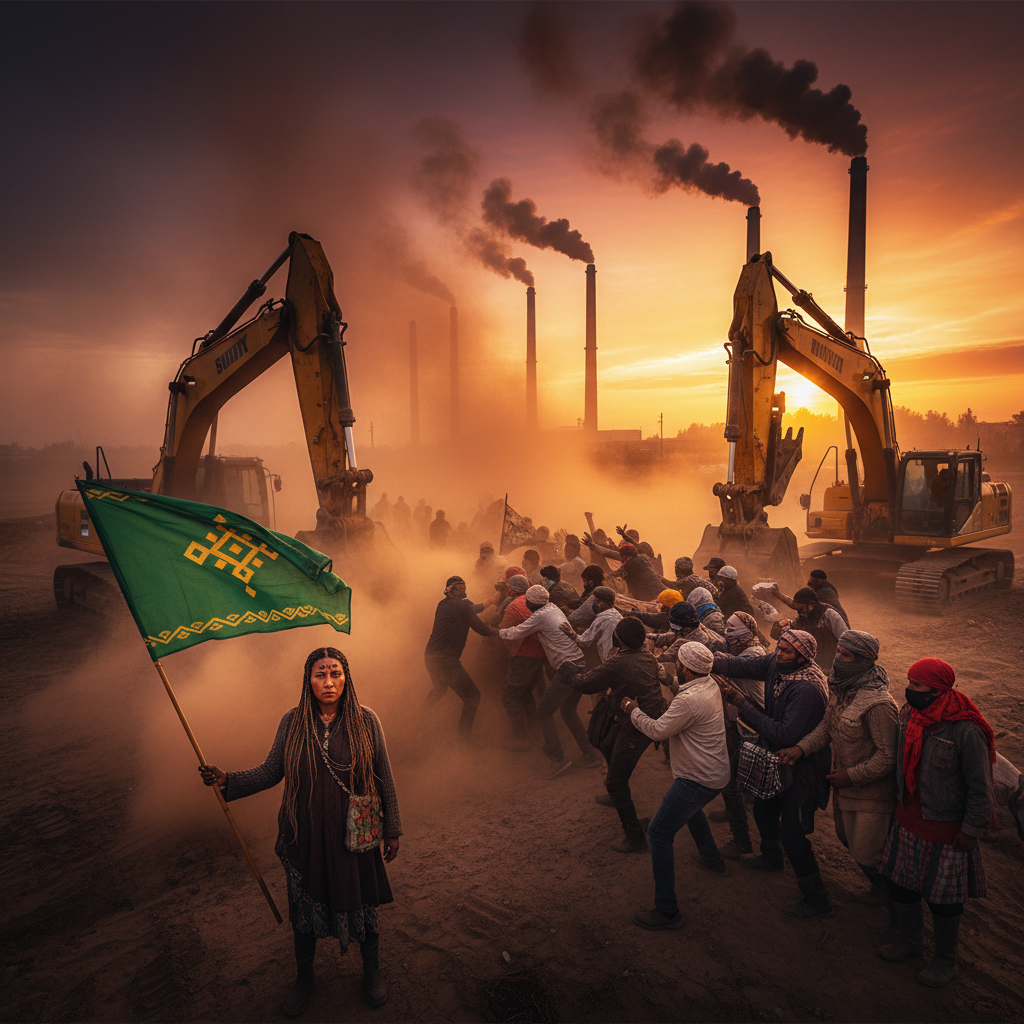
Developmental Crisis: Why Growth Sparks Protest Politics in India
India's push for rapid growth has sparked a 'developmental crisis,' where displacement and neoliberal dispossession fuel a new era of protest politics.

India's push for rapid growth has sparked a 'developmental crisis,' where displacement and neoliberal dispossession fuel a new era of protest politics.
Trending Now
Key Takeaways
- India's developmental crisis is not a failure of growth, but a consequence of how that growth is structured — privileging capital accumulation over human welfare.
- Scheduled Tribes constitute 40% of the 60–65 million people displaced by development projects since independence, revealing a systematic pattern of marginalization.
- India recorded 5.4 million displacements in 2024 alone — the highest figure in 12 years — underscoring the accelerating human cost of development.
- Protest politics in India is not spontaneous disorder; it is a dialectical response to structural dispossession, legal exclusion, and state coercion.
- The intersection of land rights, environmental justice, and indigenous resistance defines the most consequential social movements of the contemporary era.
Developmental Crisis: Why Growth Sparks Protest Politics in India
1. Introduction: The Paradox of Indian Development and the Developmental Crisis
India's economic trajectory over the past three decades presents one of the most compelling — and contradictory — narratives in modern development studies. The country has emerged as one of the fastest-growing major economies globally, consistently posting GDP growth rates that attract international investment and diplomatic admiration. Yet beneath this macroeconomic optimism lies a deepening developmental crisis — a structural chasm between the metrics of aggregate growth and the lived experience of millions of citizens who find themselves displaced, dispossessed, and criminalized for resisting the very projects that fuel this growth.
This paradox is not incidental. It is systemic. Scholars writing in the Economic and Political Weekly (EPW) have long argued that India's protest politics must be understood not as episodic outbursts of discontent, but as dialectical responses to a particular model of capital-led development — one that systematically externalizes its costs onto the most marginalized populations while internalizing profits for a narrower elite. This article examines the structural foundations of that developmental crisis, the communities it most acutely affects, and the forms of resistance it inevitably generates.
2. Defining the Developmental Crisis: Beyond GDP Numbers
The concept of a developmental crisis resists reduction to purely economic indicators. While mainstream discourse measures development through GDP growth, foreign direct investment inflows, and infrastructure indices, a more rigorous analytical framework must account for distributional outcomes, ecological sustainability, and the preservation of constitutional rights.
In the Indian context, the developmental crisis emerges from a fundamental tension between two incompatible imperatives: the drive for rapid capital accumulation through resource extraction and industrial expansion, and the constitutional obligations of the state toward social equity, environmental protection, and the rights of tribal and forest-dwelling communities.
"Development-induced displacement in India is not a side effect of progress — it is a structural feature of a growth model that treats land as a commodity and communities as obstacles." — EPW Commentary, 2012
This crisis manifests across multiple dimensions: land dispossession, forced displacement, ecological degradation, cultural erasure, and the juridical suppression of dissent. Each of these dimensions intersects with the others, creating a compounding effect that renders protest politics not merely understandable but, in analytical terms, inevitable.
3. The Neoliberal Shift: From Welfare to Accumulation
The liberalization reforms of 1991 marked a decisive reorientation of India's developmental paradigm. The post-Nehruvian model, however imperfect in its execution, nominally positioned the state as a redistributive actor committed to social welfare, agrarian reform, and public sector-led growth. The neoliberal turn fundamentally altered this compact, repositioning the state as a facilitator of private capital accumulation rather than a guarantor of social rights.
Special Economic Zones (SEZs), Public-Private Partnerships (PPPs), and fast-tracked environmental clearances became the operative mechanisms of this new paradigm. Land, previously understood through the lens of livelihoods and community identity, was reconstituted as a fungible input in the production of industrial and infrastructural value.
| Policy Instrument | Pre-1991 Framework | Post-1991 Framework |
|---|---|---|
| Land Acquisition | State-led for public purpose | Market-driven; includes private benefit |
| Environmental Clearance | Sequential; community consultation required | Fast-tracked; diluted public hearings |
| Tribal Rights | Fifth/Sixth Schedule protections emphasized | Frequently overridden by project imperatives |
| Compensation Model | Market value (historically inadequate) | Nominally improved under LARR 2013, often circumvented |
| Dissent Mechanism | Limited but legally recognized | Increasingly criminalized under sedition, UAPA provisions |
This structural shift corresponds precisely with the intensification of protest politics across India's resource-rich but economically marginalized regions — Jharkhand, Odisha, Chhattisgarh, and the Aravalli belt — where communities have mounted sustained resistance to mining, dam construction, and industrial projects.
4. Dialectics of Protest: Why Resistance to the Developmental Crisis is Inevitable
The philosophical framework of dialectics, as applied to social movements, posits that structural contradictions within a given order necessarily generate their own opposition. Applied to India's developmental crisis, this means that the conditions produced by dispossessive growth — landlessness, ecological destruction, cultural marginalization — are not merely provocations to protest; they are its generative conditions.
The EPW Commentary (2012) articulates this relationship with analytical precision, arguing that protest politics in India functions as a dialectical mirror of the developmental contradictions embedded within the state's own growth model. Resistance is not irrational or anti-developmental; it is a rational, often legally grounded assertion of rights that the state simultaneously recognizes in law and violates in practice.
This dialectical quality explains why protest movements in India repeatedly take on a legalistic character — invoking the Forest Rights Act, the Panchayats (Extension to Scheduled Areas) Act (PESA), and constitutional provisions related to tribal autonomy — while simultaneously confronting state apparatus that deploys legal instruments to suppress them.
5. Accumulation by Dispossession: The Land Acquisition Struggle
The Marxist geographer David Harvey's concept of accumulation by dispossession provides perhaps the most analytically precise framework for understanding India's land acquisition politics. Harvey describes a process whereby pre-existing rights and entitlements — to land, water, forests, and other commons — are forcibly removed and commodified, generating primitive accumulation for capital while producing dispossession for communities.
In India, this process is visible across the entire geographic arc of the "development corridor" — from the mining belts of Jharkhand to the coastal industrial zones of Andhra Pradesh. The Land Acquisition, Rehabilitation and Resettlement Act (LARR) of 2013 represented a legislative attempt to moderate this process, introducing requirements for social impact assessments, multi-crop land protections, and enhanced compensation ratios.
However, subsequent amendments at the state level — and the central government's 2015 ordinance attempt, which was eventually withdrawn after sustained parliamentary and civil society opposition — illustrated the persistent political will to subordinate community rights to capital imperatives. The land acquisition struggle, therefore, is not a localized grievance; it is the terrain upon which India's broader developmental crisis is most viscerally contested.
6. The Displacement Crisis: Statistics and Human Cost
The quantitative dimensions of India's displacement crisis illuminate the scale of what structural dispossession means in human terms.
India recorded 5.4 million displacements associated with disasters in 2024 — the highest figure in 12 years. (Internal Displacement Monitoring Centre, reported by The Hindu)
While this figure includes climate-related and disaster-induced displacement, it cannot be analytically separated from development-driven vulnerability, as infrastructure projects frequently destroy natural flood buffers, deforest watersheds, and settle communities in ecologically precarious zones.
The longer historical arc is equally stark:
Scheduled Tribes account for 40% of the 60–65 million people displaced by development projects in India since independence — despite constituting approximately 8.6% of the national population. (ARF India / UN Working Group on Human Rights)
| Population Group | % of India's Population | % of Development-Displaced Persons |
|---|---|---|
| Scheduled Tribes (Adivasis) | ~8.6% | ~40% |
| Scheduled Castes (Dalits) | ~16.6% | ~20–25% (estimated) |
| Other Marginalized Groups | ~15–20% | ~15–20% (estimated) |
| Non-marginalized Communities | ~55–60% | ~15–25% |
This disparity constitutes what scholars in the field of environmental justice term a "sacrifice zone" dynamic — wherein the burdens of development are systematically concentrated upon communities least equipped, institutionally and economically, to absorb or resist them.
7. Adivasi Resistance: The Frontlines of Indigenous Rights and the Developmental Crisis
No analysis of India's protest politics is complete without sustained attention to Adivasi (tribal/indigenous) resistance movements, which represent the most structurally coherent and historically deep-rooted challenge to the developmental crisis.
Adivasi communities possess a distinctive relationship to land — one grounded not in individual property ownership but in collective custodianship, spiritual connection, and subsistence ecology. This relationship is formally recognized in India's constitutional framework through the Fifth and Sixth Schedules, PESA (1996), and the Forest Rights Act (2006). Yet these legal protections have been systematically undermined by administrative non-compliance, inadequate implementation, and judicial interpretations that privilege project timelines over community consent.
Tribal rights in India have thus become both a legal battleground and a site of physical confrontation, with Adivasi communities mobilizing through gram sabhas (village assemblies), legal petitions, road blockades, and, in some instances, armed resistance within the broader Maoist-affected regions. The Human Rights Watch World Report 2024 documents persistent concerns about the criminalization of tribal protest and the use of security legislation against community leaders and human rights defenders in these regions.
8. The 'Security State': Legal Crackdowns on Modern Dissent
One of the most consequential features of contemporary India's response to protest politics is the deployment of an expanding legal arsenal to suppress dissent. The Unlawful Activities (Prevention) Act (UAPA), the National Security Act (NSA), sedition provisions of the Indian Penal Code, and — until its recent partial dilution — the Information Technology Act have all been instrumentalized against activists, journalists, lawyers, and community organizers engaged in developmentally motivated resistance.
Communal riots in India saw an 84% increase in 2024, with 59 reported incidents compared to 32 in 2023. (Centre for Study of Society and Secularism, reported by The Wire)
While communal violence and state coercion of dissent operate through different mechanisms, they share a common function within the political economy of developmental crisis: the fragmentation of solidarities that might otherwise coalesce into sustained, cross-community resistance movements. When marginalized communities are divided along religious lines, the structural critique of dispossessive development loses political coherence and electoral salience.
State coercion of dissent thus functions not only as direct repression but as a mechanism of political fragmentation — ensuring that the social movements challenging developmental injustice remain atomized, legally besieged, and unable to translate local grievances into national policy demands.
9. Case Studies: Niyamgiri to the Aravallis Controversy
Two case studies illustrate the range and persistence of resistance movements within India's developmental crisis landscape.
The Niyamgiri Movement (Odisha): The Dongria Kondh tribe's sustained resistance to Vedanta Resources' bauxite mining proposal on the Niyamgiri Hills stands as one of India's most celebrated instances of community-led environmental justice. Through a landmark Supreme Court ruling in 2013, gram sabhas were empowered to determine the fate of the project. Unanimously, they voted against it — asserting the sacred and ecological dimensions of their relationship to the hills. The Niyamgiri case demonstrated that constitutional mechanisms, when genuinely activated, could function as effective counterweights to extractive capital.
The Aravalli Crisis (Haryana/Rajasthan): The Aravalli hill range — one of the world's oldest mountain systems and a critical ecological buffer for the Delhi-NCR region — has faced sustained pressure from mining interests, illegal construction, and regulatory ambiguity. Environmental activists and affected communities have mounted legal challenges, with the Supreme Court periodically intervening to impose restrictions on mining activities. This case illustrates how environmental justice movements increasingly operate through judicial rather than purely political channels in contemporary India.
| Case Study | Community | Mechanism of Resistance | Outcome (as of 2024) |
|---|---|---|---|
| Niyamgiri, Odisha | Dongria Kondh (Adivasi) | Gram Sabha votes, Supreme Court litigation | Mining proposal rejected; ongoing surveillance concerns |
| Narmada Bachao Andolan | Displaced farming/tribal communities | Mass protests, hunger strikes, legal petitions | Partial: some R&R improvements; dam height raised despite opposition |
| Aravallis Controversy | Mixed communities, environmental activists | PIL litigation, media advocacy | Partial mining restrictions; enforcement remains contested |
| Pathalgadi Movement, Jharkhand | Munda tribal communities | PESA-based proclamations, autonomy assertion | Heavy police response; several leaders arrested |
10. Environmentalism as Resistance: A New Wave of Protest Politics
The convergence of environmental justice and social movement politics represents one of the most significant developments in India's protest landscape over the past decade. What was once characterized as "environmentalism" — the preserve of urban NGOs and wildlife conservationists — has increasingly been reclaimed as a framework for asserting the rights of forest-dwelling and pastoral communities against extractive industries.
This reconstituted environmentalism is distinguished by its insistence on procedural justice (the right to participate in decisions affecting one's community), distributive justice (fair allocation of both development benefits and environmental burdens), and recognition justice (acknowledgment of indigenous epistemologies and relationships to nature). These demands are simultaneously ecological and political — which explains why the state increasingly treats environmental activism as a security concern rather than a legitimate expression of civil society.
Social movements in 2024 reflect this evolution. Climate litigation has expanded; youth-led environmental groups have emerged in urban centers; and the interface between climate vulnerability and development-induced displacement has become a central concern for scholars, activists, and, increasingly, international human rights bodies.
11. The Future of Protest Politics in a Digital Democracy
The digitization of public discourse has introduced new dimensions to India's protest politics that existing analytical frameworks must grapple with. Social media platforms have enabled the rapid dissemination of information about displacement incidents, police violence against protesters, and environmental violations — creating a form of real-time accountability that was structurally impossible in earlier decades.
However, digital democracy is a double-edged instrument. The same platforms that enable solidarity and information-sharing are subject to internet shutdowns (India leads the world in the frequency of such shutdowns), algorithmic suppression, and state surveillance. The passage of legislation governing digital infrastructure has raised substantial concerns among civil liberties organizations about the potential use of data collection for monitoring activist communities.
Furthermore, the fragmentation of attention that characterizes social media ecology works against the sustained, long-term organizing that effective social movements require. Viral moments of solidarity can mask the absence of durable institutional infrastructure for advocacy. The challenge for indigenous resistance and land rights movements in the digital era is to leverage the visibility afforded by digital platforms without allowing that visibility to substitute for organizational depth.
12. Conclusion: Toward an Inclusive and Humane Growth Model Beyond the Developmental Crisis
The developmental crisis at the heart of India's growth story is not an anomaly to be corrected at the margins of policy. It is a structural feature of a development paradigm that has prioritized capital accumulation over constitutional rights, aggregate metrics over distributional equity, and project timelines over community consent. Protest politics in India — from the Niyamgiri hills to the Aravalli plains, from Adivasi gram sabhas to urban climate litigation — is the dialectical expression of this structural contradiction.
Understanding the developmental crisis requires moving beyond the comfortable binary of "growth versus environment" or "development versus rights." The most rigorous scholarship, including the foundational analysis published in the Economic and Political Weekly, insists that genuine development — sustainable, equitable, and constitutionally grounded — cannot proceed by externalizing its costs onto those least able to bear them.
The data is unambiguous: 5.4 million people displaced in a single year, 40% of all development-displaced persons drawn from 8.6% of the population, an 84% rise in communal violence that fractures the solidarities necessary for collective resistance. These numbers do not describe the price of progress. They describe the political economy of a crisis — and the inevitability of the protests that crisis will continue to generate.
Any credible pathway toward an inclusive and humane growth model must begin with three non-negotiable commitments: genuine prior informed consent for communities affected by development projects; enforceable environmental justice standards that prevent the concentration of ecological burdens on marginalized populations; and the decriminalization of dissent, restoring the constitutional right to protest as a cornerstone of democratic governance. Without these commitments, the dialectics of protest politics will continue to deepen — and the developmental crisis will remain India's most consequential unresolved contradiction.
Sources
- Economic and Political Weekly – "Developmental Crisis and the Dialectics of Protest Politics" (2012)
- The Hindu – "India Records 5.4 Million Displacements Due to Disasters in 2024, Highest in 12 Years" (IDMC Report)
- The Wire – "2024 Saw 84% Rise in Communal Riots; Religious Festivals Were Main Trigger" (CSSS Report)
- Human Rights Watch – World Report 2024: India
- ARF India / UN Working Group on Human Rights – Displacement Statistics
- Harvey, D. (2003). The New Imperialism. Oxford University Press. (Theoretical framework: Accumulation by Dispossession)
- Ministry of Tribal Affairs, Government of India – Fifth Schedule and PESA Implementation Reports
Advertisement
Frequently Asked Questions
What is the core issue of the developmental crisis in India according to the EPW journal?
The crisis is defined by a disconnect between high economic growth and the displacement of marginalized communities; estimates suggest that between 1947 and 2004, over 60 million people were displaced by development projects in India.
How do tribal populations figure into India's developmental displacement?
Although tribal groups constitute roughly 8.6 percent of India's population, they represent nearly 40 percent of all individuals displaced by industrial and infrastructure projects like dams and mines.
What role did the Special Economic Zones (SEZ) Act of 2005 play in protest politics?
The SEZ Act led to the approval of over 500 zones, sparking massive protests across states like West Bengal and Maharashtra because the policy allowed the state to acquire fertile farmland for private industrial use.
What was the historical impact of the 1894 Land Acquisition Act?
For over a century, the British-era 1894 Act allowed the state to seize land under the 'eminent domain' doctrine with minimal compensation, a practice that fueled decades of rural resistance and was finally replaced in 2013.
How did the 2013 Land Acquisition Act change the requirements for industrial projects?
Responding to dialectic protest movements, the 2013 Act mandates that at least 70 percent of landholders must consent for public-private projects and 80 percent for entirely private projects, while providing up to four times the market value in compensation.
Sponsored
You Might Also Like


Advertisement
Comments (0)
Sign in to join the conversation
No comments yet. Be the first to share your thoughts!