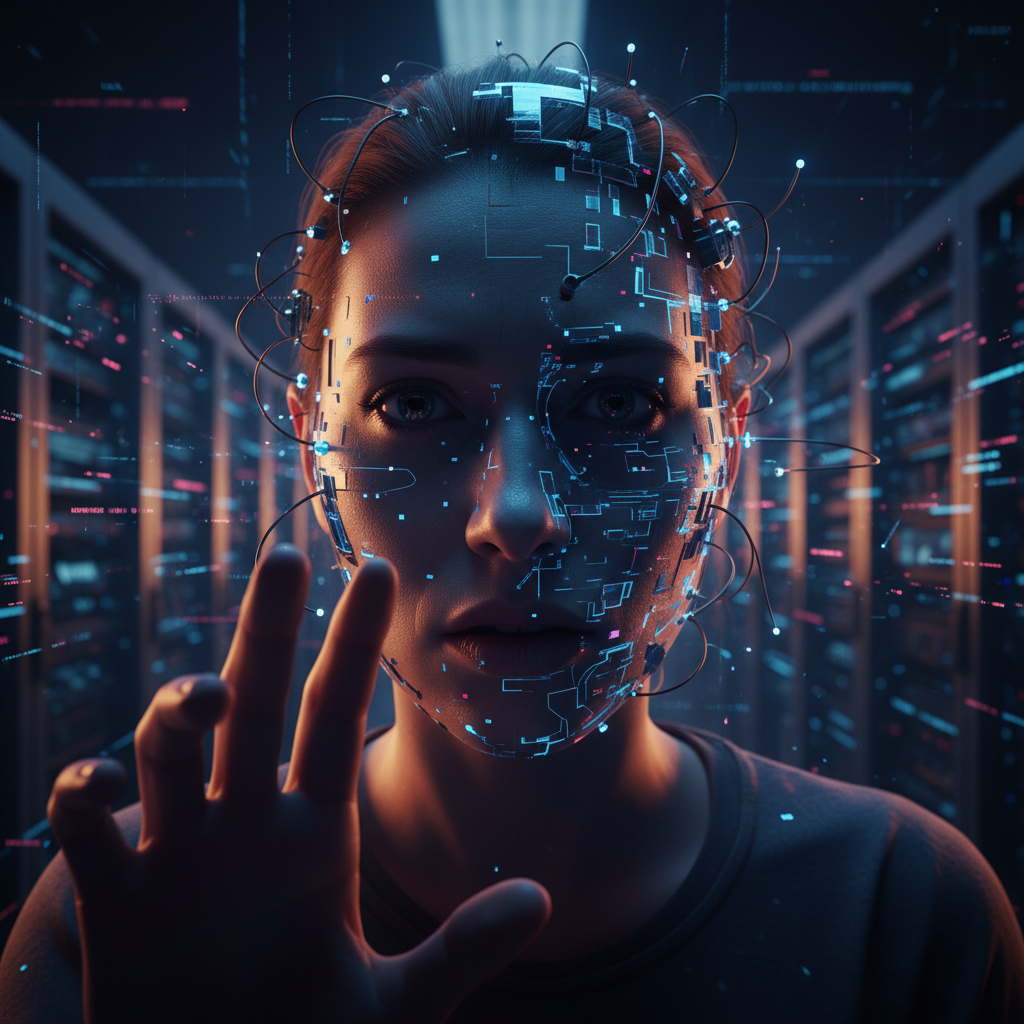
Deepfakes: How AI is Changing Politics, Crime, and Trust Forever | dee
Deepfakes are dismantling the 'seeing is believing' era, fueling $200M+ in fraud and disrupting global elections. Here is how AI is rewriting reality.

Deepfakes are dismantling the 'seeing is believing' era, fueling $200M+ in fraud and disrupting global elections. Here is how AI is rewriting reality.
Trending Now
Deepfakes: How AI Is Changing Politics, Crime, and Trust Forever
Key Takeaways
- Deepfake-related fraud attempts surged by 3,000% globally in 2023, signaling a new era of synthetic deception.
- A single deepfake video call cost one company $25 million — and this is no longer an isolated incident.
- Human ability to detect deepfakes hovers at just 57% accuracy — barely better than a coin flip.
- Deepfake technology is reshaping elections, financial crime, personal safety, and institutional trust simultaneously.
- Regulations are emerging, but technology is outpacing legislation at a dangerous speed.
- Education, digital literacy, and AI-powered detection tools are among the most powerful defenses available today.
The Death of "Seeing is Believing": Defining the Deepfake Era
There is a moment — and millions of people have experienced it — where you pause a video, lean closer to the screen, and think: Is that real?
It might be a world leader appearing to declare war. A CEO announcing a company's collapse. A neighbor's face in a video they never filmed. That creeping doubt, that micro-second of uncertainty, is not a glitch in your perception. It is a symptom of a much larger transformation quietly dismantling one of humanity's oldest certainties: that what we see with our own eyes is true.
Welcome to the deepfake era.
Deepfake technology — a portmanteau of "deep learning" and "fake" — uses artificial intelligence to superimpose, synthesize, or entirely generate realistic video, audio, and imagery of real people doing or saying things they never did or said. What began as a niche academic experiment in the mid-2010s has erupted into one of the most consequential technological forces of our time, touching politics, crime, gender, finance, and the very foundation of social trust.
This is not a story about technology. It is a story about what happens to society when the truth becomes negotiable.
The Technical Evolution: From Niche Experiments to Mainstream Threats
The first deepfakes were clumsy — blurred edges, unnatural blinking, lighting inconsistencies that made them relatively easy to spot for a trained eye. When researchers at academic institutions first demonstrated the capabilities of Generative Adversarial Networks (GANs) around 2017, the technology required significant computing power and expertise. It lived in research labs and dark corners of the internet.
That world no longer exists.
Today, generative AI tools can produce photorealistic video forgeries in minutes using nothing more than a consumer laptop and a handful of photographs. Platforms offering deepfake creation services have proliferated, some even marketed openly as "entertainment" or "content creation" tools. Voice cloning software can replicate a person's speech patterns, tone, and cadence from as little as three seconds of audio — and output unlimited dialogue in that stolen voice.
The barrier to entry has collapsed. The barrier to harm has never been lower.
| Year | Deepfake Capability | Required Expertise | Estimated Creation Time |
|---|---|---|---|
| 2017 | Basic face-swapping | High (research-level) | Hours to days |
| 2019 | Improved lip-sync and expression | Moderate | 1–3 hours |
| 2021 | Real-time video manipulation | Low-moderate | Minutes |
| 2023 | Full voice + video synthesis | Minimal | Seconds to minutes |
| 2025 | Multi-modal, near-undetectable fakes | Near-zero | Real-time |
The acceleration is not slowing down. It is compounding.
Deepfakes in the 2024 Global Elections: A New Frontier of Disinformation
2024 was not just a major election year for the United States. It was a global electoral supercycle — with more than 60 countries holding national votes representing over half of the world's population. And deepfake technology showed up to nearly every ballot box uninvited.
In January 2024, a robocall campaign targeting New Hampshire voters featured a voice-cloned version of President Joe Biden instructing Democrats not to vote in the primary. The audio was convincing enough to confuse thousands of recipients. In Slovakia, a fabricated audio recording appeared to capture a presidential candidate discussing how to rig the election — released just days before voters went to the polls, too close to the vote for effective fact-checking to reach the masses.
"Deepfake incidents in the US saw a 303% year-over-year increase during the 2024 election cycle." — Sumsub Identity Fraud Report
The implications are staggering. We are no longer talking about edited photographs or out-of-context quotes — the traditional tools of political smear campaigns. We are talking about synthetic media so convincing that voters, journalists, and even cybersecurity professionals struggle to distinguish it from reality.
What makes this especially dangerous is not just what people believe — it is what they stop believing. When fabricated political content becomes normalized, citizens begin doubting authentic footage too. A genuine recording of misconduct can be dismissed as "probably a deepfake." This phenomenon has a name, and it may be the most corrosive consequence of all.
The $25 Million Video Call: How Deepfakes Are Revolutionizing Cybercrime
In February 2024, a finance employee at a multinational firm in Hong Kong received an invitation to a video conference call with the company's CFO and several other senior executives. The call appeared completely routine. Faces were familiar. Voices matched. The discussion was professional.
At the end of the call, he had transferred $25 million to fraudulent accounts.
Every person on that call — except him — was a deepfake.
This landmark case, widely reported across global financial and security press, represents the new frontier of identity theft and corporate fraud. It was not a phishing email. There was no malware. The attack vector was human trust — surgically manipulated by AI.
"Financial losses from documented deepfake fraud exceeded $200 million in Q1 2025 alone." — World Economic Forum
And this is likely just the surface. KYC fraud — the manipulation of Know Your Customer verification systems used by banks and financial institutions — has exploded as a use case for synthetic media. Fraudsters generate AI-created identity documents and synthetic facial profiles to open bank accounts, secure loans, and launder money at scale.
"Deepfake-related fraud attempts surged by 3,000% globally in 2023." — Sumsub
Looking ahead, the numbers become almost surreal:
"Generative AI is projected to enable fraud losses reaching $40 billion in the United States by 2027." — Deloitte Center for Financial Services
This is not a future risk. The clock is already running.
The Psychological Toll: Understanding the "Liar's Dividend"
In 2018, legal scholars Bobby Chesney and Danielle Citron introduced a term that has since become essential vocabulary for understanding the deepfake era: the "liar's dividend."
The concept is both elegant and terrifying. It describes a world in which the very existence of deepfakes gives bad actors a powerful new shield: plausible deniability. Even when a recording is entirely authentic — a politician caught in a genuine moment of corruption, an executive making a discriminatory statement — they can simply claim it was fabricated. "That's a deepfake." Three words, and accountability evaporates.
The liar's dividend doesn't just protect liars. It exhausts truth. When every piece of evidence can be questioned, when every video is presumed guilty until proven innocent, the machinery of accountability — journalism, courts, public opinion — begins to seize up.
Human detection accuracy for deepfakes is estimated at only 57% — barely better than random chance. — Spiralytics
Imagine a trial where the key evidence is a surveillance video. Imagine a whistleblower whose only proof is a recorded confession. Imagine an election where the defining moment is footage of a candidate in crisis. Now imagine that any of these could be dismissed — by a lawyer, a politician, a conspiracy theorist — with three words and a skeptical shrug.
That is the psychological and institutional toll of living in the deepfake era.
The Gendered Violence of AI: Non-Consensual Sexual Imagery
No discussion of deepfake technology is complete — or honest — without confronting its most widespread, most intimate abuse.
The majority of deepfake content online is not political disinformation or corporate fraud. It is non-consensual intimate imagery (NCII) — fabricated sexual material created using the faces of real women without their knowledge or consent. Research has consistently found that over 90% of deepfake videos online are non-consensual pornography, and the targets are overwhelmingly women: celebrities, influencers, teachers, students, and ordinary people with no public profile whatsoever.
The harm is not abstract. Victims describe the experience as a form of sexual assault — a violation of their body and identity that they did not choose and cannot fully undo. The material spreads across platforms faster than it can be removed. Employers find it. Friends find it. It follows people for years.
In early 2024, explicit AI-generated images of Taylor Swift spread across social media platforms and were viewed hundreds of millions of times before platforms intervened. If one of the most protected and resourced public figures in the world cannot be shielded from this abuse, what hope does an ordinary person have?
The answer, increasingly, lies in legislation — but the laws are arriving late, and rarely with sufficient teeth.
Corporate Vulnerability: How Voice Cloning is Targeting the C-Suite
Voice cloning technology deserves its own reckoning. It has quietly become one of the most dangerous tools in the modern fraudster's arsenal — and corporations are discovering this at enormous financial cost.
In 2019, the CEO of a UK-based energy company received a phone call he believed was from his parent company's German headquarters. The voice on the line was that of his direct supervisor — accent, tone, and cadence all authentic. He was instructed to make an urgent wire transfer of €220,000 to a Hungarian supplier. He did.
The voice was AI-generated.
Since that early incident, voice cloning has grown exponentially in sophistication and accessibility. Today, commercial tools can clone a voice in real time, allowing fraudsters to participate in live conversations — adapting, responding, and convincing without any pre-recorded script.
| Attack Type | Method | Common Target | Reported Losses |
|---|---|---|---|
| CEO Fraud / BEC | Voice-cloned phone call | Finance employees | Hundreds of thousands to millions |
| KYC Bypass | Synthetic facial + voice profile | Banks, fintechs | Billions (aggregate) |
| Video Call Scam | Full deepfake video conference | Multinational firms | Up to $25M per incident |
| Political Disinformation | Voice-cloned audio messages | General voters | Societal/democratic cost |
| NCII Abuse | Face-swapped video content | Private individuals | Incalculable personal harm |
The pattern is consistent: every communication channel that once operated on the assumption of human authenticity is now a potential attack surface.
The Democratization of Deception: Deepfakes-as-a-Service on the Dark Web
The dark web has always been a marketplace for harm-for-hire. But synthetic media has introduced a new commodity: ready-made deception, available on subscription.
Deepfakes-as-a-Service (DaaS) platforms operate on the dark web and, increasingly, on mainstream encrypted messaging apps. For as little as $20 per video, customers can commission a deepfake of virtually any public figure — or, with a handful of source images, a private individual. Voice cloning packages are sold alongside them. Bundled "fraud kits" for KYC bypass target specific financial institutions with templates designed to defeat their identity verification systems.
This is not the future of crime. It is the present. And its accessibility means that the perpetrator no longer needs technical expertise, significant funding, or any particular sophistication. They need a credit card and a grievance.
The Global Regulatory Response: From the EU AI Act to US Legislation
The world's governments are scrambling to respond — with varying degrees of urgency and effectiveness.
The European Union's AI Act, passed in 2024, represents the most comprehensive framework to date. It mandates that synthetic media be clearly labeled, requires transparency from AI developers, and classifies certain applications — including deepfake-based electoral interference — as high-risk uses subject to strict oversight.
In the United States, legislative progress has been fragmented but accelerating. The DEEPFAKES Accountability Act has been proposed and debated multiple rounds in Congress. Several states, including California, Texas, and Virginia, have enacted specific laws criminalizing non-consensual intimate imagery created using AI. In the wake of the 2024 election deepfake incidents, federal pressure for comprehensive legislation has intensified.
Internationally, the picture is uneven. Some nations have robust frameworks in development. Others have virtually none. The result is a regulatory patchwork that sophisticated bad actors navigate with ease, operating from jurisdictions where enforcement is weak or absent.
| Region | Primary Legislation | Focus Areas | Status (2025) |
|---|---|---|---|
| European Union | EU AI Act | Labeling, high-risk AI, elections | Enacted (2024) |
| United States | DEEPFAKES Accountability Act | Disclosure, NCII, elections | Partial / State-level |
| United Kingdom | Online Safety Act | NCII, platform accountability | Enacted (2023) |
| China | Deepfake Regulations | Platform liability, labeling | Enacted (2022) |
| Global | No unified framework | — | Fragmented |
Detection and Defense: Tools to Identify Synthetic Media
The arms race between deepfake creation and deepfake detection is one of the defining technological contests of our age.
On the detection side, a growing ecosystem of AI-powered tools is emerging. Companies like Regula Forensics offer document and biometric verification solutions designed to catch synthetic identity fraud at the point of onboarding. Microsoft, Intel, and a range of startups have developed software capable of analyzing pixel-level inconsistencies, unnatural blinking patterns, audio-visual synchronization errors, and metadata anomalies that betray synthetic origin.
But here is the sobering truth: detection tools are perpetually one step behind creation tools. Every time a detection model identifies a new tell-tale sign of synthesis, generative models are retrained to eliminate it. The gap between what can be made and what can be caught is not closing — it is widening.
The most practical near-term defenses are not purely technical. They are procedural:
- Multi-channel verification: Never authorize significant actions based on a single communication channel, however convincing.
- Pre-arranged code words: Organizations increasingly use secret confirmation phrases for sensitive financial requests.
- Biometric liveness testing: KYC systems that require real-time interaction, unpredictable prompts, and cross-referenced identity signals.
- Digital watermarking: Embedding invisible signatures in authentic content at the point of creation to verify provenance.
Educational Literacy: Teaching the Next Generation to Spot the Fake
If technology alone cannot save us, then education must become a primary line of defense.
Digital media literacy — the ability to critically evaluate the authenticity and source of digital content — is no longer an optional skill for the well-informed citizen. It is a survival competency for everyone participating in modern public life.
Schools, universities, and content platforms are beginning to recognize this. The News Literacy Project in the United States teaches students to interrogate sources, check provenance, and apply healthy skepticism to viral content. Curricula in Finland and the Netherlands have embedded critical media literacy into standard education frameworks with measurable success.
For educators and content creators, this means building habits of verification into everyday practice:
- Reverse image search unusual imagery before sharing
- Check for official corroboration before treating audio or video as authentic
- Look for technical tells: unnatural eye movement, lighting inconsistencies, audio that doesn't quite sync
- Consult verification tools like InVID, FotoForensics, or Microsoft's Video Authenticator
For the general audience, the single most powerful tool is also the most old-fashioned: pause before you share. The social media virality engine rewards speed. Deepfake detection rewards slowness.
Conclusion: Rebuilding Trust in a Post-Truth Digital World
Here is where we arrive: a world in which seeing is no longer believing, in which the voice on the phone may not be human, in which a video call with familiar faces can cost you $25 million — or your reputation, your relationship, or your seat in government.
Deepfake technology did not create human deception. Propaganda, fraud, and manipulation are as old as civilization. But what synthetic media has done is industrialize deception — strip it of the friction, cost, and expertise that once constrained it — and place it in the hands of anyone with a laptop and a motive.
The response cannot be singular. No single law, no single detection algorithm, no single media literacy campaign will be sufficient. What is required is a systemic, layered response: robust regulation with international coordination, investment in detection research, platform accountability for synthetic content, legal protection for victims of non-consensual imagery, corporate protocols that don't assume digital communications are authentic by default, and an educated citizenry that knows how to ask, before clicking "share": Is this real?
Trust is not a resource that regenerates automatically. It is built slowly, over time, through consistency, accountability, and shared standards of evidence. Deepfake technology, at its most dangerous, is not just a tool for fraud or political manipulation — it is a corrosive agent in the social contract itself.
But here is the counter-truth worth holding onto: every era of information disruption — from the printing press to broadcast television to the internet — eventually found its equilibrium. Society adapted. New institutions, new literacies, and new norms emerged. We are in the turbulent middle of that process now.
The question is not whether we can rebuild trust in a world reshaped by synthetic media. The question is how much damage we allow before we begin.
Sources
- Sumsub Identity Fraud Report 2023
- Sumsub: 303% Surge in Deepfakes Ahead of 2024 US Elections
- World Economic Forum: Detecting Dangerous AI in the Deepfake Era
- Deloitte Center for Financial Services: Generative AI and Deepfake Fraud in Banking
- Regula Forensics: Identity Verification and Deepfake Detection
- Spiralytics: Deepfake Statistics
Advertisement
Frequently Asked Questions
What exactly are deepfakes and how fast is this technology growing?
Deepfakes are AI-generated media that replace a person's likeness with another. According to Sensity AI, the number of deepfake videos online has increased from about 14,000 in 2019 to several hundred thousand in 2024, representing a growth rate of over 900 percent as tools become more accessible.
How are deepfakes influencing global politics and elections?
Deepfakes are used to spread misinformation; in 2024, over 50 countries are holding national elections, and the FBI has warned that AI-generated content is being used to manipulate voters. A notable 2024 incident involved an AI-generated voice of President Biden used in robocalls to discourage voting in the New Hampshire primary.
What is the financial impact of deepfake-related fraud and crime?
Cybercriminals use deepfakes for Business Email Compromise (BEC). In 2024, a finance worker in Hong Kong was tricked into paying $25 million to scammers who used deepfake technology to pose as the company's CFO and other employees during a live video conference call.
Are there reliable ways for teachers and students to detect deepfakes?
While detection tools exist, they are not 100 percent accurate. Experts suggest looking for artifacts like unnatural eye blinking, inconsistent lighting, or blurring around the mouth. MIT's Media Lab suggests that analyzing the source and metadata is often more effective than visual inspection alone as AI models improve.
What laws exist to regulate deepfakes in the United States?
As of early 2024, federal law is still evolving, but at least 10 U.S. states have passed laws specifically targeting non-consensual deepfake pornography or election interference. The proposed 2023 DEEPFAKES Accountability Act is a federal measure aimed at requiring digital watermarks on AI-generated content to improve transparency.
Sponsored
Curious about technology, mathematics, education, and growth, I write as a learner exploring ideas in innovation, problem-solving, culture, and the questions shaping our world.
You Might Also Like


Advertisement
Comments (0)
Sign in to join the conversation
No comments yet. Be the first to share your thoughts!