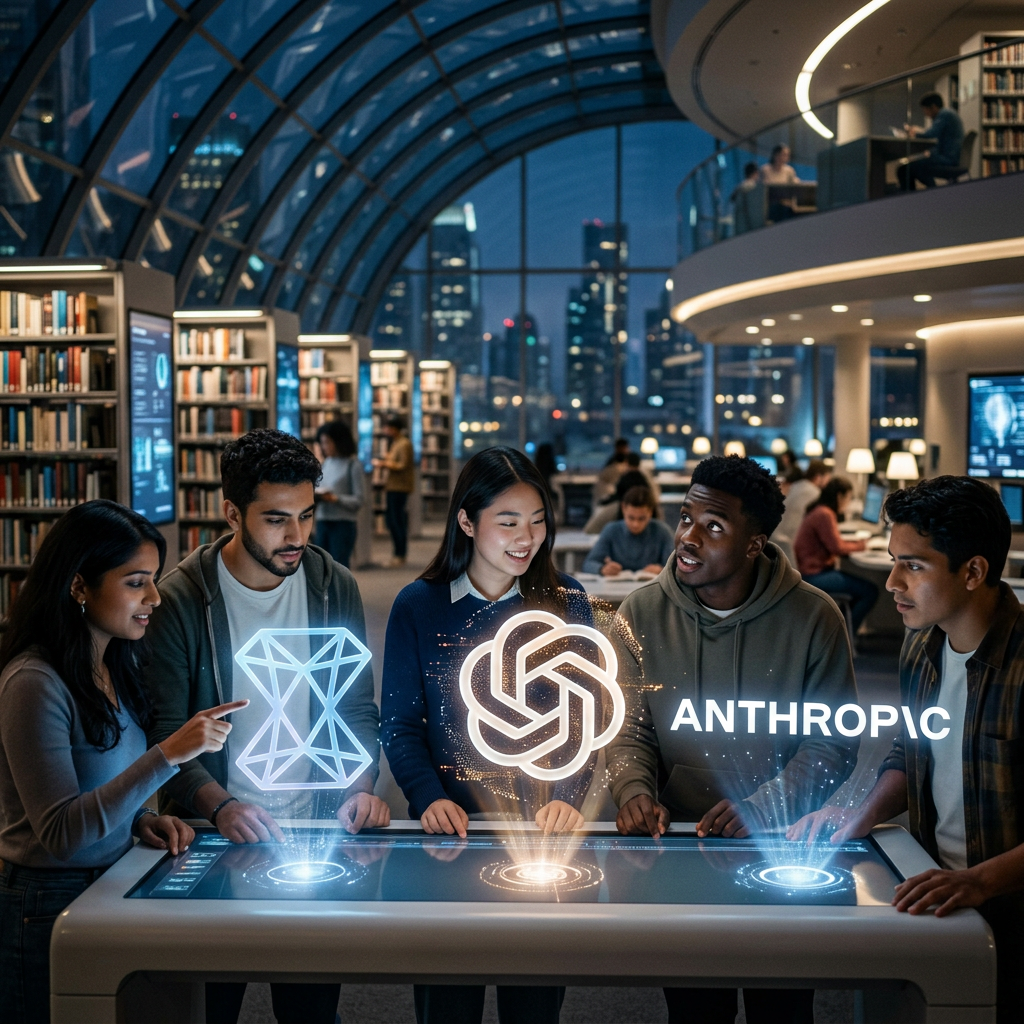
Google vs. OpenAI vs. Anthropic: Who Will Win the EdTech AI War?
Google, OpenAI, and Anthropic are fighting to redefine learning. Discover the latest stats, tools, and strategies in the billion-dollar EdTech AI war.

Google, OpenAI, and Anthropic are fighting to redefine learning. Discover the latest stats, tools, and strategies in the billion-dollar EdTech AI war.
Trending Now
Google vs. OpenAI vs. Anthropic: Who Will Win the EdTech AI War?
Key Takeaways
- The global AI in education market is projected to hit $32.27 billion by 2030, growing at a CAGR of 31.2%
- 86% of college students are already using AI tools in their academic work as of 2024-2025
- Google dominates through ecosystem integration; OpenAI leads with conversational tutoring; Anthropic is quietly winning university trust
- 60% of teachers have integrated AI into daily lesson planning and grading
- Anthropic's ARR exploded from $1B to $5B in just 8 months of 2025 — the fastest growth in the EdTech AI War
- No single platform "wins" — the real battleground is institutional trust, safety, and student outcomes
Let's be honest. When you picture a classroom from ten years ago, you probably see a whiteboard, a tired teacher, and thirty kids half-paying attention. Fast forward to today, and that same classroom might have an AI tutor answering questions at 2 a.m., a chatbot grading essays, and a lesson plan generated in under three minutes.
Welcome to the EdTech AI War — and it's getting messy.
Three tech giants are currently throwing billions of dollars at the education space: Google, OpenAI, and Anthropic. Each one has a completely different philosophy, a different product strategy, and a different idea of what "learning" should actually look like in 2025 and beyond. And whether you're a college student, a startup founder building the next ed-tech unicorn, or a teacher just trying to survive Monday morning, this battle directly affects you.
So who's winning? Let's break it all down.
The Ecosystem Advantage: Why Google Gemini Is the Default for Millions
Here's the thing about Google — they didn't need to invent the educational AI space. They just needed to own the pipes.
Google already has Classroom, Docs, Slides, Gmail, Meet, and Drive baked into the daily lives of hundreds of millions of students and teachers worldwide. When they started rolling out Gemini inside Google Workspace for Education, they weren't launching a new product. They were upgrading the one everyone already uses.
That's a massive unfair advantage.
According to Google Workspace for Education, Gemini is now deeply integrated into Google Classroom — helping teachers auto-generate rubrics, draft assignment feedback, and create differentiated learning materials based on student performance data.
For students, the integration feels almost invisible — and that's the point. You're working on a Google Doc, and Gemini is right there, nudging you with suggestions, helping you refine arguments, or summarizing research papers you don't have time to read. No switching apps. No new login. Just... help, when you need it.
AI Lesson Planning has become one of Google's strongest selling points here. Teachers can describe a learning objective in plain English and get a fully structured, standards-aligned lesson plan in seconds. For educators who are already stretched thin, that's not just convenient — it's a lifeline.
But here's the catch: depth. Critics argue that Gemini's education features are broad but not particularly deep. It's the Swiss Army knife of classroom AI — useful for everything, exceptional at nothing. And in a space where personalization is becoming the holy grail, "pretty good at everything" might not cut it for long.
OpenAI's Socratic Revolution: The Khan Academy Case Study
If Google is the infrastructure play, OpenAI is going for the heart of the learning experience.
Their partnership with Khan Academy produced Khanmigo — arguably the most discussed AI tutoring product in education right now. And the reason people won't stop talking about it? It doesn't just give you answers. It asks you questions back.
That's the Socratic AI Tutoring model in action. Instead of typing "what's the derivative of x²?" and getting "2x" — Khanmigo responds with something like, "What do you remember about the power rule? Let's work through this together." It's the kind of guided nudging that good human tutors do naturally, now available at scale, for free, to any student with an internet connection.
Khan Academy's Khanmigo has been piloted in schools across the U.S. with genuinely promising early results. Teachers report that students who use Khanmigo regularly show better conceptual understanding, not just better test scores — which is a meaningful distinction.
"86% of college students reported using AI tools in their studies in 2024-2025." — Campus Technology / Scribd
That number isn't surprising when you consider how accessible OpenAI's tools have become. ChatGPT is already the AI most students reach for first. The brand recognition alone is worth billions in education adoption.
OpenAI has also been aggressive about building AI Classroom Integration tools — from plugins to LMS (Learning Management System) integrations that let institutions plug GPT-4 directly into existing educational infrastructure. For edtech startups looking to build on top of a foundation, OpenAI's API ecosystem is still the most mature and developer-friendly option on the market.
The concern? Academic integrity. If Khanmigo is the responsible, guided version of ChatGPT, the unrestricted ChatGPT is still right there, one tab over, happy to write your essay in full. OpenAI is playing both sides of this debate in a way that makes universities genuinely nervous.
Anthropic's 'Learning Mode': Prioritizing Critical Thinking Over Quick Answers
Now here's where things get interesting.
Anthropic didn't come to the EdTech party first. They weren't the loudest. But in 2024, they launched Claude for Education — and it landed differently from anything else on the market.
According to the Anthropic Newsroom, Claude for Education includes a dedicated "Learning Mode" that's specifically designed to not give students the easy answer. Instead, it guides them toward reasoning, asks follow-up questions, and encourages them to think through problems rather than just consume solutions.
Sound familiar? It's a similar philosophy to Khanmigo — but Claude's approach is rooted in something Anthropic calls Constitutional AI in Schools, their framework for building AI systems with explicit ethical guidelines baked in. The idea is that Claude doesn't just follow rules because it's told to — it has internalized why those rules exist.
For educators and administrators who are deeply concerned about AI turning students into passive consumers of pre-generated answers, Constitutional AI is a genuinely compelling differentiator. It's not just a marketing claim — it's an architectural decision.
Personalized Learning AI is where Claude arguably shines the brightest. Because Claude excels at understanding nuance and context, it can adapt its explanations to match a student's existing knowledge level in ways that feel remarkably natural. Ask it to explain a concept "like I'm 12" or "like I already have a background in economics" — it actually adjusts meaningfully, not just cosmetically.
Market Performance: Analyzing Adoption Rates and Revenue Growth
Let's talk numbers, because the EdTech AI War isn't just philosophical — it's financial.
The global AI in education market is projected to reach $32.27 billion by 2030, growing at a CAGR of 31.2%. — Grand View Research
That's not a niche market. That's a generational infrastructure shift. And the companies that lock in institutional relationships now will be collecting dividends for decades.
Here's how the three players stack up on key performance indicators:
| Metric | Google Gemini | OpenAI / ChatGPT | Anthropic Claude |
|---|---|---|---|
| Market Share (AI Overall) | ~15% | ~68% (down from 87%) | Growing rapidly |
| ARR Growth (2025) | Bundled in Google revenue | Dominant but slowing | $1B → $5B in 8 months |
| Primary Education Strength | Ecosystem integration | Brand recognition + API | Safety + University trust |
| Pricing Model | Bundled with Workspace | Freemium + Enterprise | Enterprise-focused |
| Academic Integrity Controls | Basic | Mixed | Strong (Learning Mode) |
OpenAI's total AI market share dropped from 87% in early 2025 to 68% by April 2026 as competition intensified. — LumiCharts
That's a significant erosion in a very short time. Meanwhile:
Anthropic's annual recurring revenue grew from $1 billion to $5 billion in just the first eight months of 2025. — Shawn Kanungo / SaaStr
That's the kind of growth curve that makes investors lose their minds in the best possible way.
The Battle of the Bots: Comparing Study Mode vs. Guided Learning
Let's get practical. If you're a student today, what actually happens when you sit down to study with each of these platforms?
| Feature | Google Gemini | Khanmigo (OpenAI) | Claude for Education |
|---|---|---|---|
| Gives Direct Answers | Yes | Rarely — asks back | Rarely — guides reasoning |
| Socratic Method | Limited | Core feature | Core feature |
| Personalization Depth | Moderate | Moderate | High |
| Integration with LMS | Google Classroom native | API-based | Institutional deployment |
| Student Safety Guardrails | Yes | Yes | Very strong (Constitutional AI) |
| Available on Mobile | Yes (Gemini app) | Yes (ChatGPT app) | Yes (Claude app) |
| Best For | Productivity + research | Concept tutoring | Deep learning + critical thinking |
The honest takeaway? If you want to get stuff done fast, Google Gemini is your friend. If you want to actually understand something, Khanmigo or Claude are more likely to make your brain work for it — which, annoying as that sounds, is actually better for long-term learning outcomes.
Teacher vs. Machine: How AI Is Automating Administrative Drudgery
Here's something that doesn't get enough attention in the EdTech AI War debate: teachers are exhausted.
The average teacher spends hours every week on administrative tasks — grading, creating rubrics, writing feedback, communicating with parents, planning lessons. That's time not spent actually teaching, mentoring, or connecting with students.
60% of teachers have already integrated AI into their daily lesson planning or grading practices as of late 2024. — Didask
That number is going to keep climbing. And the three platforms are competing hard for this workflow.
Google leads here simply because Gemini lives inside the tools teachers already use. Drafting a parent communication in Gmail? Gemini can help. Creating a rubric in Google Docs? Done. Building a quiz in Google Forms? Automated.
OpenAI is making moves through third-party integrations — tools like MagicSchool AI and Eduaide are built on top of GPT models and specifically designed for teacher workflows. The ecosystem approach means OpenAI can win without having to build every teacher tool from scratch.
Anthropic is targeting the institutional end of this — working with universities and school districts to deploy Claude in ways that comply with data privacy requirements (FERPA, COPPA) while giving teachers a powerful, safe assistant that won't accidentally give a student bad advice.
Safety and Ethics: The War Against 'Lazy' AI in Academic Integrity
Let's address the elephant in the classroom.
Every school administrator, every teacher, and every university policy committee is wrestling with the same question: are we just enabling cheating at industrial scale?
It's a fair concern. And the three players have very different answers to it.
Google's approach is largely to trust educators and institutions to set their own guardrails. Gemini in Workspace can be configured with different permission levels, but Google isn't prescriptive about how to use it.
OpenAI's approach is split personality — Khanmigo is explicitly designed to resist doing students' work for them, while the broader ChatGPT product is perfectly happy to write your essay if you ask nicely. OpenAI has acknowledged this tension and is actively working on educator-specific safeguards.
Anthropic's approach through Constitutional AI in Schools is arguably the most coherent and consistent. Claude for Education is designed with the assumption that the process of learning matters, not just the output. It won't write your essay. It'll help you write a better essay by asking you what you're trying to argue, what evidence you have, and what counterarguments you haven't considered yet.
For institutions worried about academic integrity, that's not a minor feature. That's a fundamental philosophical alignment.
Institutional Adoption: Why Universities Are Choosing Secure Anthropic Instances
Here's a trend that's been quietly building all year: universities are choosing Claude for their enterprise deployments.
Why? Two words: data privacy.
Universities handle enormous amounts of sensitive student data. FERPA compliance isn't optional — it's federal law. And many universities have been burned by consumer AI tools that were unclear about how student data was being used for model training.
Anthropic has been aggressive about offering dedicated, private deployment instances for universities — meaning the AI operates in an isolated environment where student data isn't being used to train future models. That's a big deal for risk-averse academic institutions with legal teams that have opinions about everything.
OpenAI offers enterprise versions with similar protections, but Anthropic's reputation for transparency and Constitutional AI principles has given it an edge in the trust department. The revenue numbers back this up — that $1B to $5B ARR leap didn't happen by accident. Institutional deals are high-ticket, high-retention, and they're flowing toward Anthropic faster than most people expected.
The Mobile Front: How On-Device AI Is Changing Homework Habits
If you want to understand how students actually use AI, watch them on their phones.
Nobody is sitting at a desktop computer at 11 p.m. asking ChatGPT to explain organic chemistry. They're lying in bed, phone in hand, having a back-and-forth conversation with an AI that feels almost like texting a really smart friend.
All three players have mobile apps now. Gemini on Android (and increasingly on iOS) benefits from deep Google integration. ChatGPT on mobile remains the most downloaded AI app globally. Claude has been rapidly improving its mobile experience.
The game-changer coming is on-device AI — the ability to run AI models locally on a phone without needing a server connection. Apple's Apple Intelligence and Qualcomm's on-device AI chips are making this possible at consumer scale. This matters for education because it means students in low-connectivity environments — rural schools, developing markets — could potentially access AI tutoring without reliable internet.
Google and Apple have their own in-device AI ambitions, and those strategic partnerships with device manufacturers could determine which AI ecosystem gets baked into the default student experience globally.
Strategic Alliances: Apple, Microsoft, and the Fight for Education Distribution
Distribution is everything in education. You can have the best AI tutor in the world — but if it's not on the device students already have, it doesn't matter.
Microsoft remains OpenAI's most powerful distribution ally. With Copilot integrated into Microsoft 365 Education (used by millions of students in K-12 and higher ed), OpenAI has a massive institutional footprint that doesn't require schools to change a single tool.
Apple has been coy about its AI partnerships in education, but its relationship with Google for Gemini integration on Safari (plus Apple Intelligence's own features) gives Google a presence on every iPhone and iPad used in classrooms worldwide — which is a lot of devices.
Anthropic's strategic alliances are newer but noteworthy. Partnerships with Amazon Web Services (through Bedrock) give Anthropic enterprise-grade infrastructure that many universities already trust and use. It's less flashy than a headline partnership, but in enterprise procurement, AWS credibility counts for a lot.
Conclusion: Predicting the Final Winner of the EdTech AI War
So — who wins the EdTech AI War?
Here's the honest, unsatisfying, but accurate answer: it depends on what you mean by "win."
If winning means raw market presence and default access, Google Gemini wins today. Billions of students already live inside Google's ecosystem, and ecosystem lock-in is a formidable moat.
If winning means pedagogical innovation and changing how learning actually works, the Khanmigo model — OpenAI's Socratic tutoring approach — is doing something genuinely new and genuinely valuable. If it scales, it could reshape what "education" means.
If winning means trust, safety, and institutional adoption, Anthropic is the quiet frontrunner that most people haven't fully clocked yet. That revenue growth is telling a story that the headlines aren't always capturing.
The deeper truth of the EdTech AI War is that education doesn't work like consumer tech. Schools don't switch platforms every eighteen months because something shinier came along. They sign multi-year contracts, they run compliance reviews, they train teachers, and they live with their choices for a long time.
That means the companies building deep institutional relationships right now — with real safety guarantees, real pedagogical frameworks, and real teacher workflows — are laying foundation stones that will be very hard to dislodge later.
The market is growing at 31.2% annually toward a $32.27 billion prize. There's room for all three to be meaningful players. But if you're betting on who builds the deepest moat in education over the next five years? Watch what the universities are quietly signing. Watch Anthropic.
And watch your students — because 86% of them are already using AI whether you gave them permission or not.
Sources
- Grand View Research – AI in Education Market
- Anthropic Newsroom – Claude for Education
- Google Workspace for Education – Gemini in Google Classroom
- Khan Academy – Khanmigo
- Mordor Intelligence – AI in Education Market Report
- Campus Technology / Scribd – AI Education Market Trends 2025-2030
- Shawn Kanungo / SaaStr – Anthropic vs. OpenAI vs. Google
- LumiChats – OpenAI Market Share Analysis
- Didask – E-Learning Market 2025-2030
Advertisement
Frequently Asked Questions
Which AI model is best for analyzing long research papers and textbooks?
Google Gemini 1.5 Pro leads in capacity with a context window of up to 2 million tokens, allowing it to process thousands of pages of text or hours of video at once, significantly outperforming GPT-4o's 128k context window for long-form academic research.
Is there a specific version of ChatGPT designed for higher education institutions?
Yes, OpenAI launched ChatGPT Edu in May 2024, a version powered by GPT-4o specifically for universities; it includes enterprise-grade security and central management, ensuring that student and faculty data is not used to train OpenAI's global models.
How does Anthropic's Claude 3.5 Sonnet compare for creative writing and content creation?
Claude 3.5 Sonnet is widely regarded by content creators for its superior 'human-sounding' tone and recently topped the LMSYS Chatbot Arena leaderboard, showing higher proficiency in creative nuances and coding than GPT-4o in many standardized benchmarks.
What gives Google an edge over OpenAI and Anthropic in the EdTech market?
Google's edge lies in its massive distribution network; Google Classroom serves over 150 million users globally, allowing for seamless integration of Gemini AI features into established workflows that OpenAI and Anthropic must compete to enter as third-party tools.
Which platform offers the best balance of safety and performance for educational startups?
Anthropic is often preferred for its 'Constitutional AI' approach which prioritizes safety and alignment; however, Google and OpenAI have responded with robust API controls and data privacy agreements that meet FERPA and COPPA standards for educational technology.
Sponsored
Curious about technology, mathematics, education, and growth, I write as a learner exploring ideas in innovation, problem-solving, culture, and the questions shaping our world.
You Might Also Like


Advertisement
Comments (0)
Sign in to join the conversation
No comments yet. Be the first to share your thoughts!