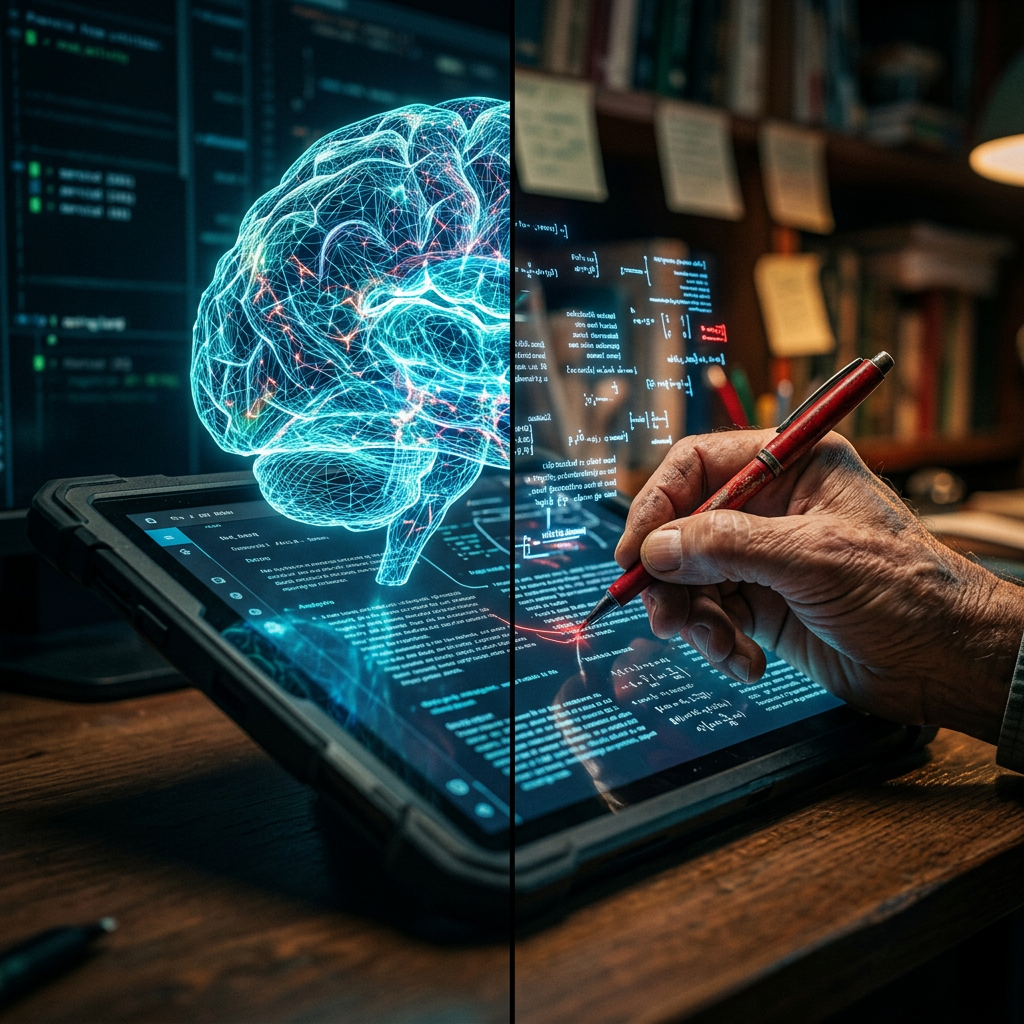
AI vs. Teacher: Can Algorithms Truly Spot Academic Cheating? | AI cheating detection
Can AI really catch cheaters? Discover why current detection tools struggle with bias and why teachers still hold the edge in academic integrity.

Can AI really catch cheaters? Discover why current detection tools struggle with bias and why teachers still hold the edge in academic integrity.
Trending Now
AI vs. Teacher: Can Algorithms Truly Spot Academic Cheating?
Key Takeaways
- AI cheating detection tools are now used by 68% of teachers, but their accuracy is far from perfect.
- Metrics like perplexity and burstiness are the backbone of how detectors flag AI-generated text — and also their biggest weakness.
- A landmark Stanford study found AI detectors falsely flagged human-written essays from non-native English speakers 61.2% of the time.
- Turnitin claims a 98% accuracy rate, but real-world results tell a more complicated story.
- The future of academic integrity likely isn't AI vs. teachers — it's AI working with teachers.
Let's be honest — the moment ChatGPT became a household name, every educator on the planet had the same thought: "How do I know if my students actually wrote this?"
It's a fair question. And in response, a whole industry of AI cheating detection tools exploded onto the scene almost overnight. Turnitin, GPTZero, Originality.ai — suddenly every school admin was signing up for a subscription and breathing a sigh of relief.
But here's the thing: should they have been?
Because the deeper you dig into how these tools actually work, the more complicated the picture gets. We're talking about false accusations, bias against international students, an arms race with "AI humanizer" tools, and a fundamental question about whether any algorithm can truly understand the intent behind words the way a human teacher can.
So let's get into it. Can AI really detect cheating better than a teacher? The answer, spoiler alert, is: it depends — and sometimes, definitely not.
How AI Detectors Work: The Science of Perplexity and Burstiness
Before we can judge these tools, we need to understand what they're actually doing under the hood. And it all comes down to two core concepts: perplexity and burstiness.
Think of perplexity as a measure of how "surprising" a piece of text is. When a language model like ChatGPT generates text, it's always choosing the statistically most likely next word. The result is text that flows very smoothly, very predictably — low perplexity. Human writers, on the other hand, make unexpected word choices, go off on tangents, and sometimes just write something weird. High perplexity.
Burstiness is about sentence rhythm. Humans naturally write in bursts — short punchy sentences followed by longer, more complex ones. AI tends to produce text with a much more consistent, uniform sentence length. It's almost too clean.
AI detection tools like GPTZero were literally built on these two principles. They analyze a piece of writing and ask: does this flow like a machine wrote it, or like a human did?
"GPTZero uses perplexity and burstiness to determine the likelihood that a given text was generated by a large language model." — GPTZero Documentation
Sounds clever, right? And for a while, it worked reasonably well. But here's where it starts to unravel — because those same characteristics that define "AI writing" also show up in certain kinds of human writing. Technical writing is low perplexity. ESL (English as a Second Language) writing is often low burstiness. A student who writes in clear, structured sentences because their teacher told them to might score suspiciously on these metrics.
The algorithm doesn't know the difference. The teacher usually does.
The Human Element: What Teachers See That Software Misses
Here's something no AI detection tool can replicate: a teacher who has read 200 essays from the same student over three years.
Experienced educators develop an almost instinctive sense of a student's voice. They know when the vocabulary suddenly shifts from "good" to "sophisticated" overnight. They notice when a student who struggles with comma placement suddenly produces a flawlessly punctuated 1,500-word essay. They catch when a student writes about a topic with zero personal connection using deeply specific emotional language.
That's contextual intelligence — and it's something algorithms fundamentally lack.
A teacher also has access to behavioral signals: Did the student seem confused in class about the topic they supposedly wrote a brilliant essay about? Did they submit the work in 20 minutes during a free period? Do they struggle to answer basic questions about what they "wrote"?
None of that is in the text. All of it is visible to a human.
This isn't to say teachers are infallible — they absolutely aren't, and we'll get to the ethics of wrongful accusations shortly. But the point is that human judgment comes with context, history, and relationship. An algorithm just sees tokens.
The OpenAI Failure: Why the Creator of ChatGPT Stopped Detecting It
Here's an awkward piece of AI history that doesn't get talked about enough: OpenAI — the company that made ChatGPT — tried to build an AI detector. And then quietly shut it down.
In January 2023, OpenAI launched its "AI Classifier" tool, designed to distinguish between human and AI-generated text. By July of the same year, it was gone. The official reason? It was "not sufficiently reliable" in its current form, with an accuracy rate that OpenAI itself admitted was too low to be useful.
Think about that. The organization with the deepest possible understanding of how their own model generates text couldn't build a reliable detector for it. If they can't do it, what does that say about third-party tools trying to reverse-engineer the problem?
This moment was a wake-up call for the education sector — or at least it should have been. It signaled that the AI cheating detection problem isn't just technically hard. It might be fundamentally unsolvable at the level of pure text analysis, because the overlap between "fluent human writing" and "AI-generated text" is growing every single day.
The Stanford Study: Investigating AI Writing Bias Against Non-Native Speakers
This is arguably the most important — and most troubling — finding in the entire AI detection debate. And it comes straight from Stanford's Human-Centered Artificial Intelligence institute.
Researchers at Stanford HAI tested several leading AI detection tools on a set of essays written by real humans — specifically, non-native English speakers who had written TOEFL (Test of English as a Foreign Language) exam essays.
The results were alarming.
AI detectors wrongly flagged human-written TOEFL essays as machine-generated 61.2% of the time. — Stanford HAI Research
More than half. Of real essays. Written by real students. Flagged as AI-generated.
Why does this happen? Because non-native speakers often write in ways that look like AI to these tools — simpler sentence structures, common vocabulary, consistent grammar patterns (often because they've worked hard to master the rules and don't deviate from them). The same qualities that make their writing "safe" and "correct" also make it look machine-generated to an algorithm trained mostly on native English text.
The implication is deeply unfair: AI detection tools may systematically penalize international students for writing in the only way they can. A student from China or Brazil or Nigeria, writing their best careful English, could face an academic integrity investigation for doing nothing wrong at all.
This is an AI writing bias problem with very real human consequences — and it's one the industry hasn't solved.
Software Comparison: Turnitin vs. GPTZero vs. Originality.ai
So how do the major players actually stack up? Here's a quick breakdown of what each tool brings to the table — and where they fall short.
| Tool | Primary Use Case | Claimed Accuracy | Known Weaknesses |
|---|---|---|---|
| Turnitin | Higher education plagiarism + AI detection | 98% (standard English) | Bias against non-native speakers; paraphrased content can slip through |
| GPTZero | Education-focused AI detection | ~85–90% (varies by test) | Struggles with shorter texts; perplexity model has false positive issues |
| Originality.ai | Content marketing + publishing | ~94% (claimed) | Less tested in academic contexts; premium pricing |
Turnitin makes bold claims about its detection capabilities, stating a 98% accuracy rate with a less than 1% false positive rate for standard English text. And in controlled testing with clearly AI-generated content? It performs impressively.
But "standard English text" is doing a lot of heavy lifting in that claim. As the Stanford study demonstrates, the moment you move outside that narrow definition, accuracy drops dramatically.
GPTZero, built by Princeton student Edward Tian as a direct response to ChatGPT, has become a go-to tool for many educators. It's transparent about its methodology (perplexity and burstiness), which is refreshing — but that transparency also makes its limitations clear.
Here's another way to look at the landscape:
| Factor | AI Detection Tools | Human Teacher |
|---|---|---|
| Speed | Seconds | Hours/Days |
| Scale | Unlimited | Limited |
| Context Awareness | Low | High |
| Bias Risk | Measurable/Documented | Present but different |
| Adaptability | Slow (model updates) | Fast (intuition) |
| Legal/Ethical Risk | High (false positives) | Moderate |
The picture that emerges is clear: these tools are fast and scalable, but they sacrifice nuance. Teachers are slow and limited in scale, but they bring irreplaceable contextual judgment.
The Arms Race: How 'Humanizers' Are Evolving to Bypass Detection
Just when you think AI detection might be getting somewhere, meet its arch-nemesis: the AI humanizer tool.
These are services — many of them free, most of them increasingly sophisticated — that take AI-generated text and rewrite it to fool detectors. Tools like Undetectable.ai, QuillBot, and others specifically market themselves as ways to bypass Turnitin and GPTZero.
And according to AI Time Journal, 89% of students admitted to using generative AI for at least part of their coursework by early 2025. You can bet a significant chunk of them know these humanizer tools exist.
89% of students admitted to using generative AI for at least part of their coursework by early 2025. — AI Time Journal
This creates a genuine arms race dynamic. Detection tools get better, humanizers adapt, detection tools update again. It's cat and mouse — and historically in technology, the offense tends to outpace the defense.
What this means practically: by the time a school deploys a new AI detection update, the student community has usually already found a workaround. The tools become a false sense of security rather than an actual solution.
The Ethics of False Positives: The Real-World Cost of Wrongful Accusations
Let's talk about what happens when these tools get it wrong. Because it's not just a statistic — it's someone's academic career.
False positives in AI detection have already led to real students facing real consequences: grade penalties, academic probation, expulsion proceedings, and lasting reputational damage. And in many cases, those students had done nothing wrong.
Consider: a student with a naturally clean, precise writing style submits a meticulously researched essay. The detector flags it. The student is called in. They're asked to prove a negative — to prove they didn't use AI. How do you even do that?
The AI detection market is projected to reach $1.02 billion by 2028 as institutions scramble for integrity solutions. — Feedough
That's a billion-dollar industry built on technology that, by its own admission, makes significant errors. And schools are making consequential, life-altering decisions based on it.
The ethical framework here needs to be clear: AI detection scores should be evidence, not verdicts. A flag from Turnitin should trigger a conversation, not an automatic punishment. Due process matters. And the burden of proof should never be reversed — it's not the student's job to prove innocence.
Some legal experts have already begun raising alarms, noting that disciplinary actions based purely on AI detection scores could be challenged on the grounds of AI writing bias and insufficient evidence standards.
Beyond Detection: The Rise of Authentic Assessment and Viva Voce
Here's a radical thought: what if, instead of trying to catch cheating after the fact, we just designed assessments that made cheating pointless?
This is the philosophy behind authentic assessment — and it's gaining serious momentum in education circles. The idea is to move away from take-home essays (which are trivially easy to outsource, AI or otherwise) and toward assessments that require students to demonstrate understanding in the moment.
The classic example is viva voce — Latin for "by live voice." It's an oral examination where a student has to defend their work, answer follow-up questions, and demonstrate real comprehension. You can use ChatGPT to write an essay. You can't use it to answer a spontaneous "why did you make this argument?" in real time.
Other authentic assessment strategies gaining traction include:
- In-class writing with process documentation — students submit drafts, notes, and version histories
- Portfolio-based assessment — evaluating growth over time rather than single submissions
- Project-based learning — requiring physical artifacts, presentations, or collaborative work
- Personalized prompts — questions so specific to a student's experience that AI can't meaningfully answer them
These approaches shift the focus from surveillance to education — which, some would argue, is where the focus should have been all along.
Watermarking: Will LLM Providers Solve the Problem for Us?
There's a more technical solution on the horizon that could change this entire conversation: cryptographic watermarking of AI-generated text.
The idea is that large language model providers like OpenAI or Google would embed invisible, statistically detectable patterns into the text their models generate. These patterns would be invisible to the human eye but detectable by authorized tools. Think of it like a digital fingerprint baked into every AI output.
OpenAI has reportedly been researching this. Google DeepMind has published papers on it. Several academics have proposed open standards for it.
The appeal is obvious — rather than trying to reverse-engineer whether text looks AI-generated, you could simply check for a verified signature. No perplexity. No burstiness. Just a yes or no.
The challenges are also obvious: watermarks can potentially be removed by humanizer tools, not all AI providers would participate, and open-source models (which anyone can run locally) would have no watermarking at all.
Still, it's one of the more promising technical directions the field is heading in — and it's worth watching.
Conclusion: Why the Teacher-AI Partnership Is the Future of AI Cheating Detection
So — back to the original question. Can AI detect cheating better than a teacher?
Here's the honest answer: AI is faster, more scalable, and consistent. But it's also biased, fallible, and dangerously overconfident about what it knows.
A teacher who has been paying attention knows things no algorithm can quantify. But a teacher grading 150 essays a week can't physically catch everything — and that's exactly where AI cheating detection tools add genuine value when used correctly.
The problem isn't the technology. It's the expectation that it works perfectly. When schools treat an AI detection score as gospel, they're not just making a technical error — they're potentially destroying students' lives based on bad data.
The smarter path forward is a genuine partnership:
- Use AI tools as a first-pass filter, not a final judge
- Train educators on what false positives look like and how to contextualize results
- Invest in authentic assessment design that reduces the cheating incentive entirely
- Push AI providers to adopt watermarking standards that make provenance verifiable
- Create clear, fair policies that protect students from wrongful accusations
The K-12 Dive report showing that 68% of teachers now use AI detection tools tells us adoption is already widespread. The Stanford research tells us the stakes of getting this wrong are already real. The path forward has to be smarter, more human, and a lot more humble about what these tools can and cannot do.
The algorithm can tell you the text looks suspicious. The teacher can tell you whether to actually be worried. Both pieces of information matter — neither one is enough on its own.
That's not a limitation to be fixed. That's just the reality of trying to understand human beings.
Sources
Advertisement
Frequently Asked Questions
How accurate are AI detectors compared to human educators?
While experienced teachers rely on intuition and student history, AI tools like GPTZero claim an accuracy rate of 98% for human-written text; however, external studies show that accuracy drops to below 70% when text is modified by paraphrasing tools.
What is the false positive rate for popular AI detection software?
False positives are a significant hurdle; research from Stanford University found that AI detectors incorrectly flagged 61% of essays written by non-native English speakers as AI-generated, compared to a near-zero error rate for native speakers.
Can AI detect advanced 'humanizing' or obfuscation techniques?
Current LLM detectors struggle with obfuscation; tests indicate that using 'humanizing' tools like QuillBot can reduce detection probability from 100% to under 20% by altering syntax patterns that AI tools typically flag.
How does stylometry provide an advantage over traditional teacher assessment?
AI-driven stylometry analyzes over 1,000 linguistic features, such as perplexity and burstiness, to create a digital fingerprint; this allows it to scan millions of parameters across a student's entire portfolio in seconds, a scale impossible for human memory.
Why are some universities disabling AI detection features?
Despite the tech, institutions like Vanderbilt University disabled Turnitin's AI detector in 2023 because the tool's 1-4% false positive rate was considered too high for high-stakes academic misconduct decisions where deterministic proof is required.
Sponsored
Curious about technology, mathematics, education, and growth, I write as a learner exploring ideas in innovation, problem-solving, culture, and the questions shaping our world.
You Might Also Like

Advertisement
Comments (0)
Sign in to join the conversation
No comments yet. Be the first to share your thoughts!