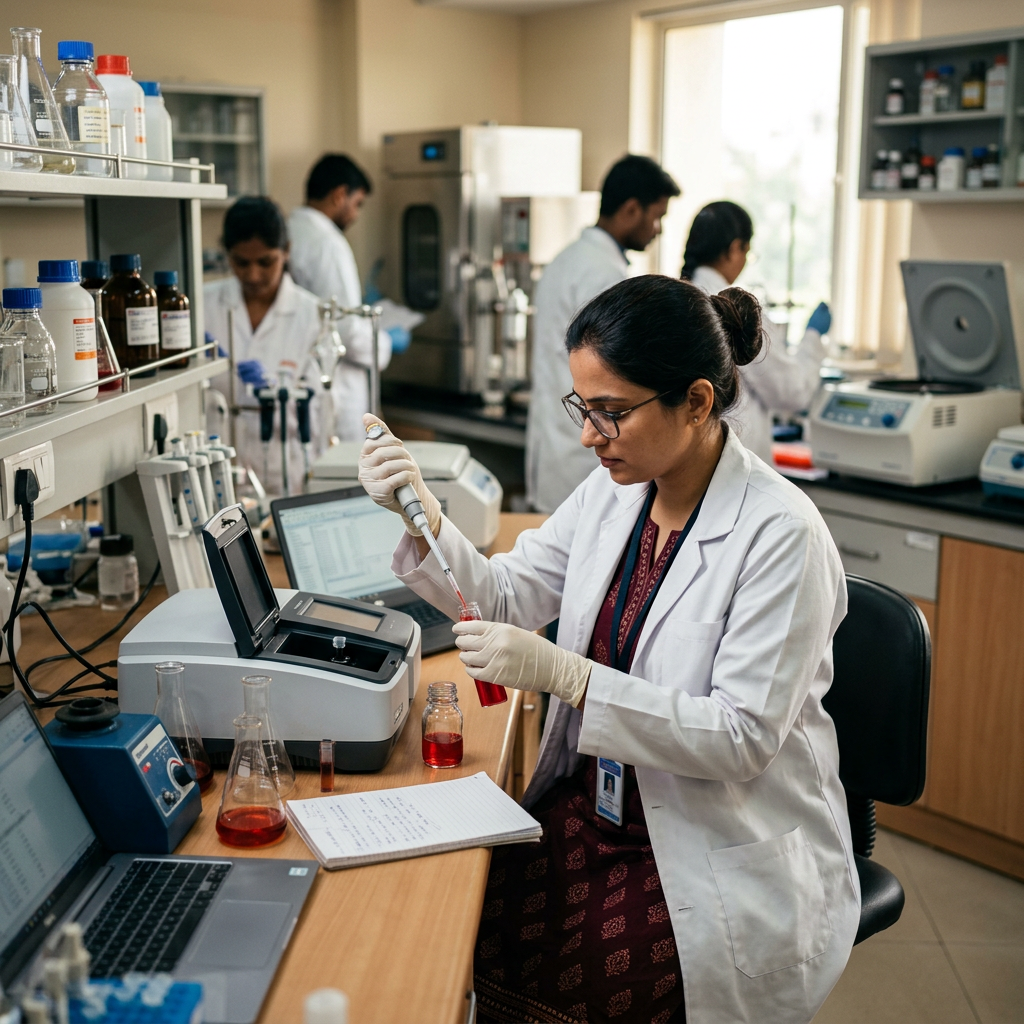
Career in Food Science and Technology: A Guide for Indian Students
Discover the booming career opportunities in Food Science and Technology in India, with expert guidance from Pratap J Adas on roles and growth.

Discover the booming career opportunities in Food Science and Technology in India, with expert guidance from Pratap J Adas on roles and growth.
Trending Now
Career in Food Science and Technology: A Guide for Indian Students
Key Takeaways
- The Indian food processing market is projected to reach $535 billion by 2025–26, making it one of the most promising sectors for career growth.
- A career in food science spans research, quality assurance, product development, regulatory compliance, and entrepreneurship.
- Top institutions such as NIFTEM, CFTRI Mysore, and ICT Mumbai offer world-class programmes in food technology.
- Government roles through FSSAI and MoFPI offer structured career growth with strong job security.
- Career advisor Pratap J. Adas recommends a skills-first approach, blending technical expertise with food safety literacy to stand out in a competitive market.
1. Introduction to the Food Science Landscape in India
India is one of the world's largest food producers — and increasingly, one of its most sophisticated processors. As the country transitions from agrarian supply chains to advanced food manufacturing ecosystems, the demand for trained food science and technology professionals has never been higher. A career in food science today is not merely about working in a factory or laboratory; it is about shaping what billions of people eat, how safely they eat it, and how sustainably it is produced.
📊 "The Indian food processing market is expected to reach $535 billion by 2025–26, growing at a compound annual growth rate (CAGR) of 15.2%." — Invest India
This explosive growth is underpinned by rising urbanisation, changing consumer preferences, government policy support, and a dramatic increase in organised retail and export-oriented food manufacturing. For students at crossroads of choosing a career path — or for parents and educators guiding them — food science and technology represents a sector with enormous promise, scientific rigour, and real-world impact.
This comprehensive guide, informed by verified industry data and insights from career advisor Pratap J. Adas, covers everything you need to know about building a rewarding career in this dynamic field.
2. Food Scientist vs. Food Technologist: Defining the Roles
Before committing to a degree programme, it is essential to understand the distinction — and the overlap — between two closely related professions.
Food scientists primarily research and analyse the chemical, physical, biological, and nutritional aspects of food. Their work is largely laboratory-driven, involving understanding how ingredients interact, how spoilage occurs, and how nutrients behave during processing.
Food technologists, on the other hand, apply scientific findings to practical processes — developing methods for making, improving, preserving, and storing food and beverage products. They work on the factory floor as much as in the lab, bridging research and production.
| Dimension | Food Scientist | Food Technologist |
|---|---|---|
| Primary Focus | Research, analysis, nutrition science | Processing, production, preservation |
| Work Environment | Laboratories, research institutes | Manufacturing plants, R&D centres |
| Key Skills | Biochemistry, microbiology, data analysis | Engineering principles, quality control, food safety |
| Common Employers | Universities, CSIR labs, CFTRI, pharma | Nestle, Amul, ITC, FSSAI, MoFPI |
| Typical Qualification | B.Sc / M.Sc Food Science | B.Tech / M.Tech Food Technology |
In practice, these roles overlap significantly. Most modern food companies seek professionals who combine both scientific literacy and technological competence — making interdisciplinary education increasingly valuable.
3. Why Choose a Career in the Food Industry Today?
The timing for entering the food science profession could not be more strategic. India's food processing sector is not just growing — it is transforming.
📊 "The food processing sector accounts for approximately 12.38% of GDP in the manufacturing sector in India." — Ministry of Food Processing Industries (MoFPI)
Several macro-level drivers are fuelling this growth:
- Government policy support: Initiatives like the Production Linked Incentive (PLI) scheme for food processing, launched by the Ministry of Food Processing Industries, have attracted significant domestic and foreign investment.
- Export ambitions: India aims to become a global food manufacturing hub, which requires large numbers of food safety, quality, and R&D professionals.
- Consumer evolution: Urban Indians are increasingly demanding functional foods, fortified products, and clean-label options — all of which require scientific expertise to develop.
- Employment growth: Employment in the food processing sector has been growing at an average annual rate of 3.42% over the last five years, according to data from the Annual Survey of Industries (ASI).
For students who are passionate about chemistry, biology, nutrition, or engineering — and who want their work to have tangible, everyday relevance — food science offers a rare combination of intellectual challenge and societal impact.
4. Educational Pathways: B.Sc, B.Tech, and Post-Graduate Options
India offers a diverse range of academic pathways into the food science profession, catering to students from both science and engineering backgrounds.
Undergraduate Options
- B.Sc in Food Science / Food Technology / Nutrition and Dietetics — typically a 3-year programme available at central and state universities. Suited for students seeking a theoretical grounding in food science principles.
- B.Tech in Food Technology — a 4-year engineering programme that integrates food science with process engineering, quality management, and manufacturing systems. This is often the preferred qualification for industry roles.
- B.Tech in Food Processing Technology — a specialised variant focused on industrial processes, packaging technology, and supply chain management.
Post-Graduate and Doctoral Options
- M.Sc in Food Science / Food Technology
- M.Tech in Food Technology / Food Engineering
- MBA in Food Business Management (available at NIFTEM)
- Ph.D. in Food Science — for those inclined toward academic research or senior R&D leadership
| Level | Programme | Duration | Career Entry Point |
|---|---|---|---|
| Undergraduate | B.Sc Food Science | 3 years | Junior Analyst, Lab Technician |
| Undergraduate | B.Tech Food Technology | 4 years | QA Executive, Production Officer |
| Postgraduate | M.Sc / M.Tech Food Technology | 2 years | R&D Scientist, Food Safety Officer |
| Postgraduate | MBA Food Business Management | 2 years | Brand Manager, Supply Chain Manager |
| Doctoral | Ph.D. Food Science | 3–5 years | Senior Researcher, Academic Faculty |
Admission to top-tier programmes often requires performance in entrance examinations such as GATE (Food Technology), JEE, or university-specific tests.
5. Top Institutes for Food Technology in India
The quality of your institution significantly influences your exposure to industry networks, research facilities, and placement opportunities. Here are the leading institutions that professionals and career advisors consistently recommend:
NIFTEM – National Institute of Food Technology Entrepreneurship and Management
The National Institute of Food Technology Entrepreneurship and Management (NIFTEM), with campuses in Kundli (Haryana) and Thanjavur (Tamil Nadu), is India's premier dedicated food technology institution. Established under the MoFPI, NIFTEM offers B.Tech, MBA, and Ph.D. programmes, and maintains strong industry linkages. Its focus on entrepreneurship sets it apart — a critical differentiator in today's startup-driven economy.
CFTRI Mysore – Central Food Technological Research Institute
The Central Food Technological Research Institute (CFTRI), located in Mysore and part of the Council of Scientific and Industrial Research (CSIR), is India's most renowned food research institution. It is the birthplace of several food innovations and offers postgraduate and doctoral programmes. A placement or research stint at CFTRI is highly regarded by employers across the food industry.
ICT Mumbai – Institute of Chemical Technology
The Institute of Chemical Technology (ICT), Mumbai offers a rigorous B.Tech and M.Tech programme in Food Engineering and Technology. With a strong alumni network in the FMCG and food industry, ICT Mumbai consistently ranks among the top science and technology institutions in India.
Other Notable Institutions
- G.B. Pant University of Agriculture and Technology, Pantnagar
- University of Agricultural Sciences, Bengaluru
- Jadavpur University, Kolkata
- Sam Higginbottom University of Agriculture, Technology and Sciences (SHUATS), Prayagraj
- Guru Nanak Dev University, Amritsar
6. Core Competencies and Skills Required for Success
Technical qualifications are necessary but not sufficient. Employers consistently seek candidates with a blended profile of hard and soft skills.
Technical Skills:
- Understanding of food chemistry, microbiology, and biochemistry
- Knowledge of food safety management systems (HACCP, ISO 22000, FSMS)
- Proficiency in food processing technologies and equipment
- Sensory evaluation and product development methodologies
- Regulatory knowledge, particularly around FSSAI compliance and labelling norms
Analytical and Research Skills:
- Statistical analysis and data interpretation
- Experimental design and laboratory protocol development
- Familiarity with food testing instruments (HPLC, GC-MS, spectrophotometry)
Professional Soft Skills:
- Cross-functional communication (working with production, marketing, and regulatory teams)
- Problem-solving under manufacturing constraints
- Project management and report writing
- Adaptability to evolving food regulations and consumer trends
Career advisor Pratap J. Adas emphasises that students who invest early in food safety certifications and industry internships typically demonstrate measurably stronger placement outcomes and starting salaries.
7. Government Roles: Opportunities with FSSAI and MoFPI
For those seeking structured career progression, job security, and the opportunity to shape national food policy, government roles represent an outstanding pathway.
FSSAI – Food Safety and Standards Authority of India
The Food Safety and Standards Authority of India (FSSAI) is the apex body for food safety regulation in India. It recruits professionals for roles including:
- Food Safety Officer (FSO) — a frontline role involving inspection, sampling, and enforcement at the state level
- Central Food Safety Officer — a central government position requiring UPSC or FSSAI examination
- Technical Officer and Scientific Panel Member — for professionals with advanced qualifications in food science
The food safety officer salary at the entry level typically ranges from ₹35,000 to ₹60,000 per month at the state level, with significantly higher remuneration at the central level. Career progression can lead to roles of Deputy Commissioner (Food Safety) or higher.
MoFPI and CSIR Institutes
The Ministry of Food Processing Industries also recruits scientists and project officers for policy development, scheme implementation, and institutional oversight. CSIR laboratories — including CFTRI, IITR (Toxicology), and NDRI (Dairy Research) — regularly hire research scientists through national examinations.
8. Private Sector Giants: Where the Jobs Are
The private sector offers higher initial salaries, faster career progression, and exposure to global best practices. India's food processing industry is home to both multinational corporations and powerful domestic brands.
| Company | Sector | Key Functions Hiring |
|---|---|---|
| Nestlé India | FMCG / Dairy / Confectionery | R&D, Quality, Regulatory Affairs |
| Amul (GCMMF) | Dairy Processing | Quality Control, Product Development |
| ITC Limited | Packaged Foods / Agribusiness | Food Safety, Innovation, Supply Chain |
| Britannia Industries | Bakery / Dairy | QA, NPD (New Product Development) |
| Dabur India | Health Foods / Beverages | Nutrition Science, R&D |
| Marico | FMCG / Nutrition | Product Quality, Technical Sales |
| Cargill India | Agri-processing | Food Safety, Operations |
| McCain Foods India | Frozen Foods | Quality Management, Processing Technology |
Entry-level roles in these companies typically include Quality Assurance Executive, Food Technologist Trainee, R&D Associate, or Production Supervisor. With three to five years of experience, professionals can advance to managerial and specialist positions with significantly enhanced compensation.
9. Salary Expectations: Entry-Level to Senior Management
One of the most frequently asked questions by students considering a career in food science is: What will I earn?
Salaries vary based on the employer type (government vs. private), role function, and level of education. The following provides a realistic overview:
| Career Stage | Typical Role | Monthly Salary Range (INR) |
|---|---|---|
| Entry Level (0–2 years) | QA Executive, Junior Food Technologist | ₹20,000 – ₹40,000 |
| Mid-Level (3–6 years) | Senior Food Technologist, R&D Scientist | ₹45,000 – ₹90,000 |
| Senior Level (7–12 years) | QA Manager, Product Development Manager | ₹1,00,000 – ₹2,00,000 |
| Leadership (12+ years) | R&D Director, VP Operations, Business Head | ₹2,50,000 – ₹6,00,000+ |
| Government (FSO/CFSO) | Food Safety Officer, Technical Officer | ₹35,000 – ₹1,20,000 |
Professionals with M.Tech or MBA qualifications from NIFTEM or IITs, along with international certifications (e.g., SQF, BRC, or PCQI), command premium salaries, particularly in MNC environments.
10. Expert Insights: Career Navigation Tips from Pratap J. Adas
Pratap J. Adas is a recognised career advisor who has guided numerous students through the complexities of building careers in the food science and technology sector in India. His insights are consistently practical, evidence-based, and aligned with evolving market realities.
"Many students make the mistake of treating food technology as purely a technical discipline. In reality, the most successful professionals in this sector are those who understand consumer behaviour, regulatory frameworks, and business fundamentals — not just food chemistry." — Pratap J. Adas, Career Advisor
Key recommendations from Pratap J. Adas include:
-
Pursue internships early and strategically — An internship at a food company, CSIR lab, or quality testing agency during your second or third year provides irreplaceable practical exposure and often leads directly to placement offers.
-
Invest in food safety certifications — Certifications such as FSSAI's FoSTaC (Food Safety Training and Certification), HACCP, and ISO 22000 Lead Auditor add measurable value to your resume, particularly for regulatory and quality roles.
-
Develop cross-disciplinary literacy — Understanding supply chain management, digital food traceability, and sustainability reporting positions candidates for leadership roles that are increasingly data-driven.
-
Consider entrepreneurship pathways — India's food startup ecosystem is thriving. With the right technical foundation and support from institutions like NIFTEM's incubation centre, food science graduates are uniquely positioned to launch product-based ventures.
-
Stay current with regulatory changes — FSSAI's regulations evolve regularly. Professionals who actively track regulatory updates and adapt product formulations or processes accordingly become indispensable to their organisations.
11. Future Trends: Plant-Based Proteins and AI in Food Safety
The next decade will see food science and technology transformed by several powerful megatrends. Staying ahead of these developments is essential for long-term career relevance.
Plant-Based and Alternative Proteins India's growing health-conscious and environmentally aware consumer base is driving demand for plant-based meat alternatives, fortified millets, and functional dairy substitutes. Food scientists with expertise in protein chemistry, texturisation, and sensory science will be highly sought after.
AI and Machine Learning in Food Safety Artificial intelligence is beginning to reshape how food safety is monitored — from predictive spoilage detection using IoT sensors to AI-assisted contaminant identification in food testing laboratories. Professionals who combine food science knowledge with data analytics and machine learning literacy will hold a significant competitive advantage.
Sustainable Packaging and Food Waste Reduction India loses approximately 40% of its food produce to post-harvest inefficiencies, according to various government and FAO estimates. The development of sustainable packaging, extended shelf-life technologies, and biopreservation methods represents a growing field of applied research and product development.
Personalised Nutrition Advances in genomics and microbiome science are enabling food companies to develop personalised nutrition products. Food scientists who engage with these areas will be at the frontier of the next wave of product innovation.
12. Conclusion: Is a Career in Food Science Right for You?
A career in food science is not simply a professional choice — it is a decision to contribute meaningfully to human health, food security, and the economic development of a nation. With India's food processing industry expanding at an unprecedented pace and the government actively investing in the sector's infrastructure and talent pipeline, the opportunities available to qualified food science professionals today are genuinely exceptional.
Whether your ambition is to conduct breakthrough research at CFTRI Mysore, develop the next bestselling product at Nestlé or Amul, enforce food safety standards as a government officer, or launch your own food startup — a well-chosen academic pathway combined with the right certifications, internships, and career guidance can take you there.
As career advisor Pratap J. Adas aptly notes: "Food science is one of the few disciplines where technical excellence, public service, entrepreneurship, and innovation all converge. The question is not whether there are opportunities — there are more than ever. The question is whether you are prepared to seize them."
If you are a student evaluating your options, speak to faculty advisors, attend industry events, and most importantly, begin building practical experience alongside your academic programme. The investment you make today in this discipline will serve both your career and your country well.
Sources
- Invest India – Food Processing Sector
- Ministry of Food Processing Industries (MoFPI)
- National Institute of Food Technology Entrepreneurship and Management (NIFTEM)
- Annual Survey of Industries (ASI) – Ministry of Statistics and Programme Implementation
- Food Safety and Standards Authority of India (FSSAI)
- Central Food Technological Research Institute (CFTRI), Mysore – CSIR
- Institute of Chemical Technology (ICT), Mumbai
Published on Voxora | Written for students, educators, and career seekers navigating India's food science and technology landscape.
Advertisement
Frequently Asked Questions
What are the primary educational requirements for a career in food science in India?
To enter this field, students generally need a 10+2 in science with Physics, Chemistry, and Biology/Mathematics followed by a B.Tech or B.Sc in Food Technology. For advanced research roles, a Master's degree or PhD is preferred, often requiring entrance exams like ICAR AIEEA or GATE.
What is the average starting salary for food science professionals in India?
Entry-level food scientists and technologists in India typically earn between INR 3,00,000 and INR 6,00,000 per annum. With 5 to 10 years of experience, professionals in R&D or quality control can see salaries increase to INR 12,00,000 or more depending on the scale of the company.
Which top companies and organizations hire food technologists in India?
Key recruiters include multinational corporations like Nestlé, PepsiCo, and Unilever, as well as Indian giants such as Amul, ITC Limited, Britannia, and Parle. Government opportunities are also available through the Food Safety and Standards Authority of India (FSSAI) and the Bureau of Indian Standards (BIS).
What are the best colleges for studying Food Science and Technology in India?
Leading institutions include the Central Food Technological Research Institute (CFTRI) in Mysore, the National Institute of Food Technology Entrepreneurship and Management (NIFTEM), and the Institute of Chemical Technology (ICT) in Mumbai. These institutions are recognized for their robust industry connections and research facilities.
What is the future outlook for the food processing industry in India?
India's food processing sector is one of the largest in the world and is expected to reach a market value of USD 535 billion by 2025-26. This growth, occurring at a CAGR of approximately 10-11%, is driving a high demand for skilled professionals to manage food safety, processing, and preservation.
Sponsored
You Might Also Like



Advertisement
Comments (0)
Sign in to join the conversation
No comments yet. Be the first to share your thoughts!