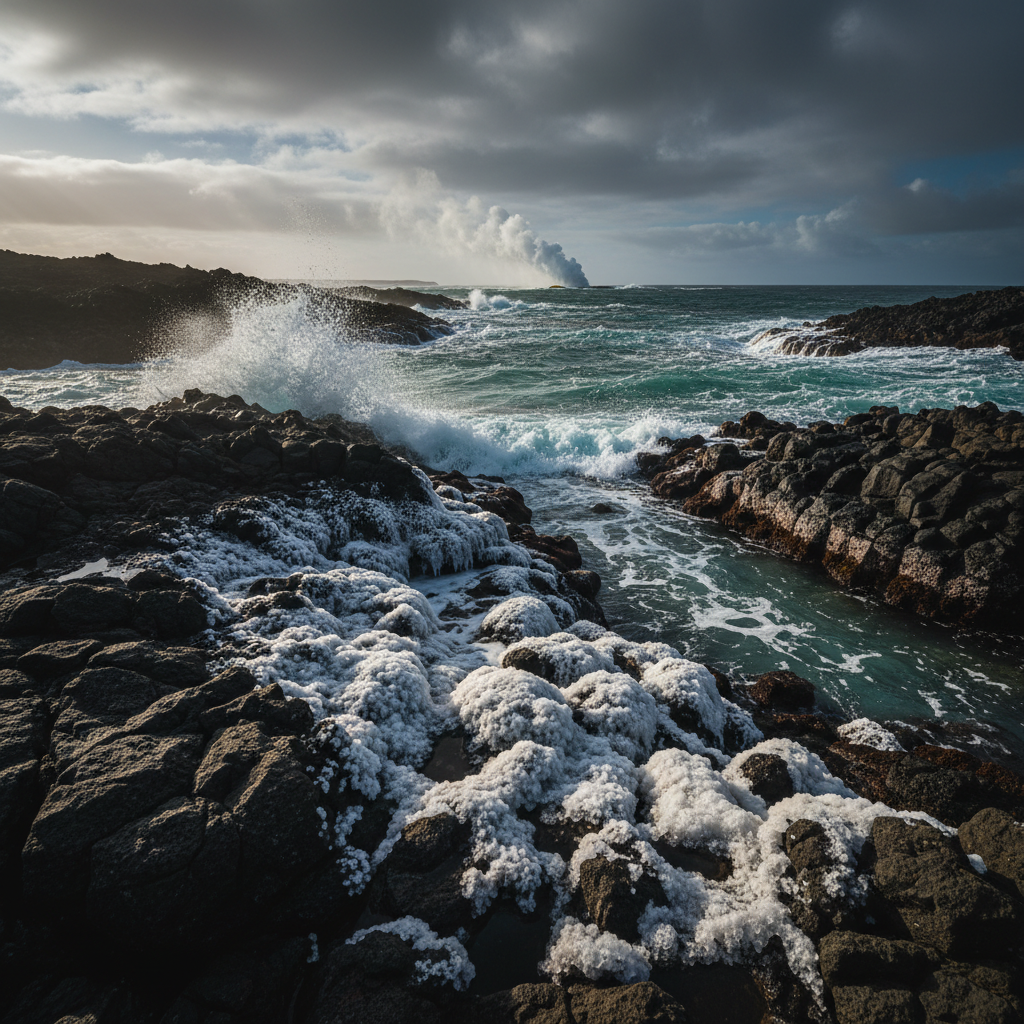
Why Is the Ocean Salty? The Surprising Science of Sea Salt
Discover the fascinating natural journey of minerals from land to sea, and how deep-sea vents keep our oceans salty while rivers remain fresh.

Discover the fascinating natural journey of minerals from land to sea, and how deep-sea vents keep our oceans salty while rivers remain fresh.
Trending Now
📝 Published on Voxora | Reading Time: ~12 minutes | Category: Science & Nature
🔑 Key Takeaways
- The ocean is salty primarily because of rock erosion, river runoff, and hydrothermal vents on the seafloor.
- The average ocean salinity is 35 parts per thousand (ppt) — that's about 3.5% salt by weight.
- Rivers carry an estimated 4 billion tons of dissolved salts to the sea every year.
- Salt accumulates in the ocean because water evaporates but salt stays behind.
- Salinity levels vary widely across the globe — from the icy Arctic to the super-salty Red Sea.
- Climate change is already shifting ocean salinity patterns, with real consequences for marine life and global weather.
Why Is the Ocean Salty? The Surprising Science of Sea Salt
Picture this: you're at the beach, waves crashing, sun blazing, and you take a big gulp of seawater by accident. Instant regret. That sharp, briny slap to the taste buds is unforgettable. But have you ever stopped mid-gag to wonder — why is the ocean salty in the first place? Like, where did all that salt even come from?
It's one of those questions that sounds simple but actually has a surprisingly deep (pun intended) answer. The short version? It's a combination of ancient geology, relentless chemistry, and a water cycle that's been running for billions of years. The long version? Well, that's what this article is for. Grab a snack — just maybe not seawater — and let's dive in.
The Primary Source: Weathering and Rock Erosion
Let's start at the very beginning — and we're talking really beginning. When rain falls from the sky, it's not pure H₂O. It picks up a tiny amount of carbon dioxide on the way down, forming weak carbonic acid. Not enough to burn you, but absolutely enough to slowly dissolve minerals out of rocks over time.
This process is called chemical weathering, and it's basically nature's version of slow-motion rock dissolving. As water flows over and through rocks, it pulls out ions — especially sodium (Na⁺) and chloride (Cl⁻), the two main ingredients in table salt. Other minerals like magnesium, calcium, potassium, and sulfate tag along for the ride too.
This has been happening for roughly 3.8 billion years — since liquid water first appeared on Earth's surface. So yeah, it's had a bit of time to add up.
According to NOAA Ocean Service, the two major contributors to ocean salinity are this kind of land-based weathering and underwater hydrothermal activity — and together, they've been slowly salting the ocean like a cosmic chef seasoning a very large soup.
How Rivers Carry Minerals to the Coast
Here's where your local river becomes an unlikely villain (or hero, depending on how you look at it). After rain and groundwater dissolve minerals from rocks, that mineral-rich water flows downhill — into streams, then rivers, and eventually out to sea.
Every river on Earth is doing this, constantly, 24/7. And the numbers are genuinely staggering:
💧 An estimated 4 billion tons of dissolved salts are carried to the sea by rivers every year. (Source: The Wildlife Trusts)
That's 4,000,000,000 tons — every single year. Year after year. For billions of years. So while any individual river might seem pretty harmless (and yes, rivers taste fresh — more on that later), the cumulative effect over geological time is absolutely massive.
The Amazon, the Mississippi, the Ganges — every major river system is essentially a slow-moving salt conveyor belt delivering dissolved minerals to the ocean. And once those minerals arrive? They don't really leave. That's the key.
Deep Sea Factories: The Role of Hydrothermal Vents
Now here's where things get really cool. It's not just rain and rivers adding salt to the ocean. The ocean floor itself is in on it.
Hydrothermal vents are essentially cracks in the ocean floor where seawater seeps down into the hot Earth's crust, gets superheated, and then shoots back up loaded with dissolved minerals. Think of them like underwater geysers — except instead of Yellowstone tourists watching, it's bizarre tube worms and blind shrimp.
These vents can blast water at temperatures up to 400°C (752°F) — though it doesn't boil because of the extreme pressure at those depths. As the water moves through the crust, it reacts with hot rocks and picks up all sorts of chemical compounds, including sulfur, iron, manganese, and various salts.
Here's an interesting twist though: hydrothermal vents don't only add salt. They actually remove some ions from seawater too, acting as a kind of chemical filter. So they're not just a one-way salt pump — they're more like an active chemical exchange system. NOAA Ocean Service describes this as one of the two main processes controlling ocean chemistry, alongside river input.
Submarine Volcanoes and the Earth's Crust
Closely related to hydrothermal vents are submarine volcanoes — and yes, there are a lot of them. Scientists estimate there are over 1 million submarine volcanoes on the ocean floor, though most are inactive at any given time.
When these underwater volcanoes erupt, they release gases and minerals directly into the ocean. This includes things like hydrogen sulfide, carbon dioxide, and a range of metallic compounds that dissolve into the surrounding seawater. Over geological time, this ongoing volcanic activity has been a steady (if slow) contributor to the chemical composition of the ocean.
The entire mid-ocean ridge system — a 65,000-kilometer-long underwater mountain chain that wraps around the entire planet — is essentially a giant zone of volcanic and hydrothermal activity. It's like the Earth's engine room, and it's been churning out minerals into the ocean for billions of years.
The Evaporation Trap: Why Salt Doesn't Leave
Okay, so rocks and rivers and volcanoes add salt to the ocean. But here's the real question: why does it stay there?
The answer is elegantly simple: water evaporates, but salt doesn't.
When the sun heats the ocean surface, water molecules get enough energy to escape into the atmosphere as vapor. This is the start of the water cycle — that vapor eventually forms clouds, falls as rain, and the whole process starts again. But here's the catch: when water evaporates, it leaves the salt behind. Salt doesn't evaporate. It's not volatile. It just... stays.
So imagine this cycle running for billions of years:
- Rain falls, dissolves minerals from rocks
- Rivers carry those minerals to the ocean
- Ocean water evaporates and returns to the atmosphere as fresh water
- Salt stays behind and accumulates
It's essentially a one-way filter. Fresh water in, fresh water out — but the salt never leaves. Over billions of years, that accumulation adds up to something truly mind-blowing:
🧂 If the salt in the ocean could be removed and spread evenly over Earth's land surface, it would form a layer more than 500 feet (166 meters) thick. (Source: USGS)
Five. Hundred. Feet. Let that sink in for a second.
Understanding Salinity: Parts Per Thousand (ppt)
Scientists measure ocean saltiness using a unit called parts per thousand (ppt), sometimes written as ‰. It basically tells you how many grams of dissolved salts are present in every 1,000 grams of seawater.
🌊 The average salinity of the world's oceans is approximately 35 ppt (3.5% by weight). (Source: NOAA)
That might not sound like much, but it's enough to make seawater completely undrinkable — and actually dangerous to drink in large quantities because your kidneys need to use more water to flush out the salt than the seawater actually provides.
The main components dissolved in seawater aren't just sodium and chloride, though those two make up the bulk of it. Here's a breakdown of what's actually in that salty water:
| Ion | Percentage of Total Salinity |
|---|---|
| Chloride (Cl⁻) | ~55% |
| Sodium (Na⁺) | ~30.6% |
| Sulfate (SO₄²⁻) | ~7.7% |
| Magnesium (Mg²⁺) | ~3.7% |
| Calcium (Ca²⁺) | ~1.2% |
| Potassium (K⁺) | ~1.1% |
| Other compounds | ~0.7% |
(Source: NOAA Ocean Service)
And just to really drive home how much salt we're talking about:
🧊 One cubic mile of seawater contains about 120 million tons of salt (sodium chloride). (Source: USGS)
Why Rivers Stay Fresh While Oceans Turn Salty
This is a great question that a lot of people wonder about. If rivers are constantly picking up minerals from rocks, why don't they taste salty too?
The answer is all about concentration and flow rate. Rivers are constantly moving — they're picking up a little bit of minerals here, depositing some there, and flushing most of it downstream relatively quickly. The amount of dissolved salts in river water is so low (usually 0.01–0.02 ppt, compared to the ocean's 35 ppt) that it's basically undetectable to our taste buds.
The ocean, on the other hand, is a massive, relatively enclosed system. Water comes in from rivers and rain, but the only way water leaves in significant quantities is through evaporation — which, as we covered, doesn't take the salt with it. So while rivers are like a pipeline delivering a dilute mineral solution, the ocean is the giant tank at the end of that pipeline that just keeps concentrating over time.
Think of it like making tea — if you keep adding tea bags to the same cup without ever changing the water, it's going to get stronger and stronger. The ocean is that cup. It's been steeping for about 3.8 billion years.
Global Variations: From the Dead Sea to the Arctic
Not all parts of the ocean are equally salty. Salinity varies quite a bit depending on geography, climate, and local conditions.
Here's a comparison of salinity levels across different bodies of water:
| Body of Water | Average Salinity (ppt) | Key Reason |
|---|---|---|
| Arctic Ocean | ~28–32 ppt | Ice melt dilutes salinity |
| Atlantic Ocean | ~35–37 ppt | High evaporation, few rivers |
| Pacific Ocean | ~34–35 ppt | Larger area, more rainfall |
| Red Sea | ~38–40 ppt | High evaporation, no rivers |
| Persian Gulf | ~38–40 ppt | Shallow, hot, low freshwater |
| Dead Sea | ~300+ ppt | Extreme evaporation, landlocked |
| Baltic Sea | ~7–8 ppt | Large freshwater river input |
(Source: Britannica)
🌡️ Concentrations of salt can reach as high as 40 ppt in the Red Sea and Persian Gulf due to high evaporation rates and minimal freshwater inflow. (Source: Britannica)
The Dead Sea is in a league of its own — technically a lake, not a sea — with salinity so extreme that almost nothing can survive in it, and you literally cannot sink in it. The Baltic Sea, on the other hand, is nearly fresh due to the enormous volume of freshwater rivers flowing into it and its relatively low evaporation rate.
The 'Steady State' Theory of Ocean Chemistry
Here's something that might surprise you: despite all that salt constantly flowing into the ocean, its salinity hasn't actually been increasing dramatically for a very long time. Scientists believe the ocean has been in a chemical steady state for hundreds of millions of years.
This theory, supported by geochemical evidence, suggests that the rate at which salts and minerals are added to the ocean is roughly balanced by the rate at which they're removed. How are they removed? Several ways:
- Sea spray carries some salt back to land
- Marine organisms use calcium, silica, and carbonate to build shells and skeletons, effectively locking those minerals into solid form
- Chemical reactions with seafloor rocks remove certain ions from seawater
- Evaporite deposits — places where ancient seas dried up and left behind massive salt formations (like rock salt mines)
According to NOAA, this input-output balance keeps the overall chemistry of the ocean relatively stable over geological time, even as individual regions can vary quite significantly.
It's kind of like a bathtub with the tap on and the drain open — if the flow in matches the flow out, the water level stays constant. The ocean's chemistry has been doing something similar for an extraordinarily long time.
How Climate Change Is Altering Salinity Patterns
Here's where things get a little more serious. The relatively stable salinity system we just described? It's being disrupted by climate change, and scientists are watching it closely.
As global temperatures rise, two major things happen that directly affect ocean salinity:
-
Ice melts — Polar ice caps and glaciers are melting at an accelerating rate, dumping huge volumes of freshwater into the ocean. This dilutes salinity in polar regions.
-
Evaporation increases — Warmer temperatures mean more evaporation in tropical and subtropical regions, concentrating salt in those areas even further.
The result? A global pattern where salty regions are getting saltier and fresh regions are getting fresher. According to NASA's salinity research, NASA's Aquarius satellite mission (launched in 2011) found clear evidence of these accelerating salinity changes tied to shifts in the global water cycle.
| Region | Trend | Cause |
|---|---|---|
| Tropical Atlantic | Increasing salinity | Higher evaporation |
| Arctic Ocean | Decreasing salinity | Ice melt + river runoff |
| North Pacific | Decreasing salinity | More rainfall |
| Mediterranean | Increasing salinity | Reduced freshwater inflow |
Why does this matter? Because ocean salinity drives circulation. The global ocean conveyor belt — known as thermohaline circulation — is powered by differences in temperature and salinity. Salty, cold water is denser and sinks, driving deep ocean currents. Disrupt that balance, and you disrupt ocean circulation patterns that regulate climate, weather, and marine ecosystems around the world. It's all connected.
Conclusion: The Ocean as a Global Chemical Balance
So — why is the ocean salty? Because for nearly 4 billion years, rain has been slowly dissolving minerals from rocks, rivers have been delivering those minerals to the sea, volcanoes and hydrothermal vents have been adding their own chemical contributions, and through it all, evaporation keeps pulling fresh water back out while leaving the salt behind. It's a beautifully relentless process that's been quietly happening long before humans, long before dinosaurs, long before complex life existed at all.
The ocean isn't just "salty" in a simple way — it's a finely balanced chemical system, shaped by geology, climate, biology, and physics all working together over unimaginable stretches of time. And now, as climate change accelerates, we're getting a real-time lesson in just how sensitive that balance actually is.
Next time you're at the beach and accidentally swallow a mouthful of seawater, you'll know exactly why it tastes the way it does — and maybe, just maybe, you'll appreciate the billions of years of planetary chemistry that went into making it that bad.
Why is the ocean salty? Because the Earth has been seasoning it since the very beginning. And it's not done yet.
Sources
- NOAA Ocean Service – Why Is the Ocean Salty?
- USGS Water Science School – Why Is the Ocean Salty?
- NASA Aquarius Salinity Overview
- Britannica – Seawater Salinity Distribution
- The Wildlife Trusts – Why Is the Sea Salty?
Published on Voxora — A Premium Publishing Platform for Writers Worldwide
Advertisement
Frequently Asked Questions
Where does the salt in the ocean come from?
Most of the salt comes from rocks on land. Rainwater is slightly acidic and erodes rocks, carrying dissolved ions like sodium and chloride into rivers, which eventually flow into the ocean. Underwater volcanoes and hydrothermal vents also contribute minerals.
How much salt is actually in the ocean?
On average, seawater has a salinity of about 3.5%, or 35 parts per thousand. This means that for every liter of seawater, there are approximately 35 grams of dissolved salts, mostly sodium chloride.
Is the ocean getting saltier over time?
The ocean's salinity has remained remarkably stable for hundreds of millions of years. While rivers continuously deposit minerals, processes like the formation of new minerals on the seafloor and biological activity remove salt at roughly the same rate.
Which ocean has the highest salt concentration?
The Atlantic Ocean is generally considered the saltiest of the five major oceans, with an average salinity of about 37 parts per thousand. The high evaporation rates in the Atlantic contribute to its increased salt concentration compared to the Pacific or Indian oceans.
Why can't humans drink seawater?
Seawater is about three times saltier than human blood. To flush out the excess salt, the kidneys require more water than was actually consumed, which leads to rapid dehydration and can be fatal.
Sponsored
Curious about technology, mathematics, education, and growth, I write as a learner exploring ideas in innovation, problem-solving, culture, and the questions shaping our world.
You Might Also Like


Advertisement
Comments (0)
Sign in to join the conversation
No comments yet. Be the first to share your thoughts!