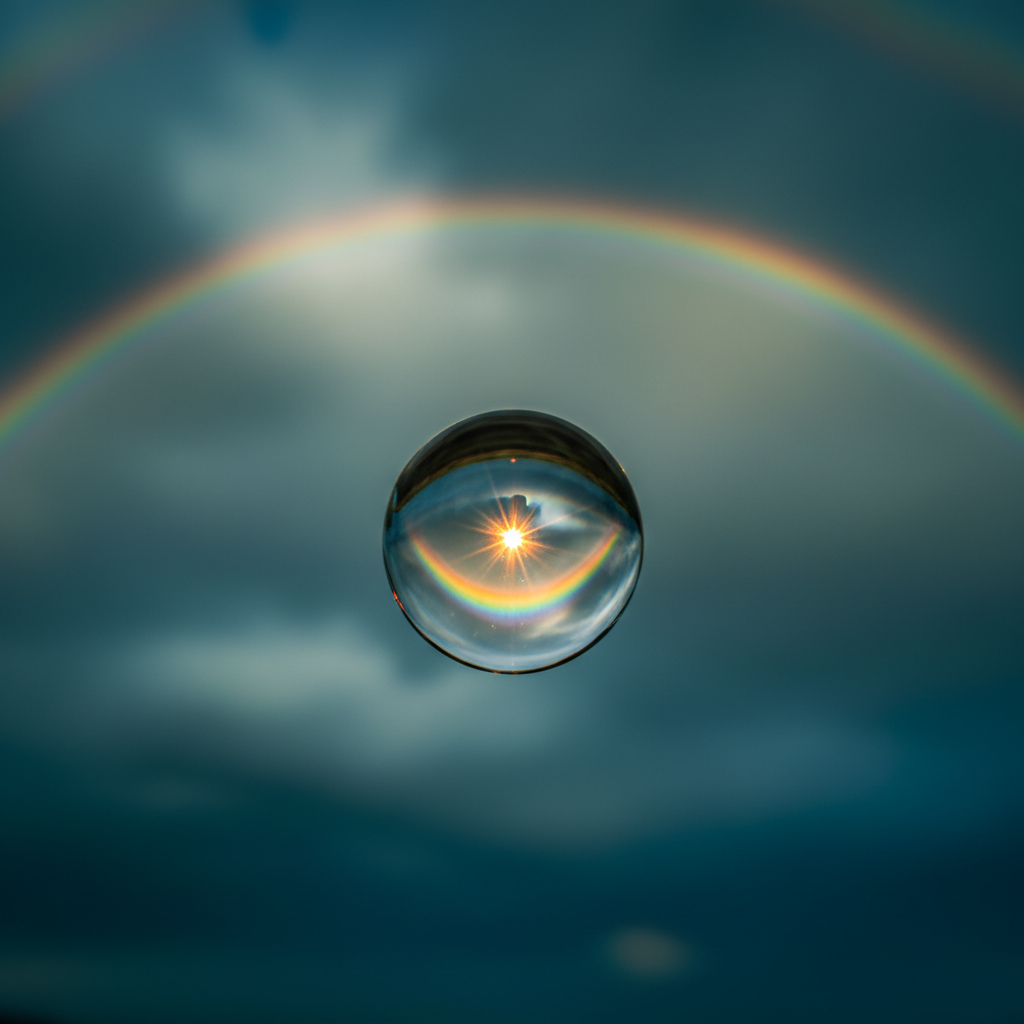
How Do Rainbows Form? The Science of Light and Water Explained
Discover the physics of rainbows! Learn how sunlight, water droplets, and precise geometry create the colorful arcs we see in the sky after a storm.

Discover the physics of rainbows! Learn how sunlight, water droplets, and precise geometry create the colorful arcs we see in the sky after a storm.
Trending Now
📘 Key Takeaways
- Rainbows form through a precise three-stage optical process: refraction, dispersion, and internal reflection of sunlight inside spherical water droplets.
- The primary rainbow appears at a fixed viewing angle of 42° from the anti-solar point, while secondary rainbows form at 51°.
- The refractive index of water varies between 1.33 (red) and 1.34 (violet), which is what causes white light to separate into distinct colors.
- Alexander's Dark Band — the darker region between primary and secondary rainbows — is a direct consequence of light geometry, not an optical illusion.
- Climate projections suggest global rainbow-viewing opportunities may increase by approximately 5% by 2100 due to shifting precipitation patterns linked to climate change.
Introduction: The Enduring Mystery of the Rainbow
Few natural phenomena have inspired more wonder across cultures, centuries, and scientific disciplines than the rainbow. From Norse mythology, where Bifröst served as a luminous bridge between worlds, to Aristotle's early geometrical observations in Meteorologica (circa 340 BCE), humanity has long attempted to explain the multicolored arc that appears in the sky after rain. Yet despite its ubiquity, the full optical mechanics of the rainbow remained poorly understood for nearly two millennia.
Today, the question of how do rainbows form is answered through the rigorous language of wave optics, geometry, and atmospheric physics — a convergence of disciplines that transforms what appears to be a simple spectacle into an elegant demonstration of natural law. This article offers a thorough, research-backed examination of rainbow formation, drawing on verified data from institutions including NOAA, NASA Science, the Met Office UK, and the University of Hawaiʻi at Mānoa.
Whether you are a school student encountering this topic for the first time or a college student seeking deeper conceptual clarity, the sections that follow will build a complete, academically grounded picture of one of nature's most beautiful optical phenomena.
The Essential Ingredients: Sun, Rain, and the Observer's Eye
Before examining the physics, it is important to recognize that rainbow formation requires a very specific convergence of three environmental and positional conditions:
- A source of white light — most commonly the sun, positioned relatively low on the horizon (ideally below 42° altitude).
- Airborne spherical water droplets — typically present as rainfall or residual mist in the atmosphere.
- A correctly positioned observer — standing with the sun directly behind them and looking toward the rain-bearing sky.
This three-way relationship is crucial. Rainbows are not physical objects existing at a fixed location in space; rather, they are observer-dependent optical phenomena. Two individuals standing side by side will technically see slightly different rainbows, each centered around their own anti-solar point — the point in the sky directly opposite the sun from the observer's perspective. This observer-specific nature makes the rainbow a deeply personal optical experience, even when witnessed collectively.
According to NOAA, the sun must be at a sufficiently low angle — generally no more than 42° above the horizon — for a rainbow to be visible to a ground-based observer. When the sun is too high, the geometric angle required for rainbow formation falls below the horizon and out of the observer's field of view.
Step-by-Step: The Three Pillars of Rainbow Physics
The formation of a rainbow can be decomposed into three sequential optical processes, each governed by well-established principles of physics:
| Stage | Process | Physical Principle |
|---|---|---|
| 1 | Light enters the water droplet and bends | Refraction (Snell's Law) |
| 2 | White light separates into spectral colors | Dispersion (wavelength-dependent refractive index) |
| 3 | Light reflects off the inner surface and exits | Internal Reflection |
Understanding each stage individually is essential to constructing a complete picture of how do rainbows form as a unified phenomenon.
Refraction: Why Light Bends When It Hits Water
When a ray of sunlight traveling through air encounters the curved surface of a spherical water droplet, it undergoes refraction — the bending of light as it transitions from one medium (air) to another (water) with a different optical density.
This bending behavior is governed by Snell's Law, one of the foundational equations of optics:
n₁ sin(θ₁) = n₂ sin(θ₂)
Where n represents the refractive index of each medium and θ represents the angle of incidence or refraction relative to the surface normal.
For a light ray moving from air (refractive index ≈ 1.00) into water, the ray slows down and bends toward the normal — the imaginary line perpendicular to the droplet's surface at the point of entry. This change in speed is directly responsible for the directional change of the light ray.
The angle at which the light bends is determined by the refractive index of water, which is not a single fixed value but varies depending on the wavelength of the incoming light. According to Canon Science Lab, the refractive index of water for visible light ranges from approximately 1.33 for red light to 1.34 for violet light — a small but critically important difference that underpins the entire spectral separation process.
Dispersion: How White Light Splits into Seven Colors
Sunlight, as characterized by NASA Science, is composed of the full visible light spectrum — electromagnetic radiation spanning wavelengths of approximately 380 nm (violet) to 700 nm (red). Although perceived as white or yellow light to the naked eye, it is in fact a continuous blend of all visible colors.
The refractive index of water for visible light ranges from approximately 1.33 for red light to 1.34 for violet light. (Canon Science Lab)
When this polychromatic light enters a water droplet, each wavelength — and thus each color — refracts at a slightly different angle due to its unique refractive index value. Violet light, with its shorter wavelength and higher refractive index, bends more sharply than red light, which has a longer wavelength and lower refractive index. This differential bending is known as dispersion, and it is the mechanism responsible for separating white light into the ordered spectral band that characterizes a rainbow.
The resulting color sequence, from outermost to innermost arc in a primary rainbow, runs as follows:
| Color | Approximate Wavelength (nm) | Refractive Index in Water |
|---|---|---|
| Red | ~700 | ~1.331 |
| Orange | ~620 | ~1.332 |
| Yellow | ~580 | ~1.333 |
| Green | ~530 | ~1.334 |
| Blue | ~470 | ~1.336 |
| Indigo | ~425 | ~1.337 |
| Violet | ~380 | ~1.340 |
This table illustrates the systematic relationship between wavelength and refraction angle — a relationship that directly determines the spatial ordering of colors in the visible rainbow arc. The Met Office UK confirms that this spectral ordering is consistent and predictable across all standard rainbow observations.
Internal Reflection: The Bounce That Sends Light Back
Following refraction at the droplet's entry surface and subsequent dispersion into constituent wavelengths, each separated color ray travels through the interior of the water droplet until it reaches the far interior wall. At this boundary — the interface between water and air — the light undergoes internal reflection.
Unlike refraction, which occurs at the entry and exit points, internal reflection involves the light bouncing off the interior surface of the droplet like a mirror, redirecting it back toward the observer's side. Crucially, this reflection is not total (100%); some light exits the droplet at this point, contributing to the general brightness of the sky. However, the portion that reflects continues back through the droplet interior, where it refracts a second time upon exiting.
It is this combination — entry refraction + internal reflection + exit refraction — that produces the concentrated, directionally specific beam of colored light that the observer perceives as part of the rainbow arc. The precision of this three-stage process, occurring simultaneously across millions of water droplets at different positions in the sky, generates the continuous, curved band of color that constitutes the full rainbow.
The Geometry of the Arc: Why the 42-Degree Angle Matters
One of the most mathematically elegant aspects of rainbow physics is the consistency of the viewing angle. Regardless of geographical location, time of day, or the specific raindrops involved, a primary rainbow is always observed at a precise angular elevation above the anti-solar point.
Primary rainbows are observed at an angle of 42°, while secondary rainbows appear at 51° due to a second internal reflection. (NOAA)
This 42-degree angle is not arbitrary. It represents the angle at which the maximum concentration of light exits water droplets after undergoing the full refraction-reflection-refraction sequence. René Descartes, in his 1637 treatise Les Météores, was among the first to calculate this geometrically, demonstrating through ray-tracing mathematics that regardless of where a ray enters a spherical droplet, the angle of deviation clusters around a minimum value — now known as the Descartes ray or rainbow ray — which corresponds to the 42° observation angle for red light.
Because different colors exit at slightly different angles (red at ~42°, violet at ~40°), the rainbow appears as a band of color rather than a single line. Red, deviating the least, appears on the outer edge of the arc, while violet, deviating the most, appears on the inner edge.
The arc shape itself — the semicircular geometry — arises from the fact that all raindrops positioned at exactly 42° from the observer's line of sight to the anti-solar point form a circle. The ground obscures the lower portion of this circle, leaving only the familiar arched shape visible to the ground-based observer.
Full Circles vs. Semi-Circles: Seeing Rainbows from the Air
Ground-based observers typically see only a semicircular arc because the Earth's surface blocks the lower half of the theoretical full circle. However, under conditions where the observer is elevated — for example, aboard an aircraft or atop a tall mountain with rain or mist below — it becomes possible to see a full circular rainbow, provided that water droplets are present in all directions around the 42° angle from the anti-solar point.
Aerial photography and aircraft passengers frequently document these complete circular rainbows, offering compelling visual evidence that the rainbow's semicircular appearance at ground level is purely a consequence of the observer's positional constraints rather than any limitation in the optical physics involved. This underscores the earlier point: the rainbow exists as a complete cone of light, with the observer located at the cone's apex.
Double Rainbows and the Mystery of Alexander's Dark Band
Under favorable atmospheric conditions, a secondary rainbow appears outside the primary arc, separated by a distinctive dark region known as Alexander's Dark Band — named after the Greek philosopher Alexander of Aphrodisias, who first described the phenomenon around 200 CE.
The secondary rainbow forms via the same fundamental process as the primary but with one critical difference: light undergoes two internal reflections within the water droplet instead of one before exiting. This additional bounce has several observable consequences:
- The secondary rainbow appears at a greater angular elevation of 51° from the anti-solar point.
- The color order is reversed — red appears on the inner edge and violet on the outer edge — because the second internal reflection inverts the spectral sequence.
- The secondary rainbow is significantly dimmer than the primary.
The secondary rainbow is approximately 1/10th as intense as the primary rainbow under the same conditions. (HyperPhysics, Georgia State University)
Alexander's Dark Band — the noticeably darker sky between the two arcs — is not an illusion but a genuine optical effect. Light contributing to the primary rainbow exits droplets at angles less than 42°, directing it inward toward the observer. Light contributing to the secondary rainbow exits at angles greater than 51°. The region between these two angles — from 42° to 51° — receives relatively little reflected light, making the sky within this band appear perceptibly darker than the sky outside the secondary or inside the primary rainbow.
| Feature | Primary Rainbow | Secondary Rainbow |
|---|---|---|
| Angular Position | ~42° from anti-solar point | ~51° from anti-solar point |
| Number of Internal Reflections | 1 | 2 |
| Color Order (outer to inner) | Red → Violet | Violet → Red |
| Relative Intensity | 100% (reference) | ~10% of primary |
| Separated by | — | Alexander's Dark Band |
Beyond Sunlight: Understanding Moonbows and Fogbows
While this article has focused primarily on solar rainbows, it is scientifically instructive to briefly acknowledge related atmospheric phenomena that arise from the same fundamental optical principles.
Moonbows (also called lunar rainbows) form when moonlight — which is reflected sunlight — passes through water droplets under conditions similar to those producing solar rainbows. Because moonlight is far less intense than direct sunlight, moonbows are rarely bright enough to trigger the cone cells in the human eye responsible for color perception; they therefore appear white or pale gray to most observers, despite being spectrally identical in structure to solar rainbows. Long-exposure photography confirms their true color content.
Fogbows form when sunlight interacts with the much smaller water droplets that constitute fog (typically 10–100 micrometers in diameter, compared to 1–2 millimeters for raindrops). Because these droplets are so small, the wave nature of light becomes dominant, and diffraction — the bending of light around the edges of small particles — competes with refraction. The result is a broad, pale, almost colorless arc, sometimes with faint reddish or bluish fringes at its edges.
Both phenomena demonstrate that the physics governing rainbow formation is broadly applicable across a range of atmospheric water-droplet conditions, with the specific characteristics of each phenomenon determined largely by droplet size and light source intensity.
Climate Change Impact: Why We Might See More Rainbows by 2100
The relationship between rainbow frequency and global climate presents a compelling intersection of atmospheric optics and climate science. Research from the University of Hawaiʻi at Mānoa projects a measurable shift in global rainbow-viewing patterns over the coming century.
Global rainbow-viewing opportunities are projected to increase by approximately 5% by the year 2100 due to climate change. (University of Hawaiʻi at Mānoa)
This projection is driven by two intersecting climate trends:
- Increased global precipitation — as rising temperatures intensify the hydrological cycle, more regions are expected to experience higher rainfall frequency, increasing the availability of the water droplets essential for rainbow formation.
- Reduced cloud cover at certain times and latitudes — paradoxically, some models suggest periods of clearer skies following rainfall events in specific regions, improving the conditions under which sunlight can strike post-rainfall droplets from behind the observer.
The study notes that these increases will not be uniformly distributed. High-latitude regions and tropical land areas are expected to see the greatest gains, while some subtropical regions may experience decreases due to projected reductions in precipitation. This geographical variability underscores the importance of integrating atmospheric optics with climatological modeling for a complete understanding of how environmental change reshapes even the most seemingly timeless natural phenomena.
Conclusion: Appreciating the Physics in the Sky
The rainbow stands as one of nature's most instructive optical phenomena — a vivid, real-time demonstration of Snell's Law, dispersion, internal reflection, and the geometry of light in the atmosphere. Understanding how do rainbows form is not merely an academic exercise; it is an invitation to perceive the physical world with greater precision and appreciation.
From the differential refractive indices of water across the visible spectrum to the fixed 42-degree geometry of the primary arc, every element of rainbow formation is governed by discoverable, quantifiable principles. The presence of Alexander's Dark Band, the inverted colors of the secondary arc, the full circles visible from aircraft, and the pale arcs of moonbows and fogbows all extend this same framework into richer observational territory.
As climate projections suggest that rainbow-viewing opportunities may grow by the end of this century, the intersection of this optical phenomenon with global environmental change further elevates its scientific relevance. The rainbow is not merely a symbol of wonder — it is a window into the elegant, lawful structure of the physical universe, one that rewards rigorous inquiry as much as it inspires aesthetic admiration.
Sources
- National Oceanic and Atmospheric Administration (NOAA) – What Causes a Rainbow?
- Met Office UK – Rainbows: Optical Effects
- NASA Science – Visible Light
- University of Hawaiʻi at Mānoa – Climate Change and Rainbows
- Canon Science Lab – Refractive Index of Water
- HyperPhysics, Georgia State University – Primary and Secondary Rainbows
Advertisement
Frequently Asked Questions
How does sunlight transform into a visible rainbow?
Rainbows form via refraction, reflection, and dispersion. When sunlight enters a water droplet, it slows and bends (refracted), reflects off the back surface, and bends again as it exits. This process separates white light into its component wavelengths, ranging from 380 nanometers (violet) to 750 nanometers (red).
At what specific angle must a rainbow be observed?
A primary rainbow is always observed at an angle of 40 to 42 degrees from the anti-solar point (the point directly opposite the sun). Red light is refracted at a 42-degree angle, while violet light is refracted at a 40-degree angle, which determines the arc's size and color distribution.
Why are the colors of a double rainbow reversed?
A double rainbow occurs when light undergoes two internal reflections inside a water droplet instead of one. This second reflection, which exits at an angle of approximately 50 to 53 degrees, causes the color sequence to flip, placing red on the inside and violet on the outside of the secondary arc.
Why is red always located on the outer edge of the primary arc?
Red light has the longest wavelength in the visible spectrum, roughly 700 nanometers, meaning it is refracted (bent) the least by water. Because it exits the droplet at the steepest angle of 42 degrees relative to the observer, it appears highest in the sky on the outer edge of the arc.
Is it possible to see a full 360-degree circular rainbow?
Yes, rainbows are mathematically full circles, but the ground usually obscures the bottom half. Observers at high altitudes, such as pilots flying at 30,000 feet or people near tall waterfalls, can often see a complete 360-degree circle because there is enough water vapor below their line of sight.
Sponsored
Curious about technology, mathematics, education, and growth, I write as a learner exploring ideas in innovation, problem-solving, culture, and the questions shaping our world.
You Might Also Like


Advertisement
Comments (0)
Sign in to join the conversation
No comments yet. Be the first to share your thoughts!