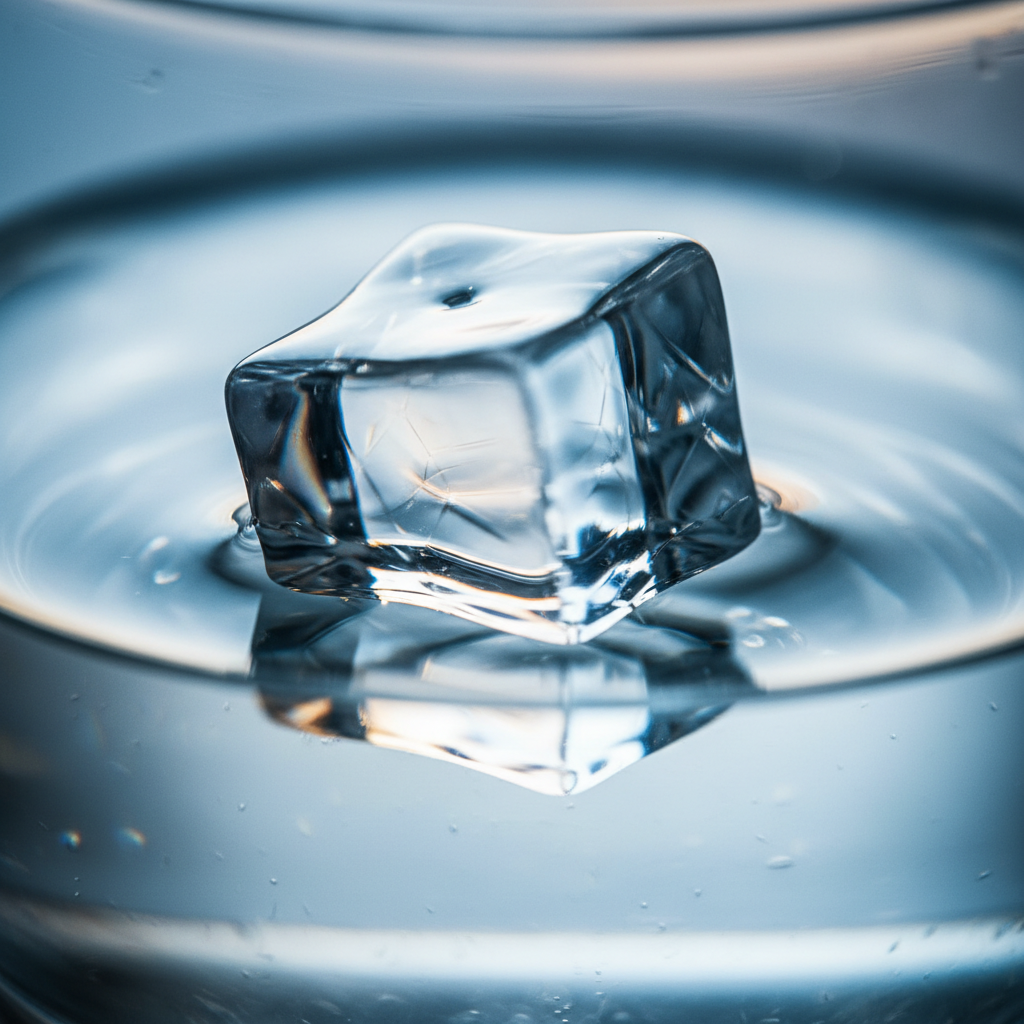
Why Does Ice Float on Water? The Science of Density Explained
Why does ice float? Explore the molecular secret of hydrogen bonds and the unique density of H2O that allows ice to stay afloat and sustain life.

Why does ice float? Explore the molecular secret of hydrogen bonds and the unique density of H2O that allows ice to stay afloat and sustain life.
Trending Now
Why Does Ice Float on Water? The Science of Density Explained
Key Takeaways
- Ice floats because it is approximately 9% less dense than liquid water
- The hexagonal crystal lattice structure of ice creates more space between molecules, making it lighter
- Water reaches its maximum density at 3.98°C (39.16°F) — not at freezing point
- Only about 11% of a floating iceberg is visible above the water's surface
- Floating ice acts as a natural insulator, protecting aquatic life from freezing temperatures
- This behavior is considered one of water's most important anomalous properties
Have you ever dropped an ice cube into your glass of water and watched it bob right up to the surface? You probably didn't think twice about it. But here's the thing — what you just witnessed is actually one of the most scientifically fascinating and ecologically important phenomena on the planet.
Why does ice float? It sounds like a simple question, right? But the answer dives deep into molecular chemistry, physics, and the very reason life on Earth exists as we know it. Most solids sink in their liquid form. Iron sinks in molten iron. Wax sinks in liquid wax. Yet ice — the solid form of water — cheerfully floats right to the top.
So what's going on here? Grab your favorite drink (with ice, obviously), and let's break this down together.
Defining Density: Why Objects Sink or Float
Before we get to the ice-specific science, let's quickly nail down the concept of density, because everything else builds on it.
Density is simply how much mass is packed into a given volume. The formula looks like this:
Density = Mass ÷ Volume
Think of it like this: imagine two boxes of the exact same size. One is filled with feathers, the other with rocks. The rock box is far heavier — it's denser. Now drop both boxes in water. The feather box floats. The rock box sinks.
The same logic applies to any object in water. If an object is less dense than water, it floats. If it's denser than water, it sinks. This is the foundation of buoyancy — and it's exactly why understanding ice's density is so critical.
The Molecular Level: How Hydrogen Bonds Work
Alright, let's zoom way in — we're talking molecular level now. Don't worry, we'll keep it painless.
Water is made of H₂O — two hydrogen atoms bonded to one oxygen atom. Because oxygen is much more electronegative (electron-hungry) than hydrogen, it pulls the shared electrons closer to itself. This gives the oxygen end of the molecule a slight negative charge and the hydrogen ends a slight positive charge.
This uneven charge distribution makes water a polar molecule. And polar molecules do something really interesting: they attract each other. The slightly positive hydrogen on one water molecule is drawn toward the slightly negative oxygen on a neighboring molecule. This attraction is called a hydrogen bond.
In liquid water, these hydrogen bonds are constantly forming, breaking, and reforming. The molecules are in a kind of organized chaos — close together, but still moving freely. This is what gives liquid water its relatively high density.
But watch what happens when the temperature drops below 0°C (32°F)...
The Hexagonal Lattice: Understanding Ice's Crystal Structure
Here's where things get genuinely cool (pun absolutely intended).
As water freezes, the molecules slow down and lose kinetic energy. The hydrogen bonds that were constantly shifting and breaking in liquid water now become permanent. Each water molecule forms four hydrogen bonds — two through its hydrogen atoms and two through its oxygen atom — and locks into a rigid, repeating pattern.
That pattern? A hexagonal crystal lattice.
Picture a honeycomb — that six-sided repeating structure. Ice forms in a very similar way. Each water molecule is held in place at the corners of these hexagonal rings, and here's the key detail: this arrangement actually spaces the molecules farther apart than they are in liquid water.
That's the counterintuitive magic right there. When water freezes, instead of packing tighter like most substances do, the molecules spread out into this open, spacious lattice structure. More space between molecules means less mass per unit of volume — which means lower density.
And lower density means... floating.
According to Khan Academy, this unique molecular behavior — where the solid form is less dense than the liquid form — is directly tied to the geometry of hydrogen bonding in water and is extraordinarily rare in nature.
The Density Dip: Comparing Water and Ice by the Numbers
Let's get into the actual data, because the numbers here are really telling.
📊 The density of ice is approximately 0.9167 g/cm³, compared to 1.0 g/cm³ for liquid water — making ice roughly 9% less dense than water. — USGS Water Science School
That 9% difference is what makes all the difference. It's enough to keep icebergs floating, keep your ice cubes at the top of your glass, and — most critically — keep entire lakes and rivers from freezing solid in winter.
Here's a handy comparison table to put things in perspective:
Table 1: Density Comparison of Water vs. Ice vs. Common Substances
| Substance | Density (g/cm³) | Floats or Sinks in Water? |
|---|---|---|
| Ice (0°C) | 0.9167 | ✅ Floats |
| Liquid Water (4°C) | 1.000 | — (Reference point) |
| Liquid Water (25°C) | 0.9970 | — |
| Seawater (avg.) | 1.025 | Sinks below fresh water |
| Balsa Wood | ~0.12 | ✅ Floats |
| Aluminum | 2.70 | ❌ Sinks |
| Iron | 7.87 | ❌ Sinks |
Sources: USGS, The Physics Factbook
The specific gravity of ice — which compares its density to that of water — is approximately 0.917. Since anything with a specific gravity less than 1 floats in water, ice comfortably clears that bar.
The 4-Degree Rule: When Water is at Its Heaviest
Here's something that surprises a lot of people: water doesn't get denser and denser all the way down to freezing. It actually hits a peak density before it freezes.
🌡️ Water reaches its maximum density at exactly 3.98°C (39.16°F) — not at 0°C when it freezes. — USGS Water Science School
This is what scientists call the anomalous expansion of water. As water cools from, say, room temperature down to 3.98°C, it behaves normally — it gets denser as it cools. But below 3.98°C, something strange happens. The hydrogen bonds start organizing into the hexagonal pre-ice structure, and the water actually expands slightly, becoming less dense even before it fully freezes.
This has huge implications for lakes in winter. Check out this temperature-density relationship:
Table 2: Water Density at Various Temperatures
| Temperature | Density (g/cm³) |
|---|---|
| 100°C (boiling) | 0.9584 |
| 25°C (room temp) | 0.9970 |
| 10°C | 0.9997 |
| 3.98°C (peak density) | 1.0000 |
| 0°C (freezing point) | 0.9998 |
| Ice at 0°C | 0.9167 |
Source: USGS Water Science School
See that dip? Water is actually less dense at 0°C liquid than it is at 3.98°C. That's the anomalous expansion of water in action. It's a quirk of chemistry that has enormous consequences for the natural world.
Archimedes' Principle and the Buoyancy of Icebergs
Now let's bring in one of history's most famous bathtub moments. The ancient Greek mathematician Archimedes reportedly leaped out of his bath shouting "Eureka!" when he realized a fundamental truth about floating objects.
Archimedes' Principle states that:
"An object immersed in a fluid is buoyed up by a force equal to the weight of the fluid it displaces."
In plain English: a floating object displaces a volume of water that weighs the same as the object itself. So a floating iceberg displaces water equal to its own weight — even though the iceberg takes up more volume than that water.
How much of an iceberg actually shows above water? Not much.
🧊 Only approximately 11% of a floating ice block's volume is visible above the water's surface. — Fizzics Education
That's right — the famous "tip of the iceberg" saying is scientifically accurate. A whopping 89% of an iceberg's mass lurks below the surface. When you do the math using the density ratio (0.9167 ÷ 1.0000), you get exactly this — about 91.67% of ice sits below the waterline.
Table 3: How Much of an Iceberg Is Underwater?
| Property | Value |
|---|---|
| Density of ice | 0.9167 g/cm³ |
| Density of seawater | ~1.025 g/cm³ |
| % of iceberg submerged (fresh water) | ~91.7% |
| % of iceberg submerged (seawater) | ~89.5% |
| % of iceberg visible above surface | ~10.5–11% |
Sources: Britannica, Fizzics Education
This is why icebergs are so dangerous to ships — you're only seeing a tiny fraction of what's really there.
Why It Matters: How Floating Ice Protects Aquatic Ecosystems
Okay, so ice floats — cool fact. But why should you actually care beyond the science exam?
Here's the thing: aquatic insulation from floating ice is one of the primary reasons complex life exists in cold-climate water bodies. Let's think through what would happen if ice were denser than water and sank.
When winter hits, the water at the surface would freeze, then sink to the bottom. New surface water would be exposed, freeze, and sink again. Layer by layer, from the bottom up, the entire lake would eventually become a solid block of ice. Every fish, plant, and microorganism in it? Gone.
But because ice floats, it forms a surface layer that acts like an insulating blanket over the water below. That layer of ice actually slows down further freezing. The water beneath — sitting at or near 3.98°C and its densest — remains liquid and life-sustaining throughout even the harshest winters.
This is why fish, frogs, and countless aquatic species can survive winter. They're tucked beneath an icy roof that's quietly protecting them from the cold above. It's one of nature's most elegant engineering solutions — and it's all thanks to the weird molecular behavior of H₂O.
According to Britannica, this property is so critical that many scientists consider the fact that ice floats to be a prerequisite for the kind of aquatic biodiversity we see on Earth today.
The Exception: When Ice Actually Sinks (Heavy Water Ice)
We've established that normal ice floats. But here's a fun curveball for you — there's actually a type of water where the ice sinks.
It's called heavy water (D₂O), where the regular hydrogen atoms (H) are replaced by deuterium — a heavier isotope of hydrogen. Heavy water ice has a density of approximately 1.017 g/cm³, while liquid heavy water has a density of about 1.106 g/cm³.
Since heavy water ice (1.017) is denser than... wait, that still floats in liquid heavy water. But here's the kicker — heavy water ice sinks in regular liquid water because its density (1.017 g/cm³) exceeds that of regular water (1.0 g/cm³).
So if you're ever at a cocktail party and someone says "ice always floats," you now have an excellent nerdy rebuttal ready to go. You're welcome.
Global Impact: Floating Ice and Climate Regulation
Zoom out even further, and the implications of floating ice become genuinely planetary in scale.
Polar ice caps and sea ice — made possible because ice floats — play a massive role in Earth's climate system. Here's how:
1. The Albedo Effect Ice and snow are highly reflective. They bounce a significant portion of incoming solar radiation back into space, helping keep Earth's temperature regulated. This reflectivity is called albedo. If ice sank instead of floating, there would be far less surface ice to reflect sunlight, and Earth would absorb significantly more heat.
2. Ocean Circulation Floating sea ice influences thermohaline circulation — the global network of ocean currents that distributes heat around the planet. As sea ice forms, it expels salt into the surrounding water, making that water denser and causing it to sink. This drives deep-water circulation patterns that regulate climates across entire continents.
3. Freshwater Storage Glaciers and ice sheets — which exist because ice floats and accumulates at the surface — store approximately 69% of Earth's freshwater. Without floating ice as the building block, this planetary freshwater reservoir simply wouldn't exist in its current form.
As climate change accelerates the melting of polar ice, scientists are watching these interconnected systems closely. The behavior of ice — rooted in those tiny hydrogen bonds we talked about earlier — has consequences that echo all the way up to global weather patterns and sea level rise.
Summary: The Life-Sustaining Anomaly of H₂O
So let's bring it all home. Why does ice float?
It comes down to one beautifully strange molecular truth: when water freezes, its hydrogen bonds lock into a hexagonal crystal lattice that holds molecules farther apart than they are in liquid water. This open, spacious structure means ice is about 9% less dense than liquid water — specifically 0.9167 g/cm³ versus 1.0 g/cm³.
Because of Archimedes' Principle and basic buoyancy physics, anything less dense than water floats. So ice floats — always toward the surface, always forming that protective layer that keeps liquid water below.
The anomalous expansion of water means it reaches peak density at 3.98°C, not at its freezing point. And that seemingly minor detail has cascading effects — from keeping fish alive under frozen lakes, to influencing global ocean currents, to regulating Earth's temperature through the albedo effect.
Why does ice float? Because the molecular quirks of H₂O make it so — and life on Earth is profoundly grateful that they do.
Next time you drop an ice cube in your drink, take a second to appreciate the molecular miracle happening right in your glass. It's a small-scale version of the same phenomenon keeping our planet habitable.
Sources
Advertisement
Frequently Asked Questions
What is the scientific reason ice floats on liquid water?
Ice floats because it is approximately 9% less dense than liquid water. When water freezes at 0 degrees Celsius, hydrogen bonds cause the molecules to arrange themselves into a rigid hexagonal lattice that pushes them further apart than they are in the liquid state.
How do the densities of ice and liquid water compare numerically?
At 0 degrees Celsius, the density of ice is approximately 0.9167 grams per cubic centimeter, whereas the density of liquid water is about 0.9998 grams per cubic centimeter. This difference ensures that ice remains buoyant on the surface.
At what specific temperature does water reach its maximum density?
Water reaches its maximum density of approximately 1.0000 gram per cubic centimeter at 3.98 degrees Celsius (39.16 degrees Fahrenheit). Above and below this temperature, water becomes less dense, which is why the 4-degree water sinks to the bottom of lakes while ice stays on top.
What role does hydrogen bonding play in making ice float?
In liquid water, hydrogen bonds are constantly breaking and reforming as molecules move. As temperature drops to 0 degrees Celsius, the kinetic energy decreases enough for stable hydrogen bonds to form a crystal structure where each molecule is bonded to four others, creating open spaces that increase the overall volume.
How does the buoyancy of ice impact life in frozen lakes?
Because ice floats, it creates an insulating surface layer with a thermal conductivity of about 2.22 W/(m·K). This prevents the entire body of water from freezing solid from the bottom up, maintaining a liquid environment at roughly 4 degrees Celsius where aquatic organisms can survive the winter.
Sponsored
Curious about technology, mathematics, education, and growth, I write as a learner exploring ideas in innovation, problem-solving, culture, and the questions shaping our world.
You Might Also Like


Advertisement
Comments (0)
Sign in to join the conversation
No comments yet. Be the first to share your thoughts!