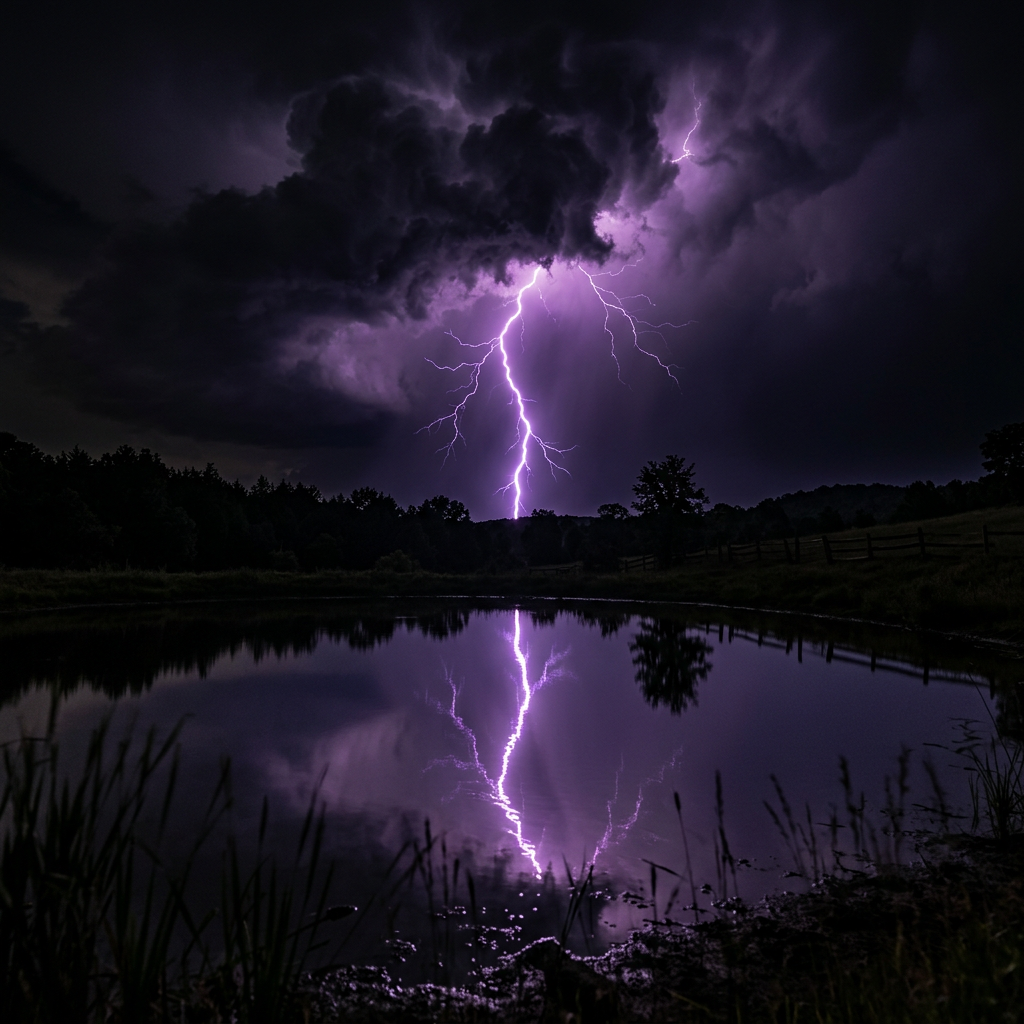
Why Do We See Lightning Before Hearing Thunder? The Science of Speed | lightning before thunder
Learn the fascinating physics behind why light outruns sound during a storm and how to calculate a lightning strike's distance using the 5-second rule.

Learn the fascinating physics behind why light outruns sound during a storm and how to calculate a lightning strike's distance using the 5-second rule.
Trending Now
Why Do We See Lightning Before Hearing Thunder? The Science of Speed
Key Takeaways
- Light travels nearly 1 million times faster than sound, which is why you always see lightning before hearing thunder.
- Lightning superheats the surrounding air to 54,000°F — five times hotter than the Sun's surface — creating the shockwave we hear as thunder.
- You can estimate how far away a storm is using the simple flash-to-bang method: count the seconds between lightning and thunder, then divide by 5.
- The longest recorded lightning bolt (megaflash) stretched an incredible 477 miles across the sky in 2020.
- If thunder follows lightning within 30 seconds, the National Weather Service says it's time to seek shelter immediately.
Have you ever sat on a porch during a summer storm, watching the sky light up in a brilliant flash — and then waited for that deep, rolling boom to follow? There's something almost theatrical about it. The lightning steals the scene first, and the thunder plays catch-up like a late actor rushing onto the stage.
But here's the thing: that gap between seeing lightning before thunder isn't just poetic drama. It's one of the most elegant demonstrations of physics that nature puts on display, completely free of charge, several thousand times a day around the globe.
So what's actually happening up there? Why does light beat sound every single time? And what does any of this have to do with something hotter than the surface of the Sun? Buckle up — we're about to break it all down in plain English.
The Great Race: Comparing the Speeds of Light and Sound
Let's start with the basics, because honestly, the numbers here are almost too wild to believe.
The speed of light in a vacuum is exactly 299,792,458 meters per second. — NASA
That's roughly 186,000 miles per second. To put that into perspective, light could circle the entire Earth about 7.5 times in just one second. It's not just fast — it's almost incomprehensibly fast.
Now let's look at sound.
Sound travels at approximately 343 meters per second (767 mph) in dry air at 20°C (68°F). — National Weather Service
767 miles per hour sounds pretty impressive on its own — that's faster than most commercial airplanes cruise. But compared to light? Sound is barely crawling.
Here's a quick comparison to make that gap crystal clear:
| Property | Light | Sound |
|---|---|---|
| Speed (meters/second) | 299,792,458 m/s | 343 m/s |
| Speed (miles per hour) | ~670,616,629 mph | ~767 mph |
| Time to travel 1 mile | ~0.000005 seconds | ~4.7 seconds |
| Earth circumference trips per second | ~7.5 trips | Cannot complete one |
The takeaway? Light is roughly 874,000 times faster than sound in air. When lightning strikes a mile away from you, the light reaches your eyes in about five microseconds — so fast that the delay is essentially imperceptible. The sound, however, takes about 4.7 full seconds to cover that same mile.
That lag is what creates the dramatic pause between the flash and the boom. It's not a mystery or a trick — it's just physics being physics.
What Is Lightning? Nature's Massive Electrostatic Discharge
Before we talk about why lightning makes thunder, it helps to understand what lightning actually is.
During a thunderstorm, ice crystals and water droplets inside massive cumulonimbus clouds collide constantly as they're tossed around by powerful updrafts and downdrafts. All that bumping and grinding causes a separation of electrical charges — positive charges tend to accumulate near the top of the cloud, while negative charges build up at the bottom.
Meanwhile, the negative charge at the base of the cloud induces a positive charge on the ground below it. When the electrical potential difference between the cloud and the ground (or between different regions of the same cloud) becomes large enough, the insulating properties of the air essentially break down. What you get is a massive, catastrophic discharge of atmospheric electricity.
That discharge? We call it lightning.
A single bolt of lightning is technically called a lightning stroke, and what looks like one continuous flash is often three to five individual return strokes happening in rapid succession — so fast they look like one to the naked eye. That "flickering" effect you sometimes notice? That's the individual strokes firing one after another.
Lightning doesn't just strike from cloud to ground, either. According to NOAA NESDIS, the majority of lightning — roughly 75 to 80 percent — occurs entirely within clouds or between clouds, never touching the ground at all.
The Birth of Thunder: How Lightning Before Thunder Happens on a Physical Level
Now here's where things get really fascinating.
When a lightning bolt fires, it doesn't just emit light. It superheats the narrow channel of air it travels through in an almost violent, instantaneous way. We're talking about a column of air that might be only 1 to 2 inches wide being exposed to extraordinary heat in a fraction of a second.
Lightning can heat the air in its path to 54,000°F (30,000°C) — five times hotter than the Sun's surface. — NOAA NESDIS
That extreme, sudden heating causes the air to expand explosively. And we mean explosively — the air pressure in the lightning channel can jump to 10 to 100 times normal atmospheric pressure in milliseconds. That rapid expansion creates a powerful shockwave that radiates outward from the channel in all directions.
That shockwave is thunder.
Close to the strike, you hear a sharp, loud crack — that's the initial shockwave hitting you with full force. But as the sound waves travel outward and bounce off terrain, clouds, and the ground, that sharp crack stretches and rumbles into the low, rolling thunder we're so familiar with. The longer the bolt (and some bolts stretch for miles), the longer and more complex the rumble you hear.
This is also why you experience seeing lightning before thunder — the light arrives almost instantaneously, while the sound has to physically travel through the air molecule by molecule, at a comparatively leisurely 767 mph.
Calculating Distance: Mastering the Flash-to-Bang Method
Here's a genuinely useful skill you can use the next time you're caught in a storm — the flash-to-bang method.
The concept is beautifully simple:
- See the lightning flash — start counting seconds immediately.
- Hear the thunder — stop counting.
- Divide the number of seconds by 5.
- That's your approximate distance in miles.
So if you count 10 seconds between the flash and the bang, the storm is roughly 2 miles away. Count 25 seconds? About 5 miles.
| Seconds Between Flash & Thunder | Approximate Distance |
|---|---|
| 5 seconds | ~1 mile (1.6 km) |
| 10 seconds | ~2 miles (3.2 km) |
| 15 seconds | ~3 miles (4.8 km) |
| 20 seconds | ~4 miles (6.4 km) |
| 30 seconds | ~6 miles (9.7 km) |
Why does dividing by 5 work? Because sound travels roughly 1 mile every 5 seconds at standard conditions. It's not perfectly precise (humidity, temperature, and wind can affect sound speed slightly), but it's accurate enough to be genuinely useful for safety purposes.
Pro tip: If you're doing this tracking and the gap is shrinking with each strike, the storm is heading toward you. If it's growing, it's moving away. Keep an eye on that trend.
Why Lightning Is Five Times Hotter Than the Surface of the Sun
This one deserves its own spotlight, because it's the kind of fact that stops people mid-sentence.
The surface of the Sun burns at approximately 10,000°F (5,500°C). That's already mind-boggling. And yet, a lightning bolt superheats its surrounding air channel to 54,000°F (30,000°C). According to both NOAA NESDIS and Encyclopedia Britannica, that makes lightning five times hotter than the Sun's surface.
Now, to be clear — lightning doesn't sustain that temperature. The whole event lasts for only a tiny fraction of a second. But in that brief moment, the energy release is enormous. A single lightning bolt can carry anywhere from 1 to 5 billion joules of energy, though most of it is dissipated as light, heat, and — of course — that thunderous shockwave.
It's also worth noting that while the air surrounding the bolt reaches those extreme temperatures, the bolt itself — the plasma channel — is even more complex. The extreme heat ionizes the air, turning it briefly into a fourth state of matter: plasma. That's what produces the brilliant white-blue light we see.
Pretty wild for something that lasts about 0.2 seconds, right?
The Mystery of Heat Lightning: Why Sometimes the Sound Never Comes
You've probably seen it on a clear summer night — flickers of light dancing along the horizon, but no thunder follows. People often call this "heat lightning," and it's one of the most commonly misunderstood weather phenomena around.
Here's the truth: there's no such thing as a special type of lightning that produces no thunder. Heat lightning is just regular lightning from a distant thunderstorm — typically one that's 50 to 100 miles away.
Remember how we said sound travels about 1 mile every 5 seconds? Well, at 100 miles out, thunder would take over 8 minutes to reach you — and by that point, the sound has lost so much energy and been scattered by the atmosphere that it's completely inaudible. The light, on the other hand, can still be seen bouncing off clouds at that distance.
So next time someone brings up "heat lightning," you can gently let them know it's actually just a regular, distant thunderstorm — and the name is a bit of a meteorological myth that stuck around longer than it should have.
Megaflashes: The New Science of Long-Distance Lightning
Speaking of lightning traveling long distances — let's talk about megaflashes, because the science here is absolutely jaw-dropping.
The world record for the longest single lightning bolt (megaflash) is 477 miles (768 km), recorded over the southern United States in 2020. — World Meteorological Organization
To appreciate just how absurd that is: 477 miles is roughly the straight-line distance from New York City to Detroit. A single lightning bolt. One discharge.
The World Meteorological Organization officially certified this record in 2022, confirming it as the longest horizontal lightning flash ever documented. These megaflashes are typically associated with large mesoscale convective systems (MCS) — massive organized clusters of thunderstorms that can span multiple states.
Megaflash science is relatively new, made possible only by the launch of advanced lightning-mapping satellites like NOAA's GOES-16 and GOES-17, which can detect and map lightning in real time across entire continents. Before these satellites, we simply didn't have the technology to track a single bolt across hundreds of miles.
The implications are significant for safety: a strike that seems to come "out of nowhere," far from the visible storm, might actually be one of these extreme long-range bolts. Which is exactly why meteorologists stress — never assume you're safe just because the skies above you look clear.
Modern Forecasting: Using Lightning Jumps to Predict Severe Weather
Here's something that might surprise you: scientists don't just respond to lightning data — they use it to predict when a storm is about to become dangerous.
The lightning jump algorithm is a forecasting tool that monitors rapid increases in lightning frequency within a thunderstorm. When a storm's total lightning rate suddenly spikes — doubling or tripling in a short period — it's often a reliable indicator that the storm is rapidly intensifying and may be about to produce large hail, damaging winds, or even a tornado.
Research shows that a lightning jump can precede severe weather by 10 to 20 minutes on average, giving forecasters a critical window to issue warnings and give people time to seek shelter. Organizations like NOAA have been integrating total lightning data from the Geostationary Lightning Mapper (GLM) aboard GOES satellites into their operational forecasting workflows.
It's a great example of how understanding basic physics — like why you see lightning before thunder — eventually leads to technology that saves lives.
When to Seek Shelter: The NWS 30-Second Rule for Lightning Safety
All of this science is genuinely fascinating, but let's bring it back to something immediately practical: staying safe in a thunderstorm.
The National Weather Service has a clear, simple rule:
If the time between lightning and thunder is 30 seconds or less, seek shelter immediately. Wait 30 minutes after the last clap of thunder before resuming outdoor activities.
Thirty seconds puts the storm at roughly 6 miles away — and that might sound like a comfortable distance, but lightning can and does strike well ahead of a storm's main body. The NWS's "When Thunder Roars, Go Indoors" campaign exists precisely because lightning safety is routinely underestimated.
Here's a sobering reminder of the stakes:
Thunderstorms caused approximately 30,000 deaths and $500 billion in economic losses globally between 2010 and 2019. — World Meteorological Organization
That's an average of 3,000 deaths per year — most of which are preventable with basic awareness and prompt action.
| Situation | Recommended Action |
|---|---|
| Thunder heard within 30 seconds of flash | Seek sturdy indoor shelter immediately |
| Outdoors with no shelter nearby | Avoid tall trees, open fields, and water |
| Inside a vehicle | Stay inside with windows up — cars offer good protection |
| After last thunder heard | Wait 30 full minutes before going back outside |
| Struck by lightning or near-strike | Call 911 immediately — lightning victims carry no charge |
If you're caught outside with nowhere to go, avoid tall isolated trees, open water, hilltops, and metal objects. Crouch low on the balls of your feet, minimize your contact with the ground, and keep distance from others.
Conclusion: Appreciating the Invisible Physics of Our Atmosphere
The next time you watch a storm roll in and see that first brilliant flash of lightning before thunder follows seconds later, you'll know exactly what's going on. You're witnessing a speed gap of nearly 874,000 to 1 — one of nature's most dramatic demonstrations of physics, playing out right in front of you.
From the electrostatic discharge that kicks the whole thing off, to the plasma channel heated to five times the Sun's surface temperature, to the explosive shockwave that becomes the rolling thunder — it's all connected in one remarkably elegant chain of cause and effect.
The science of lightning before thunder isn't just trivia. It's a window into the astonishing energy that moves through our atmosphere every single day — the same energy that modern forecasters are now using to save lives, and the same energy that carved a bolt 477 miles long across the American sky in 2020.
Physics doesn't get much more spectacular than that. And the best part? You don't need a lab or a telescope to see it. Just a front porch and a summer storm.
Sources
Advertisement
Frequently Asked Questions
Why do we see lightning before hearing thunder?
This phenomenon happens because light travels significantly faster than sound. Light moves at approximately 186,282 miles per second (299,792 kilometers per second), reaching your eyes almost instantly, while sound moves at a much slower speed of about 0.21 miles per second (343 meters per second).
How far away is a storm if there is a 5-second gap between the flash and the sound?
A 5-second delay between seeing lightning and hearing thunder indicates that the lightning strike is roughly 1 mile (1.6 kilometers) away. You can calculate the distance in miles by dividing the number of seconds by 5, or in kilometers by dividing by 3.
What exactly causes the sound of thunder?
Thunder is caused by the rapid heating and expansion of air. A lightning bolt can heat the air to 54,000 degrees Fahrenheit (30,000 degrees Celsius), which is five times hotter than the surface of the sun. This sudden expansion creates a supersonic shockwave that we hear as thunder.
Why can I sometimes see lightning but not hear any thunder at all?
This is often referred to as 'heat lightning.' It occurs when a lightning strike is more than 10 to 15 miles (16 to 24 kilometers) away from the observer. At this distance, the sound waves of the thunder dissipate or are refracted upward into higher atmospheric layers before they can reach your ears.
Does the speed of sound change during a thunderstorm?
Yes, the speed of sound varies depending on air temperature and humidity. At sea level and 32 degrees Fahrenheit (0 degrees Celsius), sound travels at about 1,087 feet per second, but it increases to approximately 1,125 feet per second when the temperature rises to 68 degrees Fahrenheit (20 degrees Celsius).
Sponsored
Curious about technology, mathematics, education, and growth, I write as a learner exploring ideas in innovation, problem-solving, culture, and the questions shaping our world.
You Might Also Like


Advertisement
Comments (0)
Sign in to join the conversation
No comments yet. Be the first to share your thoughts!