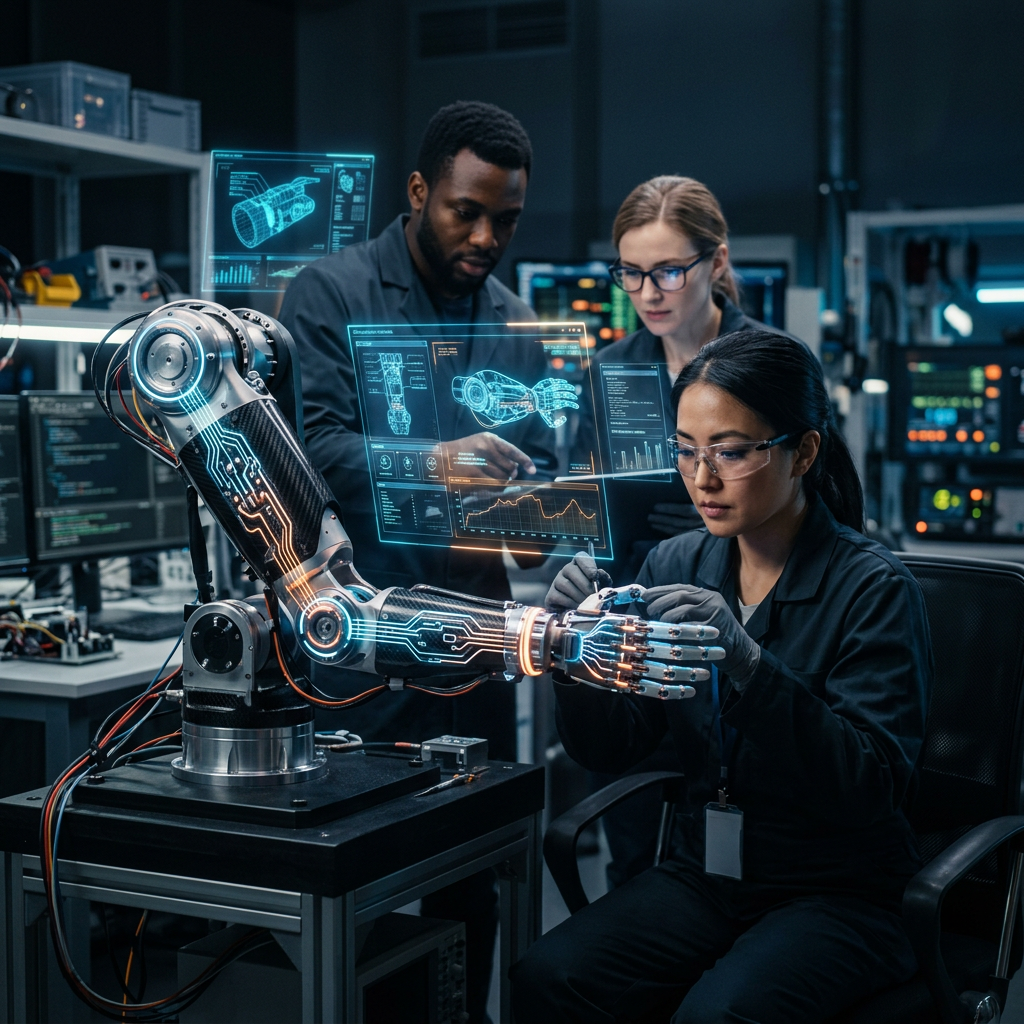
The Future of Innovation: Exploring the Massive Scope of Mechatronics
Discover the massive scope of mechatronics, from $119k average salaries to its role as the backbone of Industry 4.0 and AI-driven smart automation.

Discover the massive scope of mechatronics, from $119k average salaries to its role as the backbone of Industry 4.0 and AI-driven smart automation.
Trending Now
The Future of Innovation: Exploring the Massive Scope of Mechatronics
Key Takeaways
- The global mechatronics market is forecasted to reach $214 billion by 2028, signaling extraordinary industry expansion.
- Mechatronics integrates mechanical engineering, electronics, computer science, and control systems into one cohesive discipline.
- The average mechatronics engineer in the U.S. earns approximately $119,430 per year.
- Emerging trends like Physical AI, cobots, and eco-mechatronics are redefining the scope of the discipline.
- Industry 4.0 has positioned mechatronics as the foundational technology behind smart manufacturing worldwide.
- Educational pathways are evolving rapidly, with the mechatronics courses market projected to reach $9.11 billion by 2032.
Introduction: Defining the Synergy of Mechatronics and Its Expanding Scope
In an era defined by rapid technological convergence, few disciplines capture the spirit of modern engineering as powerfully as mechatronics. The scope of mechatronics extends far beyond what a single engineering branch can offer — it is, by design, a synthesis. Coined in Japan in the late 1960s by engineer Tetsuro Mori of Yaskawa Electric Corporation, the term "mechatronics" was originally conceived to describe the seamless blending of mechanical systems and electronics. Today, the discipline has evolved into a sophisticated, interdisciplinary field that incorporates computer science, control engineering, signal processing, and increasingly, artificial intelligence.
From the robotic arms assembling vehicles in automotive plants to the surgical systems performing minimally invasive procedures in hospitals, mechatronics is quietly powering some of the most transformative technologies of our time. For students selecting a career path, educators shaping curricula, parents evaluating future-proof professions, and curious minds seeking to understand where technology is heading — understanding the scope of mechatronics is not merely academic. It is increasingly essential.
This article explores the discipline's historical roots, core competencies, industrial applications, career prospects, and the exciting frontiers that are defining its next chapter.
The Evolution: From Simple Machines to Cyber-Physical Systems
The journey of mechatronics is a story of technological ambition meeting engineering precision. In its earliest form, the discipline concerned itself with the integration of basic actuators and sensors within mechanical systems. The introduction of programmable logic controllers (PLCs) in the 1970s marked a pivotal turning point, enabling machines to operate with a degree of autonomous decision-making that was previously unimaginable.
The 1980s and 1990s witnessed the mass adoption of embedded systems — miniaturized computers housed within devices ranging from washing machines to aircraft navigation panels. This period fundamentally redefined what mechanical systems could achieve when paired with intelligent electronics.
Today, the discipline operates at the level of cyber-physical systems (CPS) — interconnected networks of physical machinery and digital intelligence that communicate in real time. Smart factories, autonomous vehicles, drone delivery systems, and wearable medical devices are all products of this evolution. According to a study published on ResearchGate, mechatronics education itself is undergoing a fundamental transformation to align with the demands of Industry 4.0, requiring engineers who are as comfortable writing algorithms as they are designing mechanical assemblies.
Core Pillars: Mechanical, Electronic, and Computer Integration
Understanding the scope of mechatronics begins with appreciating its foundational architecture. The discipline rests on four interconnected pillars:
| Pillar | Core Focus | Example Application |
|---|---|---|
| Mechanical Engineering | Structural design, thermodynamics, kinematics | Robotic joint mechanisms, gear systems |
| Electrical & Electronics | Circuit design, sensors, actuators | Motor controllers, power electronics |
| Computer Science & Programming | Embedded software, algorithms, real-time OS | PLC programming, firmware development |
| Control Systems Engineering | Feedback loops, system stability, automation logic | PID controllers, adaptive control systems |
What distinguishes mechatronics from traditional engineering disciplines is not the depth of knowledge in any single pillar, but the ability to synthesize all four into coherent, functional systems. A mechatronics engineer designing an industrial robot must simultaneously account for structural load tolerances, servo motor specifications, real-time software control, and feedback-based error correction.
This integrative competency is precisely why mechatronics graduates are increasingly valued in industries that once relied on siloed teams of specialists. Mechanical-electronics integration at this level produces systems that are smarter, faster, and more cost-efficient than those designed through fragmented expertise.
Industry 4.0: Mechatronics as the Engine of Modern Manufacturing
Perhaps no single development has elevated the scope of mechatronics more dramatically than the advent of Industry 4.0 — the fourth industrial revolution characterized by the fusion of digital, physical, and biological systems. Mechatronics is not merely a participant in this revolution; it is one of its primary engines.
"The global mechatronics market is forecasted to reach approximately $214 billion by 2028, reflecting the discipline's central role in the digital transformation of global industry." — SMVEC Research
Smart manufacturing — the integration of IoT sensors, AI-driven analytics, and automated production lines — depends entirely on the kind of systems mechatronics engineers design and maintain. Concepts such as digital twins (virtual replicas of physical systems used for predictive analysis), machine learning-enabled quality control, and autonomous guided vehicles (AGVs) within warehouse logistics are all mechatronics-centric innovations driving Industry 4.0 forward.
The manufacturing sector is not the only beneficiary. Energy grids are becoming smarter through mechatronic control systems. Supply chains are being automated through intelligent conveyance systems. Even agriculture is being revolutionized with precision farming technologies — GPS-guided tractors, soil-sensing drones, and automated irrigation systems — all designed using mechatronics principles.
The Global Job Market: Careers, Roles, and Employment Trends
The mechatronics job outlook is consistently positive across global markets, driven by the insatiable demand for automation expertise, systems integration professionals, and robotics engineers. According to data from the CollegeBoard Career Search, employment for mechatronics engineers is projected to grow by approximately 3.81% over the next five years — a figure that, while moderate at the headline level, understates the actual opportunity landscape when adjacent roles in robotics, automation engineering, and systems design are factored in.
The Bureau of Labor Statistics reports consistent demand for electro-mechanical and mechatronics technicians, particularly in manufacturing, defense, and aerospace sectors. Beyond traditional employment models, the rise of startups in robotics, smart devices, and autonomous systems has created an entirely new tier of opportunity for mechatronics professionals.
Below is a comparative overview of common career roles within the mechatronics ecosystem:
| Career Role | Industry Sector | Primary Skill Set | Growth Potential |
|---|---|---|---|
| Robotics Engineer | Manufacturing, Defense | Robotics programming, kinematics | Very High |
| Automation Engineer | Smart Manufacturing | PLC, SCADA, process control | High |
| Control Systems Engineer | Aerospace, Energy | Control theory, simulation tools | High |
| Embedded Systems Developer | Consumer Electronics, Automotive | C/C++, RTOS, microcontrollers | Very High |
| Mechatronics Technician | Industrial Maintenance | Troubleshooting, system repair | Moderate–High |
| AI-Robotics Integration Specialist | Tech, Healthcare | Machine learning, sensor fusion | Emerging/Very High |
The geographic distribution of demand is equally compelling. The United States, Germany, Japan, South Korea, and China remain dominant hiring markets, while India, the UAE, and Southeast Asia are rapidly developing mechatronics industries fueled by infrastructure investment and manufacturing scale-up.
Salary Breakdown: What Can a Mechatronics Engineer Expect to Earn?
Compensation is often a decisive factor for students and parents evaluating engineering specializations. On this front, the data for mechatronics is compelling.
"The average annual salary for a Mechatronics Engineer in the United States is approximately $119,430." — ERI Economic Research Institute
This figure places mechatronics engineers well above the national median for all occupations and competitive with other premium engineering disciplines. Compensation, however, varies considerably based on experience level, specialization, industry, and geography.
| Experience Level | Estimated Annual Salary (U.S.) | Notes |
|---|---|---|
| Entry-Level (0–2 years) | $65,000 – $80,000 | Fresh graduates, technician roles |
| Mid-Level (3–7 years) | $85,000 – $110,000 | Systems engineers, automation leads |
| Senior-Level (8–15 years) | $115,000 – $145,000 | Principal engineers, project managers |
| Expert/Executive (15+ years) | $150,000 – $200,000+ | CTO, R&D Directors, consultants |
Industries such as aerospace, defense, and medical robotics typically offer compensation at the higher end of the spectrum, while consumer electronics and general manufacturing may sit slightly lower. Geographic premiums in cities like San Francisco, Boston, and Seattle further inflate earning potential for U.S.-based professionals. Internationally, Germany and Switzerland are noted for highly competitive compensation packages for mechatronics engineers in their advanced manufacturing sectors.
Key Applications: Automotive, Healthcare, Aerospace, and Beyond
The true measure of any engineering discipline's scope lies in the breadth of its real-world applications. Mechatronics operates across virtually every major industrial and consumer domain.
Automotive Industry: From anti-lock braking systems (ABS) and electronic stability control to fully autonomous vehicles, mechatronics is the backbone of modern automotive engineering. Electric vehicle (EV) development — encompassing battery management systems, regenerative braking, and powertrain control — is almost entirely a mechatronics endeavor.
Healthcare and Medical Devices: Surgical robots such as the da Vinci Surgical System allow surgeons to perform complex procedures with precision impossible to achieve manually. Prosthetic limbs with sensory feedback, insulin delivery pumps, and MRI-compatible robotic systems are further examples of life-saving mechatronics applications.
Aerospace and Defense: Fly-by-wire systems, unmanned aerial vehicles (UAVs), missile guidance systems, and satellite positioning mechanisms all rely on sophisticated mechatronics integration. The precision demanded in aerospace makes it one of the most technically rigorous domains for mechatronics professionals.
Consumer Electronics: Smartphone camera stabilization, autofocus systems, robotic vacuum cleaners, and smart home appliances all contain mechatronic subsystems designed for everyday consumer interaction.
Agriculture: Precision agriculture technologies — including autonomous tractors, drone-based crop monitoring, and automated irrigation — are transforming food production efficiency globally.
Emerging Trends: The Rise of Physical AI and Cobots
The frontier of mechatronics is being actively reshaped by two of the most consequential technological developments of this decade: Physical AI and collaborative robots (cobots).
Physical AI refers to the integration of advanced machine learning and perception systems into physical machines — enabling robots and automated systems to perceive, reason, and act in complex, unstructured environments. Unlike traditional automation, which operates on fixed instructions, Physical AI-powered systems can adapt dynamically to new scenarios. NVIDIA's announcement of its Isaac robotics platform and the broader race toward humanoid robots (led by companies such as Boston Dynamics, Figure AI, and Tesla Optimus) are direct manifestations of this trend. The scope of mechatronics naturally expands as Physical AI demands deeper expertise in sensor fusion, deep learning integration, and real-time embedded intelligence.
Collaborative robots (cobots) represent a paradigm shift in human-machine interaction. Unlike traditional industrial robots that operate in isolated, caged environments for safety reasons, cobots are designed to work directly alongside human workers. Equipped with force-torque sensors, vision systems, and compliant control algorithms, cobots enhance human productivity without replacing the cognitive and dexterous adaptability that humans bring to complex tasks. The cobot market is among the fastest-growing segments in industrial automation and represents a significant employment and innovation opportunity for mechatronics engineers.
Sustainability: The New Frontier of Eco-Mechatronics
As global industries confront the urgency of climate change and resource efficiency, a new sub-discipline is emerging at the intersection of mechatronics and sustainability: eco-mechatronics.
Eco-mechatronics applies the principles of mechatronic design to develop systems that are energy-efficient, resource-conscious, and environmentally benign. Applications include:
- Smart energy grids that use mechatronic control systems to balance renewable energy inputs dynamically
- Energy harvesting technologies that capture and convert ambient mechanical energy (vibration, motion) into usable electrical power
- Precision irrigation systems that deploy sensor networks and automated actuators to reduce water consumption in agriculture by up to 30–50%
- Lightweight automotive components designed using mechatronic optimization algorithms that reduce vehicle weight and improve fuel efficiency
The integration of life cycle assessment (LCA) methodologies into mechatronic design processes is also gaining traction, pushing engineers to consider environmental impact from the earliest stages of product development. As corporations face growing regulatory and consumer pressure to decarbonize, eco-mechatronics represents not only an ethical imperative but a significant commercial opportunity.
Educational Paths: Skills and Certifications for Future Engineers
The growing demand for mechatronics expertise has catalyzed substantial investment in educational infrastructure globally.
"The mechatronics and robotics courses market was valued at $4.01 billion in 2024 and is projected to reach $9.11 billion by 2032." — Maximize Market Research
This near-doubling of the education market within eight years reflects the urgency with which institutions and students are responding to industry demand. Students pursuing mechatronics can access several educational pathways:
- Bachelor's Degree in Mechatronics Engineering — The foundational qualification, offered by universities globally, typically spanning four years
- Master's Degree / M.S. in Robotics or Mechatronics — Provides specialization in areas such as autonomous systems, medical robotics, or smart manufacturing
- Associate Degrees and Technical Diplomas — Targeted two-year programs preparing students for technician and maintenance roles
- Professional Certifications — Including certifications from bodies such as SME (Society of Manufacturing Engineers), IEEE Robotics and Automation Society, and platform-based credentials from Coursera, edX, and Udemy in embedded systems, ROS (Robot Operating System), and PLC programming
Core technical competencies sought by employers include proficiency in CAD/CAM tools (SolidWorks, AutoCAD), MATLAB and Simulink, Python and C/C++ programming, microcontroller platforms (Arduino, Raspberry Pi), and industrial automation software (SIMATIC, LabVIEW).
Equally important are soft skills such as systems-level thinking, cross-disciplinary communication, and project management — capabilities that enable mechatronics engineers to bridge the traditional silos between engineering teams.
Challenges in the Field: Cybersecurity and Rapid Skill Obsolescence
No comprehensive discussion of the scope of mechatronics would be complete without acknowledging the field's significant challenges. Two issues, in particular, demand serious attention from professionals and educators alike.
Cybersecurity in Connected Systems: As mechatronic systems become increasingly networked — through IoT connectivity, cloud-based analytics, and remote monitoring — they become correspondingly vulnerable to cyber threats. An attack on an industrial control system is no longer merely a data breach; it can result in physical damage to machinery, production shutdowns, or even safety hazards. The discipline must now incorporate cybersecurity by design principles, and mechatronics engineers are increasingly expected to understand threat modeling, secure communication protocols, and system hardening strategies.
Rapid Skill Obsolescence: The pace of technological advancement in mechatronics is both its greatest strength and a persistent professional challenge. Tools, programming languages, and platforms that represent best practice today may be superseded within five to seven years. This creates an imperative for continuous professional development (CPD) — a commitment to lifelong learning that must be cultivated as a professional norm rather than treated as an occasional obligation. Educational institutions, employers, and professional bodies share responsibility for creating ecosystems that support ongoing skill development.
Conclusion: Why the Scope of Mechatronics is Limitless
The scope of mechatronics is not bounded by a single industry, geography, or technological era. It is defined by adaptability — the capacity to absorb and integrate new knowledge as the technological landscape evolves. From its origins in factory automation to its current role at the forefront of Physical AI, smart manufacturing, sustainable engineering, and healthcare robotics, mechatronics has consistently demonstrated its relevance and vitality.
For students, it represents a career path that is intellectually rich, financially rewarding, and future-resilient. For educators, it is a discipline that demands innovative, interdisciplinary pedagogy. For parents, it is one of the clearest pathways to professional relevance in an economy being restructured by automation and artificial intelligence. And for the general observer, mechatronics is the invisible architecture behind much of the world that is becoming smarter, faster, and more efficient around us.
With a global market trajectory pointing toward $214 billion by 2028, an education sector growing toward $9.11 billion by 2032, and compensation benchmarks exceeding $119,000 annually in leading markets, the data reinforces what the technology itself already demonstrates: the scope of mechatronics is not merely large — it is, in every meaningful sense, limitless.
Sources
- Bureau of Labor Statistics – Electro-Mechanical and Mechatronics Technologists and Technicians
- ERI Economic Research Institute – Mechatronics Engineer Salary, United States
- Maximize Market Research – Global Mechatronics and Robotics Courses Market
- CollegeBoard / O*NET – Mechatronics Engineers Career Profile
- ResearchGate – Mechatronics Education in the Era of Industry 4.0
- SMVEC Research – Scope of Mechatronics Engineering
Advertisement
Frequently Asked Questions
What career opportunities are available in Mechatronics?
Mechatronics graduates work in robotics, aerospace, and advanced manufacturing. With the global industrial automation market projected to reach $395.09 billion by 2029, demand is surging for specialists who can integrate mechanical and electronic systems.
What is the average salary for Mechatronics Engineers?
According to data from the U.S. Bureau of Labor Statistics, the median annual wage for engineers in this field is approximately $96,310. Entry-level roles typically start around $70,000, while senior systems engineers in aerospace can earn over $150,000 annually.
How does Mechatronics impact the future of Industry 4.0?
Mechatronics is the foundation of Industry 4.0, enabling smart factories. Estimates suggest that by 2030, the adoption of autonomous robots in manufacturing will increase productivity by 30 percent, requiring a massive workforce of mechatronics experts.
Is the scope of Mechatronics limited to the automotive industry?
No, while the EV market is a major employer, mechatronics spans healthcare (surgical robots), agriculture (automated harvesters), and consumer electronics. The surgical robotics market specifically is expected to grow at a CAGR of 15.9 percent through 2030.
What skills are most valued in the Mechatronics job market?
Employers prioritize a mix of hardware and software skills. Approximately 75 percent of job postings for mechatronics roles require proficiency in PLC programming, CAD software, and languages like C++ or Python for control systems.
Sponsored
You Might Also Like


Advertisement
Comments (0)
Sign in to join the conversation
No comments yet. Be the first to share your thoughts!