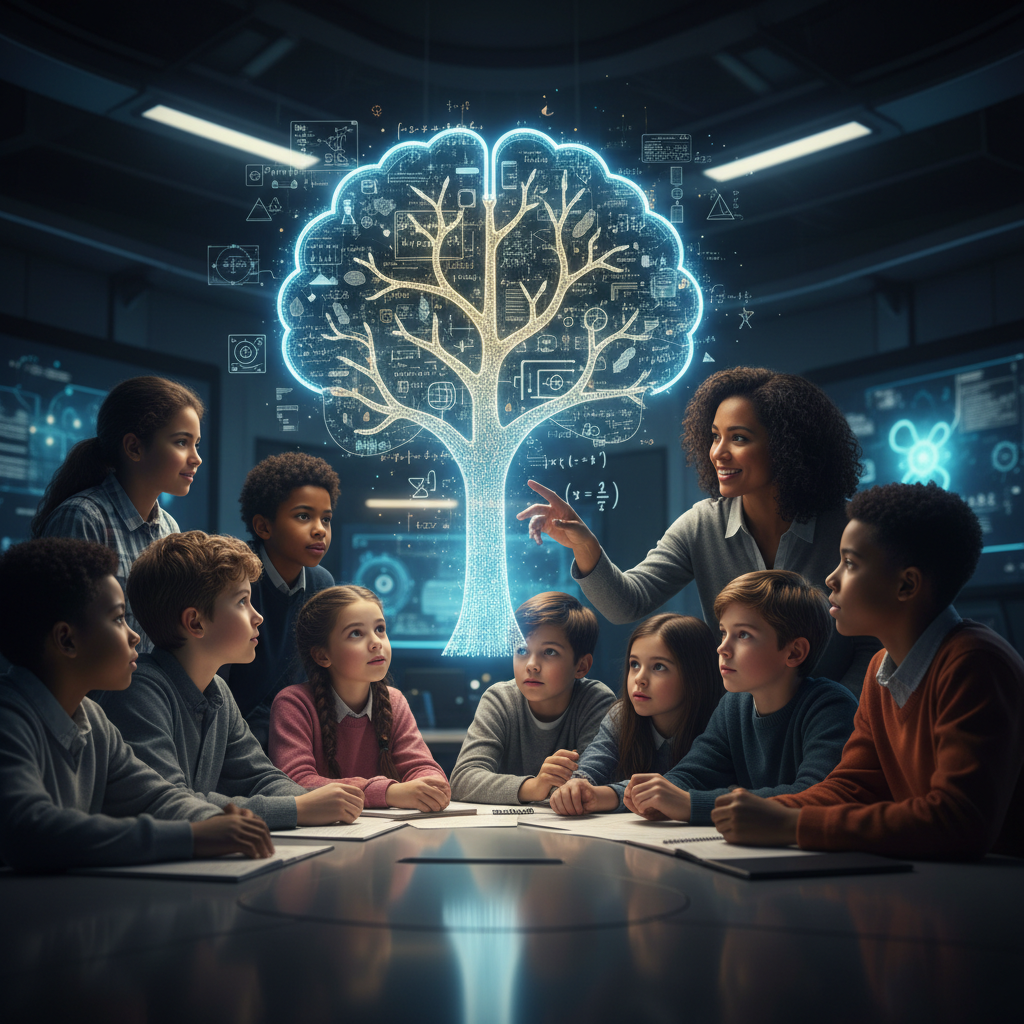
Solving the Future: The Best AI Math Reasoning Models for 2025 | mathematical reasoning models
Discover how 2025 reasoning models like OpenAI o1 and DeepSeek-R1 are transforming math education for students and saving teachers hours weekly.

Discover how 2025 reasoning models like OpenAI o1 and DeepSeek-R1 are transforming math education for students and saving teachers hours weekly.
Trending Now
Solving the Future: The Best AI Math Reasoning Models for 2025
Key Takeaways
- Mathematical reasoning models like OpenAI o1 and DeepSeek-R1 are redefining what AI can achieve in mathematics, from algebra to olympiad-level problems.
- Chain of Thought (CoT) reasoning allows models to "think through" problems step by step, making them far more reliable than earlier AI systems.
- Benchmark performance is rapidly evolving — GSM8K is now considered saturated, and AIME 2025 has emerged as the true test of elite mathematical reasoning.
- Teachers using AI math tools report saving an average of 7 hours per week, while 18% more educators found AI helpful in 2025 compared to 2024.
- Open-weight models are closing the gap with proprietary giants, democratizing access to advanced AI reasoning for classrooms worldwide.
1. Introduction: The New Era of 'Thinking' AI in the Classroom
Something fundamental has shifted in how artificial intelligence approaches mathematics. Until recently, even the most powerful language models would stumble on multi-step algebra problems, miscount objects in word problems, or confabulate plausible-sounding but incorrect solutions. That era is ending.
The rise of mathematical reasoning models — AI systems specifically designed to deliberate, reflect, and verify their own logic — marks a turning point not just for researchers, but for the millions of students and educators who interact with mathematics every day. These are not calculators dressed in natural language. They are systems capable of constructing multi-step proofs, catching their own errors mid-solution, and adapting explanations to the level of the learner.
In 2025, the conversation has moved decisively from "Can AI do math?" to "How do we best integrate AI reasoning into education?" This article examines the leading mathematical reasoning models, the technology that powers them, and the practical implications for students, college learners, and teachers navigating this transformed landscape.
2. What Is a Mathematical Reasoning Model? (System 1 vs. System 2)
To understand why today's models are so different, it helps to borrow from cognitive science. Psychologist Daniel Kahneman's framework distinguishes between System 1 thinking — fast, intuitive, pattern-based — and System 2 thinking — slow, deliberate, and logical. Early large language models (LLMs) like GPT-3 operated almost entirely in System 1 mode: they predicted the next plausible token without genuinely reasoning through consequences.
Mathematical reasoning models are designed to emulate System 2. They allocate extended computation at inference time, generating internal "scratch pads" where they test hypotheses, backtrack on errors, and verify intermediate steps before producing a final answer. This approach — known as inference-time scaling or test-time compute — is the foundational innovation separating 2025's leading models from their predecessors.
Rather than simply training a bigger model on more data, developers are training models to think longer and more carefully about hard problems. The result is a qualitative leap in performance on tasks that require genuine logical structure: proofs, symbolic manipulation, combinatorics, and competition mathematics.
3. The 2025 Leaderboard: OpenAI o1, DeepSeek-R1, and Claude 3.5 Sonnet
The competitive landscape for mathematical reasoning models in 2025 is both exciting and rapidly changing. Here is a snapshot of where the leading models stand.
Performance Comparison Table
| Model | MATH-500 Score | AIME 2024 Score | Open/Closed Weight | Key Strength |
|---|---|---|---|---|
| OpenAI o1 | ~96.4% | 83% | Closed | Elite competition math, STEM reasoning |
| DeepSeek-R1 | 97.3% | ~79% | Open | Highest MATH-500, open accessibility |
| Claude 3.5 Sonnet | ~90.1% | ~55% | Closed | Natural explanation, educational dialogue |
| GPT-4o | ~76.6% | 13% | Closed | Broad capability, lower reasoning depth |
| Qwen2.5-Math | ~95.2% | ~72% | Open | Strong open-weight alternative |
💡 Stat: OpenAI reports that its o1 model solved 83% of 2024 AIME problems, compared to just 13% by GPT-4o — a performance gap that dramatically illustrates the impact of inference-time reasoning.
The headline story of early 2025 is the extraordinary performance of DeepSeek-R1, an open-weight model developed by a Chinese AI lab. According to benchmark data, DeepSeek-R1 achieved a 97.3% score on the MATH-500 benchmark, outperforming both Claude 3.5 Sonnet and GPT-4o. What makes this remarkable is that DeepSeek-R1's weights are publicly available, meaning educators and institutions can deploy it without commercial licensing constraints.
💡 Stat: According to the Stanford HAI 2025 AI Index Report, the gap between top closed-weight and open-weight models narrowed from 8.04% in January 2024 to just 1.70% by February 2025 — a historic convergence.
This narrowing gap is consequential for education. It means that schools in lower-income regions, districts with limited technology budgets, and independent educators can increasingly access state-of-the-art mathematical reasoning tools without paying for proprietary API subscriptions.
4. Chain-of-Thought Reasoning: How Models Solve Problems Step-by-Step
Chain of Thought (CoT) reasoning is the technical backbone of modern mathematical reasoning models. First formally described in research from Google Brain, CoT prompting encourages a model to generate intermediate reasoning steps — essentially showing its work — rather than jumping directly to an answer.
In practice, this means that when you ask a CoT-enabled model to solve a complex algebra problem, it does not simply output a number. It writes out the equations it is constructing, identifies the unknowns, performs substitutions, verifies the logic, and flags potential errors — all before committing to a final answer.
How Chain-of-Thought Works: A Simplified Flow
| Stage | What the Model Does | Educational Parallel |
|---|---|---|
| Problem Parsing | Identifies known variables and question type | Reading comprehension of word problems |
| Strategy Selection | Chooses an approach (substitution, induction, etc.) | Selecting the right formula or theorem |
| Step Generation | Produces intermediate calculations | "Showing your work" on a test |
| Self-Verification | Checks for internal consistency | Reviewing the answer before submitting |
| Final Output | Delivers a confirmed answer with explanation | Writing up a clean solution |
Advanced models like OpenAI o1 go further by implementing reinforcement learning from human feedback (RLHF) on reasoning chains, training the model not just to reach correct answers, but to value the quality of its reasoning process along the way. This makes CoT outputs not only more accurate but also more pedagogically useful — students can follow the reasoning trail, not just copy an answer.
5. The Teacher's Edge: Saving Hours with AI Lesson Planning and Grading
The practical benefits of AI math tutors and reasoning tools extend well beyond the student experience. For teachers — who are frequently under-resourced and time-pressed — 2025's generation of mathematical reasoning models offers genuine, measurable relief.
💡 Stat: Math teachers using AI tools report saving an average of 7 hours per week on lesson planning and grading, according to Notie AI's 2025 analysis.
Seven hours per week is not a marginal gain. Across a school year, that represents more than 250 hours reclaimed — time that can be redirected toward individual student support, professional development, or simply sustainable work-life balance.
The Carnegie Learning State of AI in Education 2025 Report found that 18% more teachers found AI tools helpful in 2025 compared to 2024, with math teachers being the most optimistic of any subject group. The reasons are practical:
- Automated grading of problem sets with detailed error analysis
- Dynamic generation of differentiated worksheets calibrated to student ability levels
- Instant creation of worked examples tailored to specific curriculum standards
- Identification of common misconceptions across student responses
These capabilities are no longer hypothetical. Platforms like Carnegie Learning's MATHia, Khanmigo (Khan Academy's AI tutor), and emerging integrations with GPT-4o and DeepSeek-R1 are already deployed in thousands of classrooms. The teacher's role is evolving — not toward obsolescence, but toward higher-order facilitation, relationship-building, and creative curriculum design.
6. Empowering Students: AI as an Interactive Math Coach, Not a Calculator
The most transformative potential of mathematical reasoning models in education lies in how students interact with mathematics itself. The concern — legitimate and worth naming clearly — is that AI will simply become a sophisticated answer machine, eroding problem-solving skills rather than developing them.
The best implementations in 2025 are explicitly designed to counteract this tendency. Rather than providing direct answers, AI math coaches like Khanmigo use Socratic dialogue: they ask guiding questions, surface the specific step where a student's reasoning went wrong, and prompt the learner to self-correct.
For college students working through calculus, linear algebra, or statistics, tools like Wolfram Alpha's AI integration and OpenAI's o1 provide detailed derivations that serve as worked examples — arguably superior to static textbook solutions because they can be queried, questioned, and adapted in real time.
For school students, the value is in patience and personalization. An AI math coach can work through the same concept fifteen different ways without frustration, meeting the student wherever they are. It does not move on until the student demonstrates comprehension, nor does it give up when a student struggles.
The critical design principle — one that educators and platform developers must enforce — is that AI should illuminate the path to understanding, not simply deliver the destination.
7. Benchmarks Explained: Why GSM8K Is Saturated and What Comes Next
For those new to AI evaluation, benchmarks are standardized test suites used to measure model performance. In the world of mathematical reasoning models, two benchmarks have dominated the conversation: GSM8K and MATH-500.
GSM8K (Grade School Math 8,000) was released by OpenAI in 2021 to test multi-step arithmetic reasoning at an elementary school level. At launch, top models scored around 35%. By 2024, frontier models were routinely scoring above 95% on GSM8K accuracy, effectively saturating the benchmark — meaning it no longer meaningfully differentiates the best models from each other.
AIME (American Invitational Mathematics Examination) has emerged as the gold standard for elite reasoning evaluation. AIME problems require genuine mathematical insight, multi-step proof construction, and creative problem-solving that pattern-matching alone cannot solve.
Benchmark Difficulty and Saturation Status (2025)
| Benchmark | Difficulty Level | Top Model Score | Saturation Status |
|---|---|---|---|
| GSM8K | Grade school arithmetic | ~99% | ✅ Saturated |
| MATH-500 | High school competition | 97.3% (DeepSeek-R1) | ⚠️ Near saturated |
| AIME 2024 | Pre-olympiad competition | 83% (OpenAI o1) | 🟢 Active |
| AIME 2025 | Olympiad-level | ~75% (best models) | 🟢 Active frontier |
| FrontierMath | Research-level mathematics | <10% (most models) | 🟢 Far frontier |
The emergence of FrontierMath — a benchmark containing problems that require hours or days for expert mathematicians to solve — suggests that the field is actively building evaluation tools that will remain relevant for years. This matters for education: it signals that AI reasoning capability will continue improving in ways that present both opportunities and responsibilities for academic institutions.
8. Case Study: How Virtual Classrooms Are Using AI Student Bots
Across several forward-thinking institutions in 2025, a novel application of mathematical reasoning models is taking shape: AI student bots embedded in virtual classrooms. Rather than acting as tutors, these bots simulate a struggling or advanced peer, allowing teachers to practice explanations, anticipate student questions, and refine their pedagogical approach.
At a higher education level, some universities are piloting AI-generated "student cohorts" in online learning environments, where reasoning models take on the role of learners asking progressively more sophisticated questions. This forces human students to articulate and defend their mathematical reasoning — one of the most powerful learning mechanisms known to education research.
In adaptive learning platforms, AI bots analyze patterns in student error data — not just what answers are wrong, but how they are wrong — and use this to construct individualized remediation pathways. A student who consistently misapplies the distributive property receives a different sequence of practice problems than one who understands the concept but makes arithmetic errors in execution.
These applications represent a shift from AI as a tool for education to AI as a dynamic component within the learning ecosystem itself.
9. Patterns vs. Logic: The Debate Over AI's 'True' Mathematical Ability
Not everyone is convinced that today's models are genuinely reasoning. This is a legitimate, ongoing debate that educators should understand before placing unconditional trust in AI math outputs.
Critics — including some prominent mathematicians and AI researchers — argue that models like DeepSeek-R1 and OpenAI o1 succeed on benchmarks through sophisticated pattern matching rather than genuine logical deduction. They point to cases where models produce confident, detailed reasoning chains that lead to incorrect answers, or where slight rephrasing of a familiar problem causes dramatic performance drops.
Proponents counter that the distinction between "pattern recognition" and "reasoning" is philosophically murkier than it appears — and that empirical performance on genuinely novel problems (like AIME 2025 benchmarks and FrontierMath) suggests something more than surface-level matching is occurring.
For educators, the practical takeaway is this: treat AI math outputs as a first draft, not a final authority. Encourage students to verify AI reasoning against their own understanding, consult human teachers for conceptual clarity, and engage critically with the steps a model provides. AI is a powerful reasoning partner — not an infallible oracle.
10. Ethical Considerations: Preventing Overreliance and Ensuring Accuracy
The integration of mathematical reasoning models into education brings with it a set of responsibilities that cannot be deferred to future policy documents. Three issues demand immediate attention from educators and institutions.
First, accuracy and hallucination. Even state-of-the-art models produce incorrect solutions, particularly in novel or edge-case problems. A student who submits AI-generated work without verification risks not only academic penalties but — more importantly — genuine gaps in mathematical understanding.
Second, academic integrity. The line between legitimate AI-assisted learning and AI-facilitated academic dishonesty is increasingly blurred. Schools and universities need clear, thoughtful policies that distinguish between using AI to understand mathematics and using it to avoid mathematics.
Third, equity of access. While open-weight models are democratizing access, a meaningful digital divide persists. Students without reliable internet access, adequate devices, or supportive home environments remain structurally excluded from the benefits of AI-enhanced learning. Ensuring these tools reach underserved classrooms must be an active policy priority, not a passive aspiration.
11. The Future of Math Education: Adaptive Pathways and Global Accessibility
Looking beyond current benchmarks and classroom pilots, the trajectory of mathematical reasoning models points toward a genuinely transformed educational landscape.
Adaptive learning platforms powered by inference-time scaling will be able to construct, in real time, a personalized mathematics curriculum for each student — adjusting difficulty, pacing, explanation style, and motivational scaffolding based on continuous assessment. This is not science fiction; the infrastructure for it exists today, and the quality of reasoning models is now sufficient to make it practically viable.
Global accessibility is the most profound long-term implication. Advanced mathematics education has historically been a resource-intensive luxury — dependent on skilled teachers, physical infrastructure, and economic stability. As open-weight mathematical reasoning models become more capable and more deployable, the possibility of high-quality math education reaching students in rural communities, developing economies, and conflict-affected regions becomes more real with each passing year.
The Stanford HAI 2025 AI Index makes clear that the pace of improvement shows no signs of slowing. The models that will be available to educators in 2027 or 2028 will likely make today's systems look like early prototypes — which is both an exciting and a sobering consideration for anyone designing long-term educational strategy today.
12. Conclusion: Preparing Educators and Students for the AI Reasoning Shift
The rise of mathematical reasoning models is not a distant technological possibility. It is a present reality that is already reshaping how students learn, how teachers work, and how mathematics itself is understood as a discipline.
From OpenAI o1's remarkable performance on AIME to DeepSeek-R1's record-breaking 97.3% on MATH-500, the evidence is clear: AI is no longer merely mimicking mathematical fluency — it is demonstrating genuine problem-solving capability at levels that would earn high marks in any competitive mathematics program in the world.
For students, the call to action is to use these tools as thinking partners, not answer machines. Engage with the reasoning, interrogate the steps, and use AI explanations as a springboard for deeper understanding — not a substitute for it.
For educators, the opportunity is equally significant. The 7 hours per week saved on administrative tasks is not a threat to professional value — it is an invitation to invest more deeply in the human dimensions of teaching: mentorship, creativity, and the kind of relational trust that no algorithm can replicate.
For institutions and policymakers, the imperative is to move quickly and thoughtfully — building frameworks for responsible AI use, ensuring equitable access to these tools, and preparing the next generation of students not just to use mathematical reasoning models, but to understand, evaluate, and ultimately improve them.
The future of mathematics education is not human versus machine. It is human and machine, thinking together.
Sources
- OpenAI — Learning to Reason with LLMs
- Stanford HAI — Technical Performance: 2025 AI Index Report
- Carnegie Learning — State of AI in Education 2025
- DeepLearning.AI — OpenAI's o1 Models Excel in Reasoning
- Medium (AI Visionary) — DeepSeek-R1 vs. Claude 3.5 Sonnet vs. ChatGPT-4o
- Notie AI — AI Tools for Math Teachers
Published on Voxora | Category: AI in Education | Reading Time: ~12 minutes
Advertisement
Frequently Asked Questions
What are mathematical reasoning models and how accurate are they?
Mathematical reasoning models are AI systems designed to solve logic-based problems through step-by-step deduction. Current state-of-the-art models like GPT-4o achieve approximately 93.6% accuracy on the GSM8K benchmark, which consists of 8,500 high-quality grade school math word problems.
How can college students benefit from models like Minerva?
Minerva is a specialized model trained on 38.5 billion tokens of scientific and mathematical content. It excels at college-level tasks such as multivariate calculus and quantum mechanics, outperforming general-purpose models by significant margins on the MATH dataset which contains 12,500 challenging problems.
What is 'Chain of Thought' prompting in math AI?
Chain of Thought (CoT) is a reasoning method where a model generates intermediate logical steps before reaching a final answer. Research indicates that using CoT can increase the success rate of solving complex mathematical word problems by over 25% compared to direct-answer methods.
Are these models reliable for teachers to use as grading tools?
While helpful, models still exhibit 'hallucinations' or logic errors. Teachers should be aware that even advanced models may fail on 5-10% of niche geometry or high-level proof problems, meaning human oversight is essential for 100% accuracy in educational assessments.
Do mathematical reasoning models work for K-12 students?
Yes, AI-driven platforms use these models to provide personalized tutoring. Studies show that students using AI-augmented math tools can see a 15-20% improvement in standardized test scores by receiving immediate feedback on specific errors in their logical process.
Sponsored
Curious about technology, mathematics, education, and growth, I write as a learner exploring ideas in innovation, problem-solving, culture, and the questions shaping our world.
You Might Also Like


Advertisement
Comments (0)
Sign in to join the conversation
No comments yet. Be the first to share your thoughts!