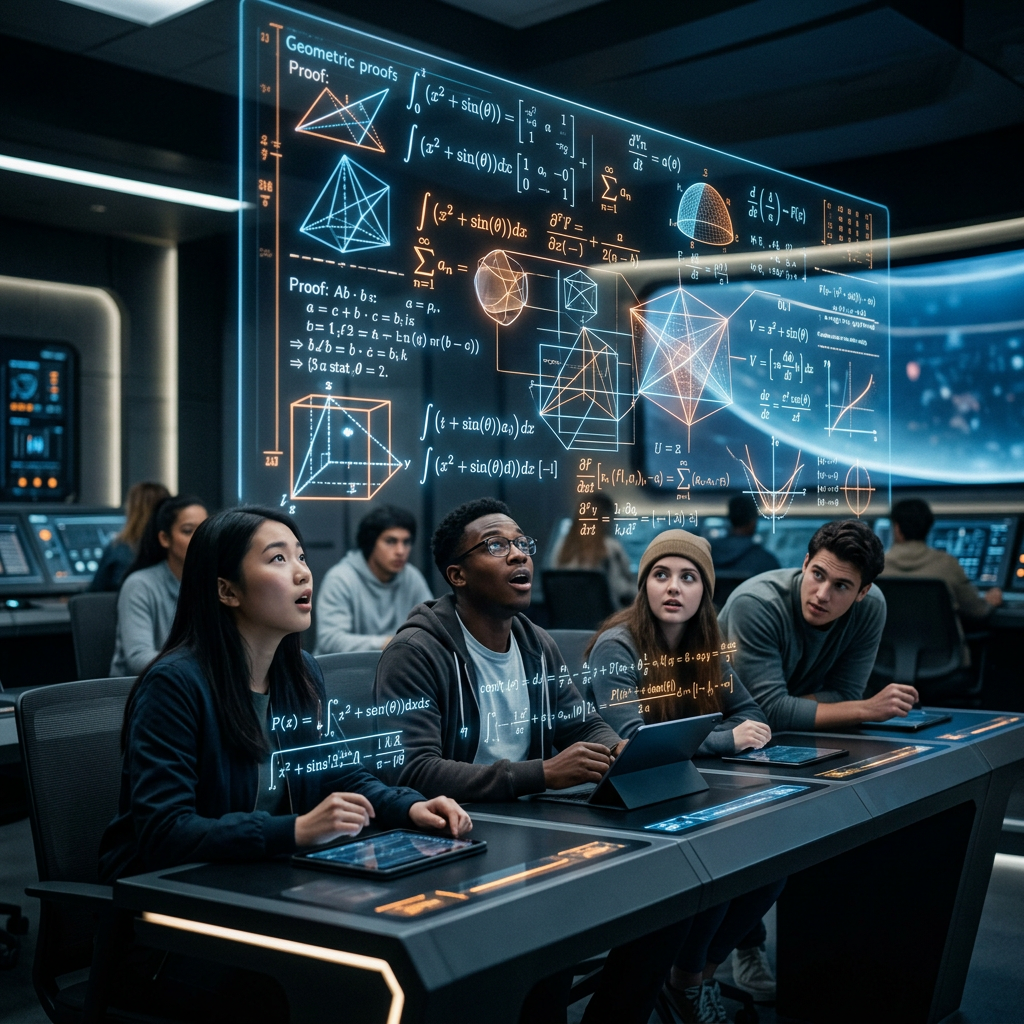
AI and the IMO: How DeepMind Reached Silver Medal Status | AI solving Olympiad problems
AI has officially reached silver-medal status at the International Mathematical Olympiad, marking a massive leap in complex, multi-step reasoning.

AI has officially reached silver-medal status at the International Mathematical Olympiad, marking a massive leap in complex, multi-step reasoning.
Trending Now
Key Takeaways
- DeepMind's AI system scored 28 out of 42 points at the 2024 International Mathematical Olympiad, placing it firmly in the silver medal category — a historic first for artificial intelligence.
- AlphaProof and AlphaGeometry 2 represent two distinct but complementary architectures powering this breakthrough, combining symbolic reasoning with deep learning.
- OpenAI's o1-preview achieved an 83% success rate on AIME 2024, compared to just 13% for GPT-4o — illustrating the dramatic leap in AI reasoning capability.
- The Lean formal language serves as a foundational verification tool, enabling AI to produce mathematically rigorous, checkable proofs.
- These developments carry profound implications for STEM education, tutoring technology, and the broader pursuit of mathematical AGI.
AI and the IMO: How DeepMind Reached Silver Medal Status
Introduction: The New Frontier of AI Solving Olympiad Problems
For decades, the International Mathematical Olympiad has served as the world's most prestigious proving ground for elite mathematical minds. Teenagers from over 100 countries spend years mastering abstract reasoning, creative proof construction, and logical rigor — all to compete for six grueling problems across two days. Until recently, this domain was considered safely beyond the reach of machines.
That assumption no longer holds.
In July 2024, Google DeepMind announced that its AI systems had achieved silver medal-level performance at the 2024 IMO — a milestone that sent shockwaves through the mathematics, education, and artificial intelligence communities alike. The achievement of AI solving Olympiad problems at this level is not merely a technical curiosity. It represents a fundamental shift in what machines can reason about, prove, and discover — and what that means for students, educators, entrepreneurs, and the future of human knowledge.
This article examines how DeepMind reached this landmark, the architectures behind it, what OpenAI's parallel advances reveal, and why this moment matters far beyond a competition score.
The 2024 IMO Milestone: DeepMind's Silver Medal Achievement
The 2024 International Mathematical Olympiad was held in Bath, United Kingdom, in July. Human contestants faced six problems spanning number theory, algebra, combinatorics, and geometry — each designed to resist brute-force computation and demand genuine mathematical insight.
DeepMind submitted its AI systems to solve the same problems under comparable conditions. The result was remarkable.
DeepMind's AI scored 28 out of 42 points at the 2024 IMO, placing it in the silver medal category — surpassing the performance threshold achieved by approximately the top 18% of human competitors. — Google DeepMind Blog
To contextualize this score: the gold medal threshold typically sits around 31–35 points depending on the year, while silver medals are awarded between roughly 22 and 30 points. DeepMind's systems solved 4 of the 6 problems correctly, with two of those solutions judged to be perfect by official IMO problem coordinators.
This achievement is categorically different from AI systems that perform well on standardized tests or multiple-choice benchmarks. IMO problems require multi-step deductive reasoning, the construction of original arguments, and proofs that must be logically airtight from premise to conclusion. There is no partial credit for approximating a solution.
| Metric | DeepMind AI (2024 IMO) | Average Silver Medalist | Gold Medal Threshold |
|---|---|---|---|
| Total Score (out of 42) | 28 | ~24–30 | 31–35 |
| Problems Solved Correctly | 4 of 6 | ~4 of 6 | 5–6 of 6 |
| Proof Verification Method | Lean formal language | Human judging | Human judging |
| Time Constraint | Extended (days) | 9 hours (2 days) | 9 hours (2 days) |
Note: DeepMind's systems operated under modified time conditions compared to human contestants.
How It Works: Understanding AlphaProof and AlphaGeometry 2
DeepMind's silver medal performance was not the product of a single AI system. It emerged from the coordinated deployment of two specialized architectures: AlphaProof and AlphaGeometry 2.
AlphaProof is a reinforcement learning-based system trained to generate and verify formal mathematical proofs. It operates by translating natural language problem statements into Lean 4, a formal proof language, and then searching the space of possible proof strategies using a process similar to how AlphaZero learned to play chess — through self-play and iterative improvement. AlphaProof handled the algebra and number theory problems at the 2024 IMO.
AlphaGeometry 2 is an evolution of the original AlphaGeometry system, which itself made headlines when it solved 25 out of 30 classical IMO geometry problems — a result published in Nature Journal in early 2024. The original AlphaGeometry established a record that dwarfed the previous state-of-the-art of just 10 solved problems.
AlphaGeometry solved 25 out of 30 IMO geometry problems within the standard time limit, surpassing the previous state-of-the-art of 10. — Nature Journal
AlphaGeometry 2 built upon this foundation with a more powerful language model backbone and an improved symbolic reasoning engine. Its neuro-symbolic architecture pairs a neural network (which generates intuitive geometric constructions) with a symbolic deduction engine (which formally verifies each step). Neither component alone would suffice — the neural side provides creative leaps while the symbolic side provides rigorous verification.
This division of cognitive labor mirrors, in many ways, how human mathematicians actually work: intuition generates hypotheses; discipline verifies them.
OpenAI o1: A Different Approach to Reasoning and AIME Success
While DeepMind pursued formal verification through specialized systems, OpenAI took a distinct path with its o1 model family — training large language models to reason through extended chains of thought before producing answers.
The results on the American Invitational Mathematics Examination (AIME), a prestigious precursor competition to the IMO for American students, were striking.
OpenAI o1-preview achieved an 83% success rate on AIME 2024, compared to just 13% for GPT-4o — a more than sixfold improvement. — OpenAI Research
The AIME is a 15-problem exam taken by the top few percent of participants in the AMC competition series. An 83% success rate would comfortably place a student in the top echelons of American mathematical competition.
| AI Model | AIME 2024 Score | Approach | Formal Verification |
|---|---|---|---|
| GPT-4o | ~13% (≈2/15) | Standard LLM inference | No |
| OpenAI o1-preview | ~83% (≈12/15) | Extended chain-of-thought reasoning | No |
| DeepMind AlphaProof | IMO-level (28/42) | Reinforcement learning + Lean proofs | Yes |
| AlphaGeometry 2 | 25/30 geometry problems | Neuro-symbolic hybrid | Yes |
The contrast between DeepMind and OpenAI's approaches is instructive. OpenAI's o1 operates in natural language and generates solutions that are readable and interpretable by humans but not formally verified. DeepMind's systems produce proofs that can be machine-checked for correctness but require translation into formal languages. Both approaches have merit; both represent frontier progress in AI solving Olympiad problems.
Why Olympiad Math is the Ultimate Test for AI Intelligence
Not all mathematical benchmarks are created equal. Many AI systems have performed impressively on tests like the SAT math section, the GRE, or even the AMC 10 — competitions that, while challenging, involve well-structured problem types that can be pattern-matched with sufficient training data.
The IMO is different in several fundamental ways:
- Novelty: Every IMO problem is designed to be unseen. No problem has ever appeared before, eliminating the possibility of memorization.
- Proof obligation: Answers must be proven, not merely stated. A correct answer without a valid proof receives no credit.
- Creative construction: Many problems require the solver to invent an auxiliary construction, definition, or transformation that is not suggested by the problem itself.
- No scaffolding: There are no hints, no multiple-choice options, and no partial-problem structures to guide reasoning.
For these reasons, the IMO has long been considered a benchmark for human mathematical genius rather than computational ability. An AI that can solve IMO problems must possess something approximating abstract reasoning, originality, and strategic thinking — capabilities that are far harder to engineer than raw computational speed.
This is precisely why the field of mathematical AGI — artificial general intelligence applied to mathematics — points to competition mathematics as one of its key milestones.
The Role of Formal Languages: Why Lean Is the Secret Weapon
One of the least-discussed but most consequential aspects of DeepMind's approach is its use of Lean, an open-source formal proof verification language developed at Microsoft Research.
In Lean, every step of a mathematical proof must be expressed in a precise, machine-checkable syntax. If any step is logically invalid — no matter how subtly — Lean rejects the proof entirely. This eliminates the possibility of hallucinated proofs: plausible-sounding but mathematically incorrect arguments that plague standard language models when asked to do math.
Why Lean matters for AI:
- Eliminates false positives: An AI cannot claim to have proved something it hasn't. The formal system acts as an unimpeachable referee.
- Enables reinforcement learning: Because proofs can be verified automatically, AI systems can train on feedback without requiring human mathematicians to check every attempt.
- Builds trust: Formally verified proofs can be audited, shared, and built upon — critical for scientific and academic credibility.
- Scales the proof library: As AI systems contribute verified proofs, the mathematical knowledge base grows in a structured, reliable way.
The integration of Lean into AlphaProof represents a significant methodological advance. It transforms mathematics from a domain where AI might hallucinate plausible nonsense into one where outputs can be objectively validated — a property almost no other AI application domain currently enjoys.
Implications for School and College Students: AI as a Tutor
For students navigating high school mathematics competitions or university-level coursework, the emergence of systems capable of AI solving Olympiad problems carries direct and practical implications.
The most immediate application is intelligent tutoring. When an AI can not only solve an IMO-level problem but also generate a step-by-step proof with clear logical justification, it becomes an extraordinarily powerful educational tool. Students can submit a problem they are struggling with and receive not just an answer, but a structured reasoning pathway that mirrors how a skilled mathematician would approach it.
Consider what this means concretely:
- A high school student preparing for national mathematics olympiads can use AI tutors to receive personalized problem analysis, identify logical gaps in their own proofs, and explore alternative solution strategies.
- A college student in a mathematical proof course can use formal verification tools to check whether their arguments are logically complete — receiving real-time feedback that would otherwise require a professor's attention.
- Self-directed learners gain access to a form of mathematical mentorship that was previously available only to students at elite institutions with access to expert faculty.
This democratization of mathematical reasoning support is arguably the most significant near-term benefit of AI advances in this space — not the competition results themselves, but what the underlying capability enables at scale.
Transforming Education: How Teachers Can Leverage Reasoning AI
For educators, AI reasoning systems represent both a challenge and an extraordinary opportunity. The challenge is familiar: if students can submit problems to AI and receive correct solutions, traditional assessment models must evolve. The opportunity is less commonly discussed but far more significant.
Practical applications for teachers and educators:
-
Automated proof checking: Teachers can assign open-ended proof problems and use formal verification tools to provide immediate, accurate feedback — dramatically reducing grading time for mathematical writing assignments.
-
Differentiated instruction: AI tutors can adapt explanations to the individual student's level, offering simpler analogies for struggling learners and deeper extensions for advanced students, all within the same classroom ecosystem.
-
Problem generation: AI systems can generate novel, well-calibrated mathematics problems at any difficulty level — giving teachers an inexhaustible supply of original practice material tailored to curriculum standards.
-
Conceptual exploration: Teachers can use AI to demonstrate multiple proof strategies for the same theorem — showing students that mathematics is not a monolithic set of rules but a rich landscape of interconnected ideas.
-
Competition preparation: For schools with mathematics teams, AI tutors trained on competition mathematics provide a scalable coaching resource that extends beyond what any single teacher can offer.
The key insight for educators is this: AI does not replace mathematical teaching; it extends the bandwidth of every mathematics educator. A teacher who integrates these tools thoughtfully can provide a richer, more individualized experience for every student in their classroom.
Entrepreneurial Opportunities: Startups in the Reasoning AI Space
For entrepreneurs and startup founders, the maturation of reasoning AI — and its demonstrated performance in domains as demanding as IMO mathematics — signals the opening of a substantial market.
| Opportunity Area | Description | Example Applications |
|---|---|---|
| EdTech Tutoring Platforms | AI-powered math tutoring with proof-level reasoning | Competition prep, university coursework support |
| Formal Verification Tools | Developer tools using Lean/Coq for software and mathematical proofs | Software correctness, financial modeling |
| STEM Assessment Platforms | Automated grading systems for open-ended mathematical proofs | University exams, standardized testing |
| Research Assistance Tools | AI co-pilots for academic mathematicians and scientists | Theorem discovery, literature synthesis |
| Corporate Training | Quantitative reasoning development for analysts and engineers | Finance, data science, engineering firms |
The reasoning AI space is not yet commoditized. Companies that build domain-specific applications — particularly those that integrate formal verification for trustworthy outputs — occupy a defensible position. The lesson from DeepMind and OpenAI's work is clear: general reasoning capability, when applied to structured domains, produces commercially and academically transformative results.
Startups that position at the intersection of neuro-symbolic AI and education, research, or enterprise applications are entering a market where the underlying technology has reached a critical threshold of credibility — and where customer demand is beginning to materialize rapidly.
The Path to Gold: Challenges Remaining for Mathematical AGI
Despite the landmark achievement of silver medal performance, substantial challenges remain before AI systems can reliably achieve gold medal status or function as genuine mathematical research partners.
Key remaining challenges:
- Time efficiency: DeepMind's systems operated under extended time conditions. Human gold medalists solve problems in 4.5 hours per session. Achieving comparable performance within human time constraints is an open problem.
- Combinatorics and creativity: The two IMO problems DeepMind's AI failed to solve in 2024 were combinatorics problems — a domain that resists formal encoding more stubbornly than geometry or algebra.
- Generalization: Current systems are trained heavily on existing mathematical knowledge. Solving problems at the frontier of unknown mathematics — where no training data exists — remains a profound challenge.
- Natural language interface: Translating between informal mathematical English and Lean formal language remains an imperfect process, introducing potential errors at the problem interpretation stage.
- Explainability: While formally verified proofs are checkable, they are not always human-readable or pedagogically illuminating — a critical gap for educational applications.
The consensus among researchers is that gold medal performance at the IMO is achievable within the next several years given current trajectories. But the harder goal — an AI that can formulate and prove genuinely new mathematical theorems of research significance — remains a longer-horizon objective, one that sits at the heart of the mathematical AGI research agenda.
Ethics and Integrity: Competitive Math in the Age of AI
Any serious treatment of AI in competitive mathematics must address the ethical dimensions directly. As AI solving Olympiad problems becomes more capable, several integrity questions arise that affect students, educators, and competition organizers alike.
Academic integrity: Mathematics competitions exist to identify and develop exceptional human talent. If AI assistance becomes available during preparation, competition organizers must clarify what constitutes legitimate training versus unfair advantage. Most olympiad communities have begun developing policies in this direction.
Assessment validity: If the skills being assessed — proof construction, logical creativity — can be substituted by AI, then traditional assessments may need to evolve toward oral examinations, live problem-solving sessions, or hybrid formats that resist AI substitution.
Equity considerations: Access to powerful AI tutoring tools is not uniformly distributed. If elite students at well-resourced schools leverage AI for competition preparation while others cannot, existing educational inequalities may widen rather than narrow.
Transparency in research: When AI systems contribute to mathematical research, questions of attribution, authorship, and intellectual credit must be carefully considered by the academic community.
These are not reasons to resist the technology — they are reasons to engage with it thoughtfully, proactively, and with clear institutional guidelines. The mathematical community has navigated major technological transitions before; this one demands the same careful deliberation.
Conclusion: What's Next for AI Solving Olympiad Problems?
The silver medal achieved by DeepMind's AI at the 2024 IMO is not a finish line. It is a starting point — the clearest demonstration yet that AI solving Olympiad problems is no longer a theoretical aspiration but an empirical reality, with verifiable results judged by international mathematics experts.
The convergence of reinforcement learning for math, formal verification through Lean, neuro-symbolic architectures, and increasingly powerful language models has produced a step-change in AI's mathematical reasoning capacity. OpenAI's o1-preview reaching 83% on the AIME, DeepMind's AlphaGeometry solving 25 of 30 classical IMO geometry problems, and the 2024 silver medal performance together constitute a pattern, not an anomaly.
For students, this means unprecedented access to intelligent mathematical guidance. For teachers, it means new tools to amplify their impact. For entrepreneurs, it signals a maturing technology ready for applied innovation. For the mathematics community, it raises deep questions about the nature of mathematical creativity, proof, and discovery.
The road to gold — and beyond that, to genuine mathematical co-discovery with AI — is now clearly visible. The journey has begun in earnest, and the implications will reverberate through education, science, and our understanding of intelligence itself for decades to come.
Sources
- Google DeepMind Blog — "AI Solves IMO Problems at Silver Medal Level"
- OpenAI Research — "Learning to Reason with LLMs"
- Nature Journal — AlphaGeometry Research Paper
- The Verge — "Google DeepMind AI Silver Medal International Mathematical Olympiad"
Published on Voxora — The Premium Platform for the World's Best Writers.
Advertisement
Frequently Asked Questions
How well can AI currently perform on math competitions like the International Mathematical Olympiad (IMO)?
Google DeepMind's AlphaGeometry system successfully solved 25 out of 30 geometry problems from past IMO exams within the official time limit, achieving a performance level comparable to a human IMO silver medalist.
What impact does AI have on students preparing for competitive exams?
AI tools provide 24/7 personalized tutoring; for instance, models fine-tuned on STEM datasets can solve over 90% of mid-level competition problems, helping students understand complex derivations through step-by-step breakdowns.
Can AI solve complex problems in fields other than mathematics, such as physics or informatics?
Yes, AlphaCode demonstrated high proficiency by ranking in the top 54% of participants in competitive programming contests on Codeforces, solving problems that require both logical reasoning and advanced coding skills.
What are the commercial opportunities for entrepreneurs in the AI-Olympiad space?
With the global AI in education market expected to grow at a CAGR of 36% through 2030, there is a massive opportunity for startups to build specialized 'reasoning engines' that move beyond simple chat to formal mathematical verification.
Will AI replace the need for human teachers in advanced mathematics education?
No, while AI can solve specific hard problems, it lacks the ability to explain 'why' a certain creative leap was made in a pedagogical context; educators are now using AI as a co-pilot to generate millions of synthetic practice variations for students.
Sponsored
Curious about technology, mathematics, education, and growth, I write as a learner exploring ideas in innovation, problem-solving, culture, and the questions shaping our world.
You Might Also Like


Advertisement
Comments (0)
Sign in to join the conversation
No comments yet. Be the first to share your thoughts!