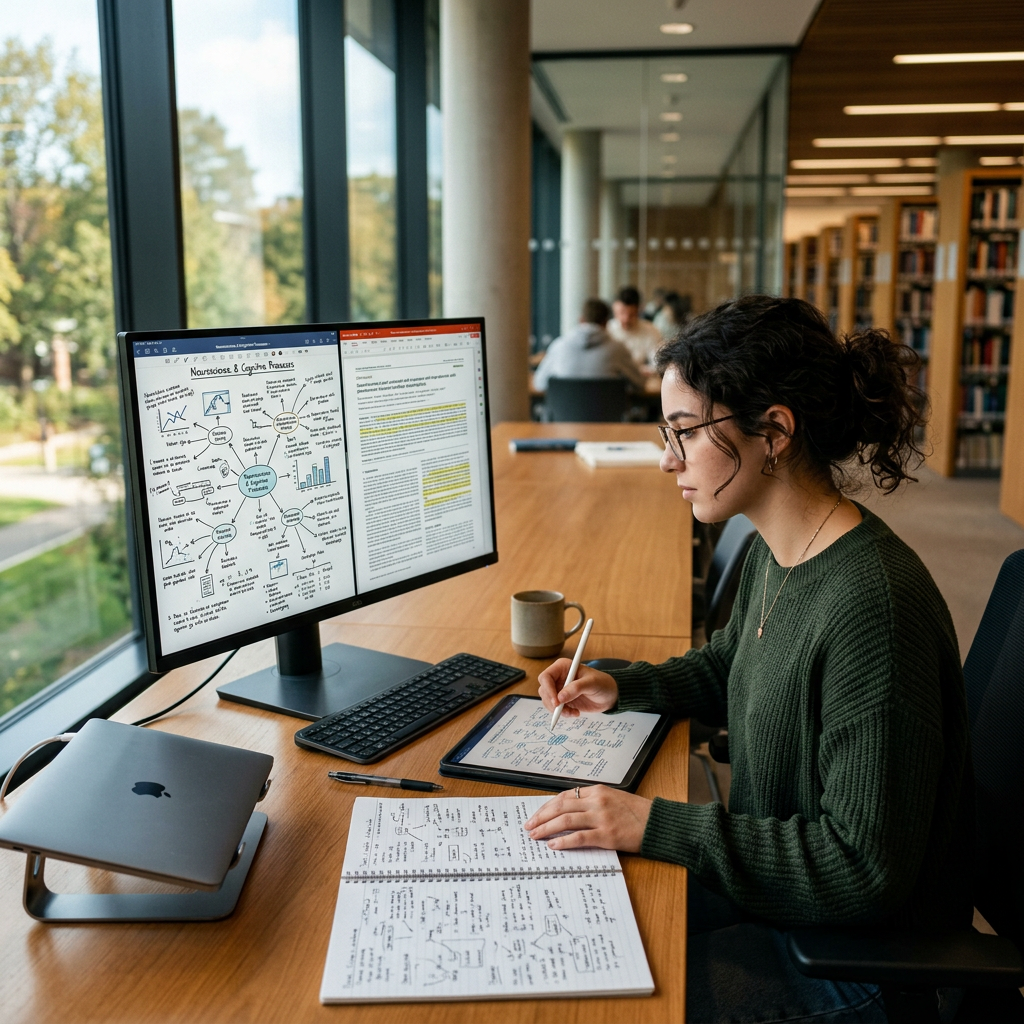
How to Study Effectively: 7 Science-Backed Methods for Students
Master the science of learning with proven methods like active recall and spaced repetition to boost retention by 50% and secure a higher GPA.

Master the science of learning with proven methods like active recall and spaced repetition to boost retention by 50% and secure a higher GPA.
Trending Now
How to Study Effectively: 7 Science-Backed Methods for Students
Key Takeaways
- Passive rereading creates an illusion of competence — active recall and spaced repetition produce measurably superior retention.
- Students using active recall score up to 20% higher on exams than those relying on passive review.
- Spaced repetition raises mean exam scores from 61% to 70% compared to massed practice.
- The Pomodoro Technique improves retention by 31% over continuous, unbroken study sessions.
- Sleep deprivation is a measurable academic risk — every lost hour below eight hours reduces GPA by 0.07 points.
- Combining multiple evidence-based techniques — dual coding, interleaving, and the Feynman Technique — creates a compound learning advantage no single method alone can replicate.
Introduction: The Illusion of Competence in Passive Studying
Most students know the feeling: you spend three hours re-reading your textbook the night before an exam, feel confident walking in, and then struggle to recall what you reviewed just hours earlier. This frustrating disconnect is not a matter of intelligence — it is a matter of method.
Cognitive scientists call this the illusion of competence — a well-documented psychological phenomenon where the mere exposure to material produces a false sense of mastery. When you re-read a chapter, the words feel familiar. But familiarity is not the same as retrievable knowledge, and on exam day, that distinction is everything.
Understanding how to study effectively requires looking beyond conventional wisdom and into the peer-reviewed science of memory, cognition, and learning. The methods outlined in this article are not productivity hacks or motivational strategies — they are research-validated techniques that change the way your brain encodes, consolidates, and retrieves information. Whether you are a high school student preparing for standardized exams or a college student navigating a demanding curriculum, these seven methods will fundamentally transform how you approach studying.
The Neuroscience of Learning: How Memories Are Built
Before exploring specific techniques, it is essential to understand what is actually happening in your brain when you study. Memory formation is a biological process, and working with that process — rather than against it — is the foundation of effective studying.
Learning occurs in three phases:
- Encoding — Information enters working memory through sensory experience.
- Consolidation — The brain strengthens neural pathways, largely during sleep, transforming short-term into long-term memory.
- Retrieval — Stored information is recalled and made accessible when needed.
Most passive study habits — rereading, highlighting, and passively watching lecture recordings — only engage the encoding phase superficially. The techniques in this article are specifically designed to strengthen consolidation and retrieval, which is where true, lasting learning takes place.
Active Recall: The #1 Scientifically Proven Study Method
If there is one technique that the scientific literature endorses above all others, it is active recall — the practice of deliberately retrieving information from memory rather than passively reviewing it.
📊 Research Finding: Students using active recall techniques score 20% higher on average in exams compared to those who rely on passive rereading. — University of York / Studley AI
The mechanism behind active recall's superiority is called the testing effect or retrieval practice effect. Each time you attempt to recall a piece of information — even unsuccessfully — you strengthen the neural pathways associated with that memory. The struggle to retrieve is not a sign of failure; it is the learning itself.
How to implement active recall:
- Flashcards: Write a question on one side and the answer on the other. The Leitner System — sorting cards into boxes based on how well you know them — further systematizes this approach.
- Blank page method: Close your textbook and write everything you remember about a topic on a blank sheet of paper, then check for gaps.
- Practice testing: Prioritize past exam papers, self-quizzes, and end-of-chapter questions over re-reading notes.
- Teach-back sessions: Verbally explain concepts to a study partner without looking at your materials.
| Study Method | Average Retention After 1 Week | Effort Level |
|---|---|---|
| Re-reading | ~20-30% | Low |
| Highlighting | ~25-35% | Low |
| Summarizing | ~40-50% | Medium |
| Active Recall / Practice Testing | ~60-80% | High |
| Active Recall + Spaced Repetition | ~75-85%+ | High |
Table 1: Retention rates across common study methods (based on cognitive science literature)
Spaced Repetition: How to Hack the Ebbinghaus Forgetting Curve
In 1885, German psychologist Hermann Ebbinghaus mapped the forgetting curve — a mathematical model demonstrating that humans forget approximately 50% of new information within an hour and up to 70% within 24 hours without reinforcement. More than a century later, neuroscience has validated his findings and provided a solution: spaced repetition.
Spaced repetition involves reviewing material at strategically increasing intervals — for example, after 1 day, then 3 days, then 7 days, then 21 days. Each review session resets the forgetting curve at a progressively higher baseline, meaning the information decays more slowly with each repetition.
📊 Research Finding: Learners who utilized spaced repetition achieved a mean exam score of 70%, compared to 61% for those who did not use the method. — University of Leicester / SACO Education
This 9-percentage-point difference may appear modest in isolation, but across an entire academic semester, it can be the margin between a grade boundary.
How to implement spaced repetition:
- Anki: The gold-standard flashcard application that uses an algorithm (SM-2) to schedule cards based on your self-reported confidence. Free and available on all platforms.
- Manual spacing: Divide your notes into Day 1, Day 3, Day 7, and Day 14 review folders.
- Calendar blocking: Schedule review sessions at the outset of your semester, treating them as fixed academic commitments.
The critical behavioral shift spaced repetition demands is beginning early. It is structurally incompatible with cramming — which is, by design, its entire point.
The Feynman Technique: Simplify to Master Complex Subjects
Named after Nobel Prize-winning physicist Richard Feynman — famous for his ability to explain extraordinarily complex physics in plain language — the Feynman Technique is a four-step method for achieving genuine conceptual understanding rather than surface-level familiarity.
The four steps:
- Choose a concept you want to understand and write its name at the top of a blank page.
- Explain it in plain language as if you were teaching it to a 12-year-old with no prior knowledge of the subject.
- Identify the gaps. Wherever your explanation breaks down, becomes vague, or requires jargon to fill a void — that is a gap in your understanding. Return to your source material to resolve it.
- Simplify and use analogies. Refine your explanation until it is genuinely clear, using concrete analogies to replace abstract terminology.
The Feynman Technique is especially powerful for STEM subjects, economics, and any discipline involving interconnected conceptual frameworks. Its strength lies in the fact that you cannot simplify what you do not truly understand — making gaps in knowledge immediately and unambiguously visible.
Unlike rote memorization, this technique builds what cognitive scientists call deep structural knowledge — the ability to apply concepts flexibly across novel problems, which is precisely what high-stakes exams demand.
Interleaving: Why Mixing Subjects Beats Blocked Practice
Most students practice blocked study — completing all problems of one type before moving to the next (e.g., finishing all algebra problems, then all geometry problems). Intuitively, this feels organized and efficient. Research consistently shows it is not.
Interleaving — the practice of alternating between different subjects, topics, or problem types within a single study session — produces superior long-term retention and transfer of knowledge, despite feeling more difficult in the moment.
The difficulty is, in fact, the point. Interleaving forces your brain to actively discriminate between concepts, select the appropriate strategy, and rebuild context with each switch. This additional cognitive effort, known as desirable difficulty, accelerates the formation of durable neural connections.
Practical interleaving strategies:
- Instead of studying Chapter 3 for two hours, alternate 25-minute blocks between Chapter 3 (Biology), Chapter 5 (Chemistry), and Chapter 2 (Physics).
- When practicing mathematics, mix problem types within a single session rather than completing one category exhaustively.
- Rotate between subjects on alternating days rather than dedicating entire weeks to one subject before finals.
| Practice Type | Short-Term Performance | Long-Term Retention | Exam Transfer |
|---|---|---|---|
| Blocked Practice | High (feels productive) | Lower | Lower |
| Interleaved Practice | Lower (feels difficult) | Higher | Higher |
Table 2: Blocked vs. Interleaved practice — short-term vs. long-term outcomes
The Pomodoro Method: Managing Cognitive Load and Focus
Developed by Francesco Cirillo in the late 1980s, the Pomodoro Technique is a time-management framework built around the science of sustained attention and cognitive load. The method involves 25 minutes of focused work followed by a 5-minute break, with a longer 15–30 minute break after every four cycles.
📊 Research Finding: A 2022 UC Berkeley study found that students using the Pomodoro Technique had 31% better retention than those who studied continuously without breaks. — Sajoo Life / UC Berkeley
The neurological basis for this finding relates to cognitive load theory — the brain's working memory has a finite capacity, and sustained, unbroken focus depletes the mental resources needed for deep processing. Short breaks allow the prefrontal cortex to consolidate recent information and restore attentional resources, making the subsequent work session meaningfully more productive.
How to implement the Pomodoro Technique effectively:
- Identify the specific task before starting the timer — vague intentions produce vague results.
- Eliminate all notifications during the 25-minute interval (phone on Do Not Disturb, browser notifications off).
- Use the 5-minute break for physical movement, hydration, or mindful rest — not social media browsing, which competes for the same attentional networks.
- After four Pomodoros, take a genuine 20–30 minute restorative break.
The Pomodoro Technique pairs exceptionally well with active recall and interleaving — each 25-minute block can be dedicated to a different subject, with retrieval practice built into the session structure.
Dual Coding: Using Visuals and Words for Double Retention
Dual coding theory, introduced by cognitive psychologist Allan Paivio, proposes that humans process verbal and visual information through two distinct but interconnected cognitive channels. When both channels are engaged simultaneously, memory encoding is significantly strengthened compared to using either channel alone.
In practical terms: combining written notes with relevant diagrams, charts, timelines, or concept maps produces deeper and more durable learning than text-only or image-only study.
How to apply dual coding:
- Concept maps and mind maps: Visually map the relationships between ideas rather than writing linear notes.
- Annotated diagrams: Draw a process or system (e.g., the water cycle, a circuit diagram, the stages of mitosis) and annotate each component in your own words.
- Timelines: For history, law, or any chronological subject, construct visual timelines that organize events spatially.
- Sketch-noting: During lectures, combine abbreviated text with simple sketches and icons to represent key ideas.
Dual coding is not about artistic skill — rough diagrams drawn by hand are neurologically equivalent to polished visuals. The cognitive work of translating verbal information into a visual representation is itself the mechanism of deeper encoding.
The GPA Killer: Why Sleep Is More Important Than an All-Nighter
No discussion of how to study effectively is complete without addressing what happens between study sessions. Sleep is not passive downtime — it is the biological mechanism through which memory consolidation occurs. During slow-wave and REM sleep, the hippocampus replays and transfers encoded information to the neocortex for long-term storage. An all-nighter does not merely make you tired; it actively undermines the consolidation of everything you studied.
📊 Research Finding: Each hour of sleep lost below the recommended eight hours is associated with a 0.07 decrease in a student's cumulative GPA. — Carnegie Mellon University / National Institutes of Health
For context: a student consistently sleeping six hours per night — two hours below the recommended threshold — faces a cumulative GPA reduction of 0.14 points due to sleep deprivation alone. Over an academic career, this is the difference between degree classifications.
Evidence-based sleep hygiene for students:
- Maintain a consistent sleep and wake schedule, including weekends, to regulate your circadian rhythm.
- Avoid screens for at least 30–60 minutes before bed — blue light suppresses melatonin production.
- Schedule your most cognitively demanding review sessions in the morning or early afternoon, when working memory capacity is at its peak for most students.
- Treat 8 hours of sleep as a non-negotiable academic investment, not an indulgence.
Optimizing Your Environment: Science-Backed Ways to Block Distractions
The finest study techniques in the world are significantly diminished by a distracting environment. The data on student distraction is striking and unambiguous.
📊 Research Finding: College students are distracted approximately 35% of their total study time on average, which negatively predicts final exam performance. — Research.com / Miller & Thompson
More than one-third of study time lost to distraction is not a minor inefficiency — it is a structural obstacle to academic performance. Fortunately, environmental design is one of the most actionable variables a student can control.
Evidence-based environmental optimization:
- Remove your phone from the room (not silenced — physically absent). Research consistently shows that the mere presence of a smartphone on a desk reduces available cognitive capacity, even when the device is face-down and silent.
- Use website blockers (Freedom, Cold Turkey, or browser extensions) during study sessions to restrict access to social media platforms.
- Establish a study-only space. The brain forms strong contextual associations — studying consistently in the same dedicated location strengthens the psychological cue for focus.
- Manage auditory environment. Low-level ambient noise (such as brown noise or instrumental music without lyrics) can improve focus for some learners; complete silence is optimal for others. Identify which environment serves your cognitive profile and replicate it consistently.
Digital Tools of 2025: Leveraging AI for Active Learning
The landscape of educational technology has evolved dramatically, and the most effective students are those who leverage digital tools strategically — not as replacements for active engagement, but as instruments to systematize it.
| Tool | Primary Function | Best Used For |
|---|---|---|
| Anki | Spaced repetition flashcards | Vocabulary, definitions, formulas |
| Notion / Obsidian | Connected note-taking | Concept mapping, knowledge organization |
| ChatGPT / Claude | Socratic questioning partner | Feynman Technique, concept testing |
| Forest / Be Focused | Pomodoro timer + focus gamification | Session structure and distraction blocking |
| Quizlet | Collaborative flashcard sets | Group study and practice testing |
AI tools deserve particular attention in 2025. Used passively — asking an AI to summarize a chapter — they replicate the same illusion of competence problem as rereading. Used actively — asking an AI to quiz you, identify weaknesses in your explanations, or generate novel practice problems — they become extraordinarily powerful active recall engines. The distinction is in how you engage with the tool, not the tool itself.
Conclusion: Building Your Personalized Science-Based Study Routine
Understanding how to study effectively is ultimately about replacing effort-intensive but low-yield habits with evidence-based techniques that work with your brain's biological design. The seven methods outlined here — active recall, spaced repetition, the Feynman Technique, interleaving, the Pomodoro Method, dual coding, and prioritizing sleep — are not individually revolutionary. Their power compounds when combined into a coherent, personalized system.
A practical starting point: begin one study session this week using only active recall — no rereading, no highlighting. Use a blank page. Write what you know. Identify the gaps. Review those gaps. Then space your next review session three days later. This single behavioral shift, sustained over a semester, will produce measurably better outcomes than any amount of passive reviewing.
Academic success is not a function of how many hours you sit with a textbook. It is a function of how intelligently those hours are structured. The science is clear. The methods are accessible. The only remaining variable is implementation.
Sources
- Carnegie Mellon University — Nightly Sleep Is Key to Student Success
- National Institutes of Health — PMC Article on Sleep and Academic Performance
- Research.com — Habits of Highly Effective Students
- University of York / Studley AI — Active Recall vs. Passive Recall
- SACO Education / University of Leicester — Spaced Repetition: The Science of Remembering
- Sajoo Life / UC Berkeley — The Science Behind the Pomodoro Technique
Published on Voxora — Premium Publishing for Writers Worldwide
Advertisement
Frequently Asked Questions
What is the most scientifically proven method for long-term retention?
Active recall and spaced repetition are the most effective methods. A 2013 study published in Psychological Science in the Public Interest rated practice testing and distributed practice as having high utility, showing they significantly outperform common habits like highlighting or rereading.
How long should a study session last to maximize concentration?
The Pomodoro Technique, which uses 25-minute focus blocks followed by 5-minute breaks, is highly effective. Research on sustained attention suggests that the human brain's performance begins to decline significantly after 90 minutes of continuous cognitive load.
How does sleep deprivation affect my ability to learn new information?
Sleep is essential for memory consolidation. A study by the University of California found that sleep deprivation can lead to a 40% decrease in the brain's ability to store new memories, as the hippocampus loses its capacity to process incoming data without adequate rest.
Is it better to study in silence or with background music?
Silence is generally superior for complex tasks. Research from the University of Wales showed that students who studied in a quiet environment performed up to 60% better on recall tests than those who listened to music with lyrics, which competes for the brain's phonological processing resources.
Does multitasking while studying reduce academic efficiency?
Yes, significantly. Research indicates that multitasking can lead to a 40% drop in productivity and a decrease in IQ by 10 points. The brain experiences a 'switching cost' every time focus shifts, which prevents the deep encoding of information necessary for school and college exams.
Sponsored
Curious about technology, mathematics, education, and growth, I write as a learner exploring ideas in innovation, problem-solving, culture, and the questions shaping our world.
You Might Also Like


Advertisement
Comments (0)
Sign in to join the conversation
No comments yet. Be the first to share your thoughts!