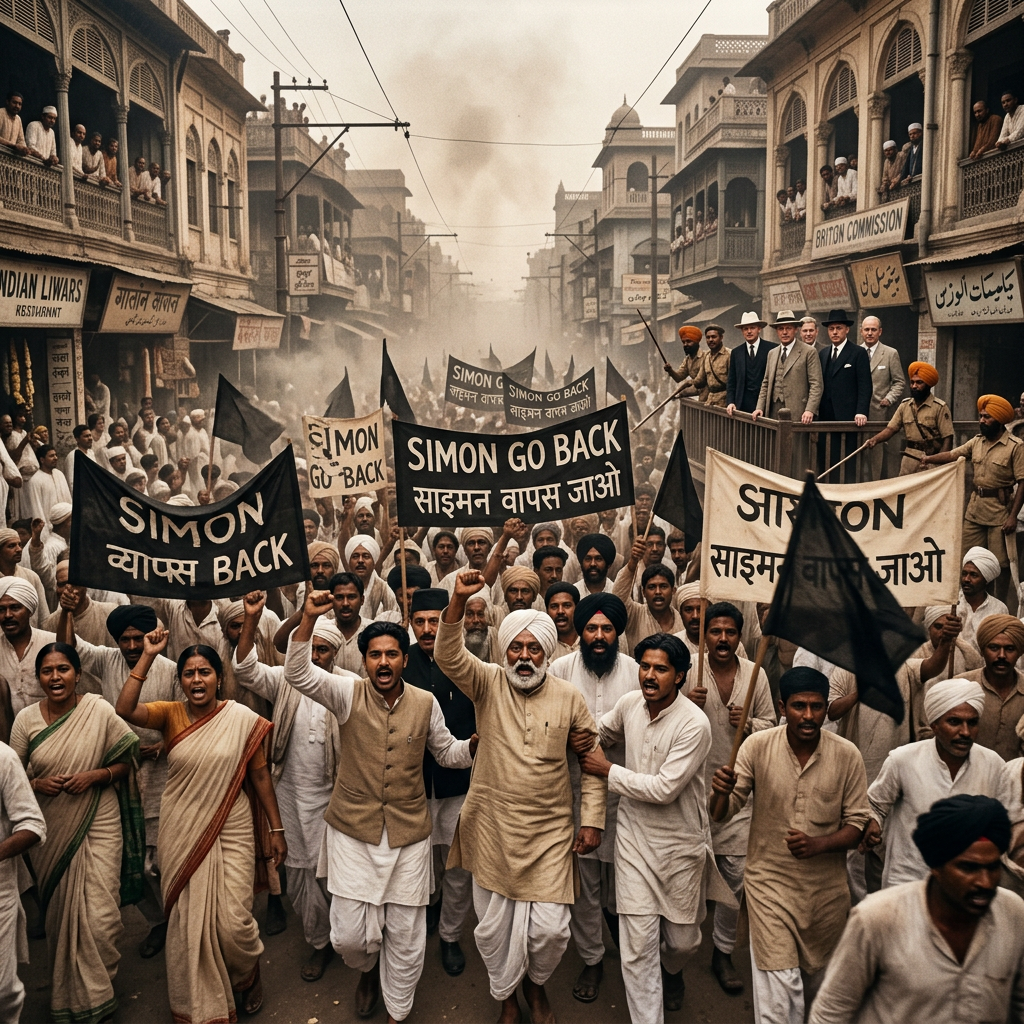
From Boycott to Statehood: The Odia Struggle for a Separate Province |
Discover how Braja Sundar Das and Odia leaders leveraged the 1927 Simon Commission to secure Odisha's status as India's first linguistic province.

Discover how Braja Sundar Das and Odia leaders leveraged the 1927 Simon Commission to secure Odisha's status as India's first linguistic province.
Trending Now
From Boycott to Statehood: The Odia Struggle for a Separate Province
Key Takeaways
- Braja Sundar Das, a visionary leader from Kantabania, Jajpur, defied the Congress boycott directive and strategically engaged the Simon Commission to press Odia linguistic and territorial demands.
- The Indian Statutory Commission of 1927–28 formally acknowledged that the consolidation of Odia-speaking areas into a single province was a justified and necessary administrative reform.
- The C.R. Attlee Sub-Committee was established specifically to examine Odia grievances, marking the first time a colonial inquiry body gave specialized attention to the Odia unification question.
- The O'Donnell Boundary Commission proposed a province covering approximately 33,000 square miles with a population of 8.27 million people.
- Odisha was formally inaugurated as a separate province on April 1, 1936, comprising six original districts: Cuttack, Puri, Balasore, Sambalpur, Ganjam, and Koraput.
- The Odia statehood movement remains one of India's earliest and most successful linguistic reorganization movements, offering a model for democratic self-determination within a colonial framework.
1. Introduction: The Visionary from Kantabania
In the annals of India's independence movement, few struggles combine the precision of legal diplomacy with the depth of cultural identity as powerfully as the Odia unification movement. At the heart of this movement stood Braja Sundar Das, a lawyer, legislator, and statesman born in Kantabania, a modest locality in the Jajpur district of present-day Odisha. His life's work was defined not merely by political activism but by an unwavering conviction: that a people united by a shared language, literature, and heritage deserved to govern themselves as one.
The year 1927 marked a turning point. When the British government dispatched the Simon Commission — formally known as the Indian Statutory Commission — to assess prospects for constitutional reform in India, the Indian National Congress declared a nationwide boycott. Yet Odia leaders, operating within a unique political reality, saw the commission not as an instrument of colonial oppression alone, but as a rare platform through which their long-standing demand for a separate Odisha province could receive formal recognition.
This article traces the extraordinary sequence of events — from Kantabania to Patna, from colonial commission rooms to provincial inauguration — through which Braja Sundar Das and his contemporaries transformed an administrative grievance into a constitutionally recognized homeland. Their story is one of calculated diplomacy, cultural resilience, and strategic courage.
2. The 1927 Political Landscape: The Simon Commission's Arrival in India
To understand the significance of the Odia leaders' decision, one must first appreciate the charged political atmosphere of late 1920s colonial India. The Indian Statutory Commission, popularly known as the Simon Commission after its chairman Sir John Simon, arrived in India in 1927–28 with a mandate to review the constitutional reforms introduced by the Government of India Act of 1919 and recommend further changes.
The commission's composition was immediately controversial: all seven of its members were British, with no Indian representation whatsoever. This exclusion ignited nationwide outrage. The Indian National Congress, under the direction of its senior leadership, issued a firm directive for a complete boycott of the commission. Across India, demonstrators met the commission's motorcades with black flags, and the slogan "Simon Go Back" echoed in city after city.
| Commission Detail | Information |
|---|---|
| Formal Name | Indian Statutory Commission |
| Popular Name | Simon Commission |
| Chairman | Sir John Simon |
| Year of Arrival in India | 1927–28 |
| Number of Members | 7 (all British) |
| Indian Representation | None |
| Congress Response | Complete Boycott |
| Sub-Committee for Odia Demands | C.R. Attlee Sub-Committee |
Despite the Congress boycott, several regional political groups recognized an opportunity: the commission had to interact with Indian stakeholders to produce a credible report. For Odia leaders, who had spent decades pressing for the merger of Odia-speaking territories scattered across Bengal, Bihar, Madras, and the Central Provinces, the arrival of the Simon Commission represented a once-in-a-generation opportunity.
3. To Boycott or Cooperate? The Strategic Dilemma of Odia Leaders
The decision to engage rather than boycott the Simon Commission was neither taken lightly nor arrived at unanimously. Odia political leaders were acutely aware of the Congress directive, and defying it carried significant political risk. However, they were also acutely aware of a more pressing reality: the Odia-speaking population had no consolidated political homeland.
Odia speakers were administratively divided across multiple provinces under British India. The Utkal Sammilani, the premier organization advocating for Odia unity, had been making representations since 1903. Visionaries like Madhusudan Das — often called the "Father of Odisha" and the founder of Utkal Sammilani — had laid the ideological groundwork for linguistic reorganization decades earlier. But formal colonial recognition remained elusive.
The leaders of Odisha reasoned that abstaining from the commission would mean surrendering the floor to other provincial voices, potentially leaving Odia territorial claims unaddressed for another generation. Their calculus was clear: political pragmatism must, in this instance, outweigh party loyalty.
A committee was consequently formed, led by Braja Sundar Das, to formally represent the Odia cause before the Simon Commission. This decision would prove to be one of the most consequential strategic moves in the history of the Odia Unification Movement.
4. The Committee to Patna: Braja Sundar Das Takes the Lead
Braja Sundar Das was ideally suited to lead this delegation. A graduate of Presidency College, Calcutta — and notably one of only three Odia graduates from that institution in his era — he represented the intellectual vanguard of the Odia political class. His legal training, his command of colonial administrative language, and his deep roots in Odia cultural life made him a formidable advocate.
Braja Sundar Das was one of only three Odia graduates from Presidency College, Calcutta, in his era — a distinction that underscores the elite academic foundation that distinguished leaders of the Odia unification movement. — Wikipedia: Braja Sundar Das
The committee decided to meet the Simon Commission at Patna, the capital of Bihar and Orissa Province, where the commission was scheduled to hold sessions. This location was itself symbolically significant: Odia speakers in Bihar and Orissa were administratively merged with non-Odia populations, making Patna the seat of a provincial government that did not reflect Odia identity or aspirations.
The Patna delegation was not a hurried, informal affair. The committee prepared detailed memoranda documenting the linguistic boundaries of Odia-speaking regions, the demographic composition of contested territories, and the historical basis for treating Odia as a distinct cultural and linguistic community deserving its own administrative unit. The depth of this preparation reflected the intellectual seriousness with which Braja Sundar Das approached the task.
5. The C.R. Attlee Sub-Committee: A Specialized Inquiry into Odia Demands
Recognizing the complexity and specificity of the Odia question, the Simon Commission established a dedicated Sub-Committee to examine the issue in greater detail. This body was placed under the chairmanship of C.R. Attlee — the same Clement Richard Attlee who would later become Prime Minister of the United Kingdom and oversee Indian independence in 1947.
The establishment of the C.R. Attlee Sub-Committee was a landmark moment. For the first time, the colonial administrative machinery had created a specialized inquiry mechanism specifically to examine the demands of the Odia people. This sub-committee engaged directly with the delegation led by Braja Sundar Das and other Odia leaders, examining evidence, hearing testimonies, and deliberating on the merits of linguistic reorganization.
The discussions were substantive and, by colonial standards, remarkably thorough. Odia representatives presented evidence covering:
- Geographic distribution of Odia-speaking populations across multiple provinces
- Linguistic distinctiveness of the Odia language and its literary heritage
- Economic viability of a consolidated Odia province
- Administrative inefficiencies caused by the current dispersal of Odia communities
- Cultural suppression experienced by Odia speakers under non-Odia provincial administrations
The sub-committee's engagement with these arguments demonstrated that the Odia cause had moved beyond petition and protest into the realm of structured policy deliberation.
6. Key Findings: Why the Simon Commission Supported a Separate Odisha
The final report of the Simon Commission contained a finding of extraordinary importance for the Odia people: the demand to annex all Odia-speaking areas under one special province was deemed justified. This was not a vague expression of sympathy but a formal policy recommendation by a statutory body commissioned by the British Parliament.
The commission's reasoning was grounded in several key principles:
- Linguistic coherence: The Odia language represented a clear, distinct, and historically established linguistic identity. Administrative units built around linguistic communities were recognized as more efficient and equitable.
- Cultural continuity: Odia literature, tradition, and social organization formed an integrated cultural system that was being artificially disrupted by the existing provincial boundaries.
- Democratic representation: A consolidated Odia province would enable Odia speakers to elect representatives who genuinely understood and could address their specific needs.
The Simon Commission's report formally opined that the demand of the Odia people to annex Odia-speaking areas under one special province is justified — a colonial acknowledgment that became the legal and moral foundation of Odisha's eventual statehood. — DDCE Utkal University: History of Modern Odisha
This finding lent the Odia movement a degree of legitimacy it had previously lacked in formal colonial discourse. It transformed the demand from a regional aspiration into a recognized constitutional imperative.
7. Annexing the Jamidaris: The Unification of Princely States
One of the most complex dimensions of the proposed Odia province was the question of Jamidaris (zamindaries) and Princely States. The Odia-speaking region included numerous semi-autonomous territories governed by local rulers under British paramountcy. The Simon Commission's report went beyond merely recommending a consolidated province — it also opined that all Jamidaris and Princely States within the Odia-speaking region should be annexed under the proposed Odisha province.
This recommendation was significant for several reasons. The Princely States in the Odia region — collectively known as the Garhjat states — were administratively distinct entities with their own revenue systems, legal codes, and governance structures. Integrating them into a unified province required not only political will but also a complex administrative framework.
| Category of Territory | Administrative Status (Pre-1936) | Recommended Status (Post-Simon Report) |
|---|---|---|
| Odia Districts in Bengal | Part of Bengal Province | To be merged into Odisha Province |
| Odia Districts in Madras | Part of Madras Province | To be merged into Odisha Province |
| Bihar and Orissa Province | Combined administration | To be separated; Odia areas to form new province |
| Garhjat Princely States | Semi-autonomous under paramountcy | To be annexed into Odisha Province |
| Zamindari Territories | Feudal administrative units | To be integrated into unified provincial structure |
The recommendation to consolidate the Princely States was a bold administrative proposition. It anticipated the broader integration of princely states that would follow Indian independence nearly two decades later. For the Odia movement, this recommendation ensured that the proposed province would not be a fragmented entity but a geographically and administratively coherent homeland.
8. The O'Donnell Boundary Commission: Drawing the Map of a New Province
With the Simon Commission's recommendations providing political and moral momentum, the British Government of India took the next formal step: announcing the appointment of a Boundary Commission under the Chairmanship of S.P. O'Donnell. The O'Donnell Boundary Commission was tasked with the precise and technically demanding work of delineating the boundaries of the proposed Odisha province.
This was not a merely cartographic exercise. Every boundary decision carried profound implications for tens of thousands of people — determining which village fell under which province, which community gained access to which administrative services, and which language would govern public life in a given territory.
The proposed Odisha province as outlined in the O'Donnell Commission report covered approximately 33,000 square miles with a population of 8.27 million people, establishing the demographic and geographic foundation of what would become a fully constituted province. — Learner's Mate Historical Data
The commission's work was meticulous and, by necessity, involved adjudicating contested territories where Odia and non-Odia populations were intermixed. The Testbook reference on the Odisha Boundary Commission 1931 confirms O'Donnell's central role in this delimitation process. The outcome of the commission's deliberations would directly shape the map of a province that Odia leaders had been demanding for more than three decades.
9. Public Mobilization: Gathering Mass Support for the Odia Cause
Even as formal commissions deliberated in colonial chambers, the leaders of Odisha understood that political success required more than bureaucratic persuasion — it required the organized and demonstrable support of the Odia people themselves. In the months and years following the Simon Commission's engagement, Odia leaders undertook a concerted campaign of public mobilization across Odia-speaking territories.
Community meetings, cultural gatherings, and public assemblies were organized to educate the general public about the significance of provincial unification. The Utkal Sammilani played a crucial organizational role, channeling the energies of local leaders, intellectuals, teachers, and community elders into a unified campaign.
This mass mobilization served several strategic purposes:
- Demonstrating popular legitimacy: It showed colonial authorities that the demand for a separate province was not the agenda of a small elite but a broadly shared aspiration of the Odia-speaking population.
- Building political cohesion: It drew together Odia communities that were separated by geography, caste, and economic status into a shared political identity.
- Sustaining momentum: It ensured that the Odia cause remained publicly visible and politically active during the years of bureaucratic process between the Simon Commission report and formal provincial inauguration.
The legacy of figures like Madhusudan Das, whose vision of a unified Odisha had inspired generations, provided the ideological fuel for this mobilization. The grassroots energy generated during this period was as important to the final outcome as any formal commission recommendation.
10. April 1, 1936: The Inauguration of the Odisha Province
On April 1, 1936, the long struggle culminated in a historic moment: the formal inauguration of Odisha as a separate province of British India. This date is now commemorated annually as Utkala Dibasa — Odisha Day — a celebration of cultural identity, linguistic pride, and political achievement.
Odisha was established as a separate province comprising six original districts: Cuttack, Puri, Balasore, Sambalpur, Ganjam, and Koraput — a geographic foundation that reflected the core Odia-speaking territories that had been the focus of the unification movement for decades. — Odisha Review
| Original District | Geographic Region | Significance |
|---|---|---|
| Cuttack | Central Odisha | Historical capital; cultural heartland |
| Puri | Coastal Odisha | Religious and cultural center; Jagannath Temple |
| Balasore | Northern Odisha | Key port and trade district |
| Sambalpur | Western Odisha | Resource-rich; significant Odia-speaking population |
| Ganjam | Southern Odisha | Southern boundary of Odia cultural territory |
| Koraput | Southern Odisha | Tribal heartland; geographic anchor of the south |
The inauguration of the province validated every strategic decision made by Braja Sundar Das and his contemporaries — the decision to engage the Simon Commission, the meticulous preparation of memoranda, the diplomatic engagement with the Attlee Sub-Committee, and the decade-long campaign of public mobilization.
11. Legacy of Braja Sundar Das: Language, Literature, and Statehood
Braja Sundar Das did not merely contribute to the political achievement of Odia statehood; he embodied the integration of intellectual life, cultural identity, and political purpose that defined the finest leaders of the Odia unification movement. His legacy endures across multiple domains.
As a lawyer and legislator, he demonstrated that colonial legal structures could be navigated and leveraged by indigenous leaders committed to self-determination. As a cultural advocate, he understood that the case for a separate province rested ultimately on the richness and distinctiveness of the Odia language and its literary tradition — a tradition stretching back to the classical compositions of the Panchasakha saints and the poetry of Sarala Das.
His decision to lead the delegation to Patna in the face of the Congress boycott required moral courage as well as strategic clarity. History has vindicated that courage. The formal recognition by the Simon Commission of the Odia people's right to a consolidated province — a recognition secured in no small measure through the advocacy of Braja Sundar Das — became the foundational document upon which the province of Odisha was built.
His story also offers a broader lesson for the Utkala Dibasa History that is taught in schools and colleges across Odisha today: that the path to statehood was paved not by confrontation alone, but by disciplined diplomacy, intellectual preparation, and an unwavering faith in the legitimacy of cultural identity as a basis for political self-governance.
12. Conclusion: Lessons in Diplomacy from Odisha's Founding Fathers
The story of Braja Sundar Das and the Simon Commission is more than a chapter in regional history. It is a masterclass in the art of political strategy under conditions of colonial constraint. Faced with a national boycott directive, Odia leaders chose a different path — not out of indifference to the broader freedom struggle, but out of a clear-eyed recognition that the specific needs of their people required specific advocacy.
The results speak for themselves. By engaging the Indian Statutory Commission 1927, by presenting a meticulously prepared case before the C.R. Attlee Sub-Committee, and by sustaining a campaign of public mobilization that demonstrated mass support for unification, Odia leaders secured a colonial commission recommendation that became the legal and moral cornerstone of a new province. The subsequent work of the O'Donnell Boundary Commission translated that recommendation into cartographic reality, and on April 1, 1936, the province of Odisha came into existence.
Today, as students, educators, families, and citizens across Odisha celebrate Utkala Dibasa, it is worth pausing to recognize the extraordinary chain of events — stretching from the lanes of Kantabania to the commission rooms of Patna — that made that celebration possible. The founding fathers of Odisha, led by Braja Sundar Das, remind us that cultural identity is not merely a matter of sentiment. When organized, articulated, and advocated with intelligence and dignity, it becomes the foundation of statehood itself.
Sources
- Wikipedia: Braja Sundar Das
- Odisha Review: Formation of Separate Orissa Province
- Testbook: Odisha Boundary Commission 1931
- DDCE Utkal University: History of Modern Odisha
- Learner's Mate: Historical Data on O'Donnell Commission
Published on Voxora — Premium Content for Curious Minds Worldwide.
Advertisement
Frequently Asked Questions
Who led the Odisha delegation to meet the Simon Commission in 1928?
The delegation was led by Braja Sundar Das, a prominent leader from Kantabania, who organized a committee to present the demand for a separate Odisha province to the commission in Patna.
Why did Odia leaders engage with the Simon Commission despite the Congress boycott?
While the Indian National Congress boycotted the Simon Commission in 1927–28, Odia leaders chose to meet them because they saw it as a critical opportunity to formally demand the creation of a separate province for Odia-speaking people.
What role did C.R. Attlee play in the formation of Odisha?
C.R. Attlee was appointed as the head of a specific Sub-Committee established to address the issues raised by Braja Sundar Das and other Odia leaders regarding their administrative independence.
What were the major recommendations of the Simon Commission regarding Odisha?
The commission's report concluded that the demand for a separate province was justified and recommended that all Jamidari and Princely States in the region be annexed into the proposed Odisha province.
Which commission was formed following the Simon Commission's report to define Odisha's borders?
Following the report, the Government of India appointed a Boundary Commission under the chairmanship of S.P. O'Donnell to determine the official limits of the unified Odisha province.
Sponsored
You Might Also Like


Advertisement
Comments (0)
Sign in to join the conversation
No comments yet. Be the first to share your thoughts!