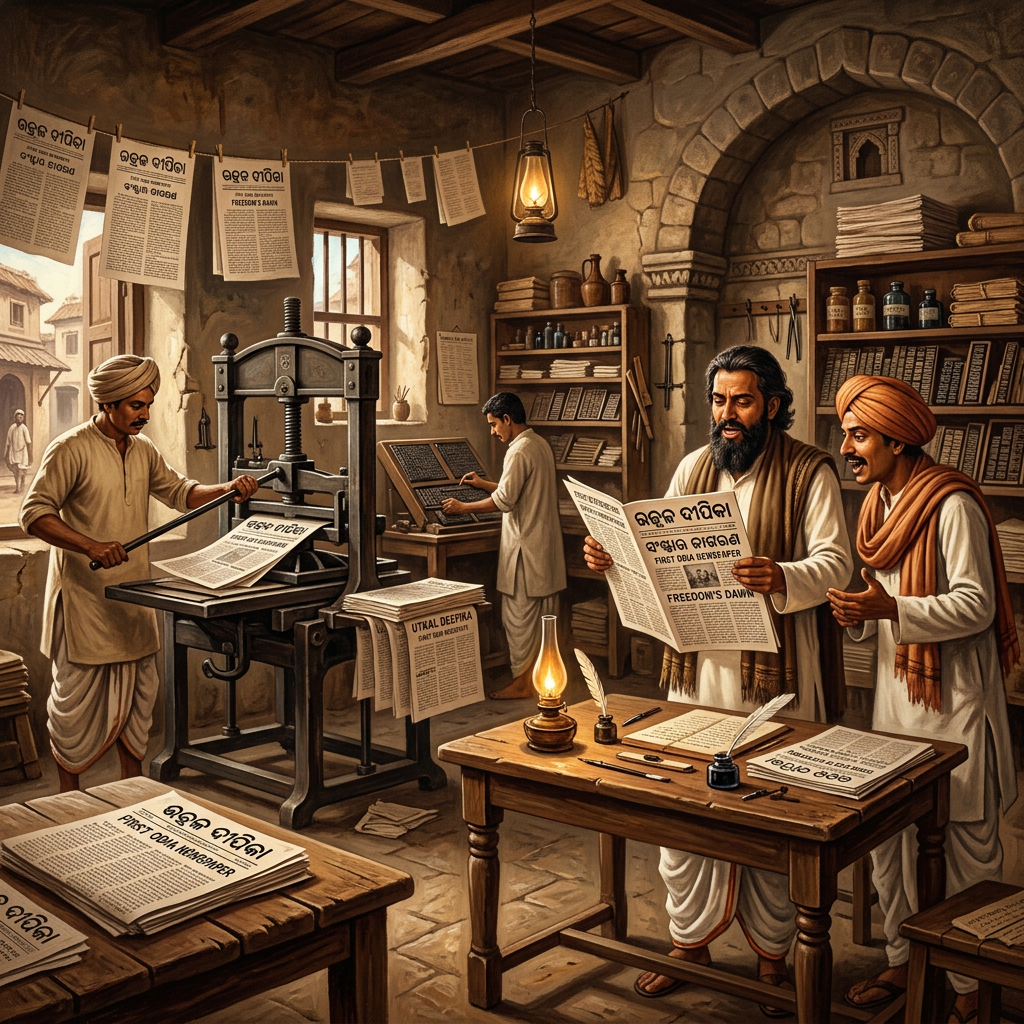
Bichitrananda Das: The Visionary Architect of Modern Odisha
Bichitrananda Das was a visionary 19th-century reformer who saved the Odia language, co-founded its first newspaper, and sparked the unification of Odisha.

Bichitrananda Das was a visionary 19th-century reformer who saved the Odia language, co-founded its first newspaper, and sparked the unification of Odisha.
Trending Now
Bichitrananda Das: The Visionary Architect of Modern Odisha
Key Takeaways
- Bichitrananda Das co-founded Utkal Deepika in 1866 — Odisha's first newspaper and a cornerstone of the Odia identity movement.
- He established the Cuttack Printing Company, creating the physical infrastructure for Odia literacy and journalism.
- Das played a pivotal role in defending the Odia language against Bengali replacement attempts in the 19th century.
- His 1875 memorandum became the first formal step toward Odisha's formation as a separate province.
- He championed higher education by supporting institutions like Ravenshaw Collegiate School, which eventually became Ravenshaw University.
- The Melabardhini Sabha he organized laid the intellectual foundation for the Utkal Sammilani, central to Odisha's unification.
- August 4 is officially observed as Odia Journalism Day in his honor.
- Odisha became India's first linguistically formed state on April 1, 1936 — a movement Das seeded decades earlier.
Introduction: The Unsung Hero of the Odia Renaissance
Every great civilization rests on the shoulders of those who refused to let it disappear.
In the smoky, uncertain corridors of 19th-century colonial Odisha — a land divided, its language threatened, its people scattered across multiple British administrative provinces — one man quietly, persistently, and brilliantly chose to fight back. Not with arms, but with ink. Not with rebellion, but with education. Not with anger, but with a vision so clear that it took generations to fully understand its magnitude.
That man was Bichitrananda Das.
While names like Madhusudan Das and Fakir Mohan Senapati frequently dominate conversations about the Odia renaissance, Bichitrananda Das stands as a foundational pillar — a true architect who laid the bricks before others built the towers. He was a civil servant who became a cultural crusader, a printer who became a freedom fighter of language, and an administrator who became the conscience of a civilization.
As Odisha celebrates Utkal Divas on April 1 each year, marking the day it became India's first linguistically formed state in 1936, it is impossible to fully honor that legacy without understanding the man who planted its earliest seeds — sometimes seven decades before the harvest.
This is his story.
Early Life and Administrative Influence: The Seristadar to Commissioner Ravenshaw
To understand Bichitrananda Das, one must first understand the world he was born into.
The Odisha of the mid-19th century was a fractured land. Odia-speaking territories were splintered across the Bengal Presidency, the Central Provinces, and Madras Presidency under British rule. There was no unified Odisha. There was no protected Odia identity. And in the offices of colonial administration, there was precious little room for native voices to rise.
Das began his career as a Seristadar — a senior clerical officer — under the Bengal Civil Service. But his position gave him something invaluable: proximity to power. He worked closely with Commissioner T.E. Ravenshaw, one of the more sympathetic British administrators of his time, who recognized both the potential of Odisha's people and the transformative ideas that Das carried.
This proximity was not squandered.
Das used his influence to advocate for the region's people, to push for institutional development, and to build networks of like-minded intellectuals who believed that Odisha deserved better — a unified identity, a protected language, and access to knowledge. In many ways, he was the classic example of a man who understood that change comes not just from protest, but from patient, strategic institution-building.
The Birth of Utkal Deepika: Revolutionizing Odia Journalism in 1866
If there is a single act for which Bichitrananda Das deserves eternal recognition, it is the founding of Utkal Deepika — The Light of Odisha.
On August 4, 1866, Das and his collaborator Gouri Shankar Ray did something that had never been done before: they published the first Odia-language newspaper in history. The launch wasn't just a media event — it was a cultural declaration. It said, loudly and in print, that Odia is a living language. Odia people have a voice. And that voice will not be silenced.
🗞️ Utkal Deepika, co-founded by Bichitrananda Das, remained in publication for 70 years (1866–1936), spanning the entire movement for Odisha's statehood. — Odisha Bytes
That 70-year run is staggering in its own right. From its founding year through to Odisha's formal recognition as a separate state, Utkal Deepika was there — reporting, rallying, informing, and inspiring. It was not just a newspaper; it was a living chronicle of Odisha's struggle for identity.
The paper became a gathering point for Odia intellectuals, poets, reformers, and social thinkers. It carried debates about language policy, education, and culture. It gave Odia society a mirror to see itself clearly, and a megaphone to speak to the world.
📅 August 4 is officially celebrated as 'Odia Journalism Day' in Odisha to commemorate the founding of Utkal Deepika by Das and Gouri Shankar Ray. — Government of Odisha
Today, when young Odia journalists sit down to write, when news portals publish in the Odia script, when television anchors speak in Odia on prime time — they are all standing on the foundation that Bichitrananda Das and Gouri Shankar Ray laid in 1866.
Cuttack Printing Company: Building the Infrastructure for Literacy
Great ideas need great infrastructure.
Bichitrananda Das understood this with extraordinary clarity. It is one thing to dream of an educated, literate Odia public. It is quite another to actually build the mechanisms that make literacy possible. And so, he established the Cuttack Printing Company — one of the most consequential institutions in Odia cultural history.
At a time when printing presses were rare, expensive, and largely controlled by colonial authorities or Bengali interests, the Cuttack Printing Company represented self-determination in physical form. It was the means by which Odia texts could be produced, distributed, and preserved at scale.
| Institution | Founded By | Impact |
|---|---|---|
| Cuttack Printing Company | Bichitrananda Das | Enabled mass Odia-language publishing and distribution |
| Utkal Deepika Newspaper | Bichitrananda Das & Gouri Shankar Ray | First Odia newspaper; ran for 70 years |
| Ravenshaw Collegiate School | Supported by Das | Evolved into Ravenshaw University |
| Odia Panjika | Standardized by Das | Cultural calendar adopted statewide |
| Melabardhini Sabha | Organized by Das | Foundation of Utkal Sammilani |
The press produced not just newspapers, but books, pamphlets, religious texts, and educational materials in Odia — nourishing a reading public that colonial administration had long neglected. In many ways, the Cuttack Printing Company was to Odisha what the printing revolution was to Renaissance Europe: the mechanism that turned ideas into movements.
The Language War: Defending Odia Against Bengali Replacement
Of all the battles that Bichitrananda Das fought, perhaps none was more urgent — or more existential — than the fight to protect the Odia language itself.
In the 1860s and beyond, a dangerous administrative logic was gaining ground within the Bengal Presidency: that Bengali should replace Odia as the medium of instruction and official communication in Odia-speaking regions. This wasn't merely a bureaucratic preference. It was a cultural extinction threat dressed in administrative clothing.
Imagine waking up one morning to find that your mother tongue — the language of your poetry, your prayers, your identity — had been officially declared unnecessary. That the words your grandmother used to sing lullabies were to be replaced by a foreign tongue, however culturally rich in its own right.
This was the reality that Das refused to accept.
He mobilized intellectuals, wrote petitions, organized public gatherings, and used the pages of Utkal Deepika to make the case — again and again — that Odia was not a dialect of Bengali, but a distinct, ancient, and sovereign language with its own script, literature, and history.
| Threat to Odia Language | Response by Bichitrananda Das |
|---|---|
| Bengali replacement in schools | Advocacy for Odia-medium education |
| Suppression of Odia printing | Established Cuttack Printing Company |
| Administrative marginalization | Used civil service position to lobby for Odia |
| Cultural erasure | Published Utkal Deepika as cultural anchor |
| No unified Odia province | Filed 1875 memorandum for separate province |
His efforts were instrumental in preserving the structural integrity of the Odia language at a time when it was most vulnerable. And the vindication of his position came slowly but decisively: Odia was officially recognized as a distinct language, and Odisha eventually became a separate state — precisely because Odia identity was proven to be irreducibly its own.
Pioneering Higher Education: From Cuttack District School to Ravenshaw University
Bichitrananda Das believed that language without education was a castle without walls.
He was a strong and active supporter of educational institutions at a time when higher learning in Odisha was embryonic at best. Most notably, he championed the development of institutions like the Cuttack District School and the Ravenshaw Collegiate School — institutions that would serve as the intellectual nurseries of a generation.
His relationship with Commissioner T.E. Ravenshaw extended beyond administrative convenience. Both men shared a conviction that education was the most durable form of social investment. Das's advocacy and organizational efforts helped these institutions find the footing they needed to grow.
The Ravenshaw Collegiate School eventually evolved, over decades, into Ravenshaw College, and ultimately into Ravenshaw University — one of the oldest and most respected universities in Eastern India today. When students walk those historic corridors in Cuttack, they walk through a legacy that Bichitrananda Das helped build.
🎓 "The investment in education is never lost. It multiplies across generations." — The philosophy that guided Das's institutional work, echoed in every student who has graduated from Ravenshaw.
This was not charity. This was strategic nation-building — the recognition that if Odia people were to govern themselves, lead themselves, and articulate their own identity, they needed educated minds capable of doing so.
Melabardhini Sabha: The Intellectual Seeds of Odia Nationalism
Great political movements rarely begin with politicians.
They begin with thinkers. With gatherings. With conversations in rooms where people dare to imagine something different. For Odisha, that room was the Melabardhini Sabha — an intellectual assembly organized by Bichitrananda Das that became, in retrospect, one of the most consequential meetings in Odia history.
The Melabardhini Samaroha (meaning roughly, the "society for broadening horizons") brought together Odia intellectuals, educators, journalists, and cultural leaders for organized discussion and action around Odia identity and governance. It was a space where ideas were sharpened, alliances were forged, and the seeds of a much larger movement were planted.
Those seeds eventually grew into the Utkal Sammilani — the premier organization that drove the movement for a unified, separate Odia state. The Utkal Sammilani is widely credited as the central engine of Odisha's unification movement, and its intellectual DNA can be traced directly back to the conversations Das organized in the Melabardhini gatherings.
This is how history works at its most organic. One man creates space for dialogue. That dialogue births an organization. That organization drives a movement. That movement reshapes the map of a nation.
The 1875 Memorandum: The First Step Toward a Separate Province
History often has a document at its center — a charter, a proclamation, a petition.
For the Odia statehood movement, that document was the 1875 memorandum, significantly associated with the advocacy of Bichitrananda Das and his contemporaries. This formal petition called for the unification of Odia-speaking territories under a single administrative province — a radical demand at the time, but one grounded in the irrefutable logic of linguistic and cultural unity.
🗺️ Odisha became the first state in India to be formed on a linguistic basis on April 1, 1936 — a movement initiated by Das's 1875 memorandum. — Wikipedia - Utkal Sammilani
Think about that timeline for a moment: 61 years separated the memorandum from its fruition. Das filed a demand in 1875 that would not be answered until 1936. He would not live to see it. But he planted it anyway, with the full knowledge that the right thing to do does not wait for convenient timing.
| Year | Milestone in Odia Statehood Movement |
|---|---|
| 1866 | Utkal Deepika founded — Odia voice enters public sphere |
| 1875 | Memorandum filed for a separate Odia province |
| 1880s–1890s | Melabardhini Sabha and intellectual movement gains momentum |
| 1903 | Utkal Sammilani formally established |
| 1936 | Odisha officially formed as India's first linguistic state |
This is Das's greatest legacy — not just what he built, but what he made possible for others to build after him.
Standardizing Culture: The Modernization of the Odia Panjika
Culture is not only preserved in newspapers and schools. It lives in the rhythms of daily life — in festivals, in agriculture, in the sacred measurements of time.
Bichitrananda Das understood this deeply, which is why, alongside his political and educational work, he undertook the important task of standardizing the Odia Panjika — the traditional Odia almanac that governs religious observances, agricultural timings, auspicious dates, and cultural festivals across Odisha.
Before his intervention, the Panjika existed in multiple, inconsistent forms — leading to confusion, conflicting observances, and a fragmentation of cultural practice across regions. Das worked to modernize and standardize it, creating a unified cultural calendar that could be adopted consistently across Odia-speaking communities.
The result was profound. A standardized Panjika meant that families across Odisha — from the coastal districts to the tribal highlands — were celebrating the same festivals on the same days, reading from the same cultural script. It was a soft but powerful act of unification, weaving communities together through shared time and shared tradition.
Today, the Odia Panjika remains one of the most widely used cultural reference documents in Odisha's households. Its roots trace back, in no small part, to the modernizing vision of Bichitrananda Das.
The Legacy of Bichitrananda Das in Modern-Day Odisha
Stand anywhere in modern Odisha — in the campus of Ravenshaw University, in the newsrooms of Odia media organizations, in the offices of cultural bodies that work to preserve the Odia script — and you are standing inside the legacy of Bichitrananda Das.
He was a man who understood that identity is infrastructure. That before a people can achieve political freedom, they must first have cultural confidence. That before a language can be protected by law, it must first be loved and lived by its people.
His contributions span every dimension of that foundational work:
- Journalism: Utkal Deepika gave Odia society a public voice for 70 unbroken years.
- Education: His support for Ravenshaw institutions seeded generations of Odia leadership.
- Printing: The Cuttack Printing Company made Odia literacy physically possible at scale.
- Language Defense: His resistance to Bengali imposition preserved Odia's structural independence.
- Political Organizing: The Melabardhini Sabha and the 1875 memorandum gave the statehood movement its intellectual architecture.
- Cultural Standardization: The modern Odia Panjika bears the imprint of his reforming vision.
🌟 "A civilization that forgets its architects cannot sustain its own buildings."
As Odisha Review and historians of the Odia movement have documented, the 19th-century renaissance in Odisha was not the work of one man alone — but Bichitrananda Das was undeniably among the most consequential figures of that era, deserving far greater public recognition than he currently receives.
Conclusion: Why Utkal Divas Is Incomplete Without Bichitrananda Das
Every year on April 1, Odisha celebrates Utkal Divas — the anniversary of its formation as India's first linguistically organized state. There are ceremonies, cultural programs, speeches, and a proud collective remembrance of the journey that brought Odia people to that historic moment.
But history is only fully honored when it is fully told.
Bichitrananda Das was not a king. He held no title of revolutionary. He did not lead an army or deliver a famous speech at a famous moment. He was something rarer and arguably more important: he was a patient, visionary builder who understood that the true revolution happens in the decades before the landmark date — in the printing press, in the classroom, in the petition, in the gathering of minds, in the defense of a mother tongue.
The Odia language that Odisha celebrates on Utkal Divas? Bichitrananda Das fought to keep it alive. The newspaper tradition that covers those celebrations? He founded it in 1866. The university whose alumni lead those ceremonies? He helped plant its institutional roots. The statehood movement that culminated in 1936? He filed its foundational memorandum in 1875 — and waited, patiently, for history to catch up.
As we at Voxora reflect on the stories that deserve to be told — the figures who deserve to be remembered — Bichitrananda Das stands as a towering example of what it means to give everything to a cause larger than oneself, with no guarantee of recognition, and with complete certainty that it is the right thing to do.
Utkal Divas is not just a date. It is a testament. And Bichitrananda Das is one of its greatest authors.
Sources
- Odisha Bytes — 153 Years of Odia Journalism
- Wikipedia — Utkala Deepika
- Wikipedia — Utkal Sammilani
- History of Odisha — The Rise of the Odia Movement
- Odisha Review — Government E-Magazine
- Government of Odisha — Official Portal
Published on Voxora | Written for general audiences passionate about Indian history, culture, and identity.
Advertisement
Frequently Asked Questions
Who was Bichitrananda Das and what is his primary legacy?
Bichitrananda Das was a pivotal 19th-century social reformer and intellectual recognized as an architect of modern Odisha. He is best known for co-founding Utkal Deepika in 1866, the first Odia newspaper, and for his efforts in establishing the Cuttack Printing Company to foster local literary growth.
How did Bichitrananda Das contribute to the development of Ravenshaw College?
He played a foundational role in promoting higher education by supporting the Cuttack District School and Ravenshaw Collegiate School. His advocacy and support for these educational institutions provided the groundwork for their eventual evolution into Ravenshaw College, a premier academic institution in Odisha.
What was the significance of the newspaper Utkal Deepika?
Launched in 1866 by Bichitrananda Das and Gaurishankar Rai, Utkal Deepika was the first newspaper in the Odia language. It served as a vital tool for social awakening and a guiding light for society, helping to bring national recognition to Cuttack and the surrounding region.
How did Bichitrananda Das protect the Odia language from being replaced?
During a period when there were active administrative attempts to replace Odia with Bengali, Das acted as a vigilant guardian. He organized intellectual movements to resist these changes, ensuring that Odia remained the official language and a central pillar of the state's identity.
What was the Melabardhini Samaroha and why was it important?
The Melabardhini Samaroha was an intellectual movement organized by Bichitrananda Das to promote cultural unity. This movement is significant because it laid the foundation for the Utkal Sammilani, the organization that ultimately led the successful campaign for the unification of Odisha as a separate province in 1936.
Sponsored
You Might Also Like


Advertisement
Comments (0)
Sign in to join the conversation
No comments yet. Be the first to share your thoughts!