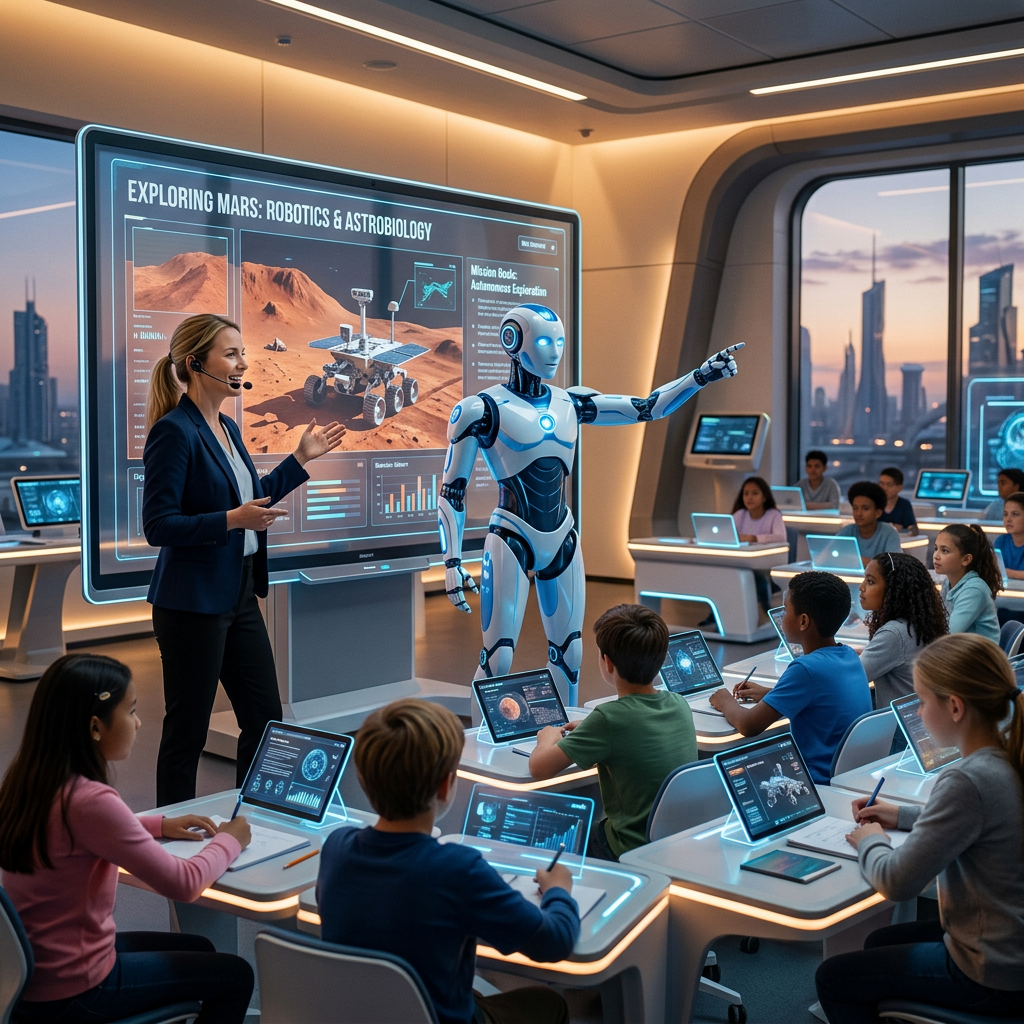
Why AI Won’t Replace Teachers: The Human Side of Learning | will AI replace teachers
Will AI replace teachers? Explore why human mentorship is irreplaceable and how AI is transforming classrooms into personalized learning hubs in 2026.

Will AI replace teachers? Explore why human mentorship is irreplaceable and how AI is transforming classrooms into personalized learning hubs in 2026.
Trending Now
Why AI Won't Replace Teachers: The Human Side of Learning
Key Takeaways
- The question of will AI replace teachers is one of the most debated topics in modern education — the evidence says no, but transformation is inevitable.
- AI tools are saving educators nearly 6 full weeks of work per year, freeing them to focus on mentorship and deeper human connection.
- The global AI in education market is on track to grow from $7.05 billion in 2025 to $136.79 billion by 2035.
- 92% of higher education students used generative AI in some form in 2025 — making digital fluency a survival skill, not a trend.
- The future of education is hybrid: AI handles repetitive, data-driven tasks while teachers lead with empathy, creativity, and social-emotional guidance.
- Parents, students, and institutions must engage proactively with AI integration — not resist it.
1. The AI Revolution: Is the Traditional Classroom Dying?
Walk into any modern classroom today and you will notice something has fundamentally shifted. Students query AI chatbots for homework explanations. Teachers use learning management systems powered by machine learning to track comprehension in real time. Administrators deploy educational technology platforms to predict dropout risks before they materialize. The question on every parent's lips, every student's mind, and every educator's heart is unavoidable: will AI replace teachers?
The anxiety is understandable. We have watched AI disrupt industries — from journalism and law to customer service and logistics. It is natural to wonder whether the teaching profession stands on similarly unstable ground. Yet a closer examination of research, classroom data, and the fundamental nature of human development tells a far more nuanced story.
The traditional classroom is not dying. It is evolving — rapidly, dramatically, and in ways that demand we understand the distinction between what machines can optimize and what only humans can cultivate.
This article explores that distinction in depth, grounded in verified research and global data, to help students, parents, and education professionals navigate one of the most consequential shifts in the history of learning.
2. Myth vs. Reality: Why AI Cannot Replace Human Teachers
The myth that will AI replace teachers stems from a fundamental misunderstanding of what teaching actually is. Popular culture frames education as information delivery — a teacher inputs knowledge, a student outputs understanding. Under that reductive model, yes, AI could theoretically replace teachers. It can deliver content faster, more consistently, and at scale.
But teaching has never been merely about information transfer.
UNESCO has long emphasized that education is fundamentally a human rights issue — one rooted in dignity, relationship, and the holistic development of individuals. Their frameworks consistently highlight that teachers serve as cultural transmitters, emotional anchors, and moral guides in a child's development. These are not incidental features of good teaching. They are its core.
Consider what a skilled teacher actually does in a single school day:
- Detects that a quiet student is struggling emotionally, not academically
- Adjusts the energy of a lesson mid-delivery based on the room's mood
- Resolves a conflict between students in a way that teaches empathy
- Celebrates a breakthrough moment with genuine shared joy
- Challenges a gifted student with a question that redefines their worldview
No AI system — however sophisticated — can replicate the lived human experience required for these moments. Social-emotional learning (SEL), which research consistently links to better academic outcomes, long-term mental health, and civic participation, depends entirely on human relationships. Algorithms can identify that a student is disengaged. Only a compassionate teacher can understand why and respond in a way that matters.
"The evidence is clear: teachers are among the most powerful influences on student outcomes — not just academically, but socially, emotionally, and developmentally." — McKinsey & Company, "The State of Education 2024"
3. The Teacher's New Co-Pilot: How AI Saves 6 Weeks of Work Yearly
If AI is not replacing teachers, what is it doing inside modern classrooms? The most accurate answer: it is becoming the most powerful co-pilot educators have ever had.
According to the Engageli 2026 Report, teachers who use AI tools weekly save an average of 5.9 hours per week — the equivalent of six full weeks per school year. That number is not abstract. It represents thousands of hours reclaimed from administrative burden and redirected toward human-centered teaching.
What are those hours saved from? Primarily:
- Lesson plan generation and curriculum design
- Automated grading of multiple-choice, short-answer, and even essay drafts
- Progress tracking and report card preparation
- Differentiated materials creation for diverse learners
- Parent communication drafting and scheduling
📊 Teachers using AI tools weekly save an average of 5.9 hours per week — equivalent to six full weeks per school year. — Engageli 2026 Report
This time dividend is transformative. A teacher who no longer spends three hours on Sunday grading papers can spend that time developing a project-based learning unit that genuinely excites students. A teacher freed from generating 30 individualized worksheets can dedicate that energy to one-on-one mentoring sessions.
The narrative of teacher automation as a threat misses this reality entirely. For the majority of educators, AI is not a replacement — it is a relief.
4. Hyper-Personalization: Tailoring Education to Every Student
One of the most profound promises of AI in education is personalized learning at a scale that was previously impossible. Traditional classrooms operate on a fundamentally compromised model: one teacher, thirty students, a single curriculum pace. Inevitably, some students are bored, others are lost, and only a narrow band in the middle is optimally challenged.
AI-powered adaptive learning platforms — tools like Khan Academy's Khanmigo, Carnegie Learning, and DreamBox — use real-time data to adjust content difficulty, pacing, and presentation style to each individual learner. A student who struggles with fractions receives targeted micro-lessons and additional practice. A student who masters algebra quickly is advanced to pre-calculus content without waiting for the rest of the class.
| Feature | Traditional Classroom | AI-Enhanced Classroom |
|---|---|---|
| Learning Pace | Fixed (class-wide) | Adaptive (individual) |
| Feedback Speed | Days to weeks | Immediate |
| Content Differentiation | Limited by teacher time | Automated & scalable |
| Progress Monitoring | Periodic assessments | Continuous & real-time |
| Social-Emotional Support | Strong (human-led) | Limited (rule-based) |
| Creative Mentorship | Excellent | Minimal |
This table illustrates something critical: AI and human teachers are not competitors on the same axis. They are complementary forces operating on different dimensions of education. AI wins on speed, scale, and data processing. Teachers win on empathy, inspiration, and relational depth.
McKinsey & Company research on education transformation notes that schools successfully integrating adaptive learning technologies see measurable improvements in student engagement and performance — particularly among historically underserved student populations who benefit most from individualized pacing and immediate feedback loops.
5. The Future Role of Educators: From Lecturers to Mentors
The evolution underway in education is not the elimination of teachers — it is the elevation of teachers. As AI absorbs the transactional dimensions of teaching (information delivery, routine assessment, administrative logistics), the irreplaceable dimensions of the profession come into sharper focus.
The teacher of 2030 will be less a lecturer and more a learning architect and human mentor. Their most valuable functions will include:
- Facilitating critical thinking through Socratic dialogue and project-based inquiry
- Nurturing emotional intelligence and interpersonal skills in students
- Providing career and life guidance that contextualizes academic content
- Building classroom community and a culture of curiosity
- Interpreting AI-generated data with professional judgment and human wisdom
This shift demands significant investment in teacher training and professional development. Educators need fluency in edtech trends 2026 and beyond — not to become technologists, but to become informed curators of the best tools available for their students.
UNESCO has called on member nations to prioritize teacher professional development in the AI era, emphasizing that the goal must be to empower teachers with technology, not to replace them with it. This framing — empowerment versus replacement — should define every conversation about AI and education.
6. AI Tutors vs. Human Tutoring: Finding the Right Balance
The rise of AI tutors represents one of the most democratizing developments in education history. For decades, private tutoring has been a privilege of economic advantage. Wealthy families could purchase individualized academic support; others could not. AI tutoring platforms are disrupting that inequity.
📊 The global AI in education market is projected to grow from $7.05 billion in 2025 to $136.79 billion by 2035. — Grand View Research
This explosive market growth reflects genuine demand. AI tutors offer extraordinary advantages: 24/7 availability, infinite patience, consistent quality, and zero social anxiety for students who might be reluctant to ask human tutors for help repeatedly.
However, the limitations of AI tutoring are equally real and must be honestly acknowledged.
| Dimension | AI Tutors | Human Tutors |
|---|---|---|
| Availability | 24/7 | Scheduled sessions |
| Cost | Low to free | High (premium market) |
| Patience & Consistency | Unlimited | Variable |
| Emotional Support | Minimal | High |
| Deep Subject Expertise | Broad, not always nuanced | Specialized & contextual |
| Motivational Coaching | Limited | Strong (relationship-based) |
| Adaptability to Mood | None | Significant |
The optimal model is not a binary choice between AI tutors and human tutors — it is strategic integration. AI tutors handle foundational skill-building, homework support, and knowledge reinforcement. Human tutors address complex problem-solving, confidence building, motivational challenges, and the kind of intellectual mentorship that changes a student's relationship with learning itself.
Schools and families that understand this distinction will extract the maximum benefit from both resources.
7. The Digital Divide: Ensuring Equitable AI Access for All Students
No discussion of AI in education is complete without an honest reckoning with equity. The optimistic projections about personalized learning and AI tutoring rest on a premise that is far from universal: reliable access to technology.
Globally, hundreds of millions of students lack consistent internet access, modern devices, or electricity. Even within wealthy nations, the digital divide maps closely onto existing inequalities of race, class, and geography. If AI-powered education tools are adopted without deliberate equity frameworks, they risk deepening the very gaps they promise to close.
UNESCO warns explicitly that the rollout of educational technology without equity safeguards could create a two-tier global education system — one where privileged students benefit from hyper-personalized AI learning while disadvantaged students fall further behind.
Policy recommendations from leading researchers include:
- Public investment in broadband infrastructure in underserved communities
- Device subsidy programs for low-income students and families
- Offline-capable AI tools designed for low-connectivity environments
- Teacher training equity — ensuring educators in under-resourced schools receive the same AI literacy support as those in premium institutions
- Diverse AI development teams to minimize algorithmic bias in educational tools
Classroom innovation must serve every classroom — not only the well-funded ones. This is a moral imperative, not merely a policy preference.
8. Academic Integrity and the Ethics of AI in Schools
The statistic from HEPI (Higher Education Policy Institute) is striking: 92% of higher education students used generative AI in some form during 2025, up dramatically from 66% in 2024. This near-universal adoption is both a testament to AI's utility and a profound challenge for academic integrity.
📊 92% of higher education students used generative AI in some form in 2025, up from 66% in 2024. — HEPI Student Survey
When a student submits an AI-generated essay as their own work, have they learned? Have they demonstrated understanding? Have they developed the cognitive muscles that education exists to build? These are not rhetorical questions — they are the central ethical tensions of modern pedagogy.
The most productive institutional responses are not blanket bans (which the data suggests are both ineffective and impractical) but rather pedagogical redesign:
- Assessment formats that resist AI shortcuts: oral examinations, in-class writing, project portfolios with documented process
- AI literacy curricula that teach students how to use AI ethically as a thinking tool — not a thinking replacement
- Transparent AI use policies that distinguish between assisted and independent work
- Critical evaluation skills so students can assess AI outputs rather than blindly trust them
Institutions that treat AI as purely a threat to integrity will lose ground to those that meet students where they are and teach responsible, empowered AI use.
9. Preparing for the AI-Powered Workforce: Skills Students Need
The ultimate purpose of education extends beyond academic performance — it is preparation for a meaningful life and a productive career. In an economy increasingly shaped by AI, what skills will actually matter?
McKinsey & Company research on the future of work consistently highlights that the skills most resistant to automation are those most deeply human:
- Critical and systems thinking — the ability to evaluate complex problems holistically
- Creative and innovative reasoning — generating original solutions and ideas
- Emotional intelligence and interpersonal communication
- Ethical judgment and values-based decision-making
- AI fluency — understanding what AI can and cannot do, and directing it effectively
Notably, this list reads as a curriculum for great teaching as much as workforce preparation. The best teachers have always cultivated these capacities. The AI era simply makes their centrality undeniable.
Students who graduate with strong AI fluency, robust critical thinking, and deep human communication skills will not be displaced by AI — they will be the ones directing it. Schools and families that orient education toward these outcomes will give students a genuine competitive advantage.
10. What Parents Should Know About AI-Integrated Curriculums
For parents navigating this landscape, the volume of information can feel overwhelming. Here are the most important evidence-based principles to guide your engagement:
Ask the right questions of your child's school:
- How is AI being used in the classroom, and what oversight exists?
- Are teachers receiving professional development in edtech tools?
- How is the school addressing academic integrity in the AI era?
- Is data collected by AI platforms being protected appropriately?
Support healthy AI habits at home:
- Encourage your child to use AI as a starting point for thinking, not a substitute for it
- Discuss AI outputs critically — ask your child what they think about what AI generates
- Monitor for over-reliance: if your child cannot explain concepts without AI assistance, that is a meaningful signal
Advocate for equity:
- Engage with school boards and parent associations on digital access equity initiatives
- Support policies that ensure every student — regardless of household income — has access to quality devices and connectivity
Remain engaged, not alarmed: The integration of AI in education is not a crisis to be feared — it is a transition to be navigated thoughtfully. Parents who stay informed and engaged are essential partners in ensuring that transition serves children's best interests.
11. Conclusion: A Hybrid Future for Global Education
The question of will AI replace teachers has a clear, research-supported answer: no. But the more important question — how will AI transform teaching and learning? — demands our full attention.
The evidence paints a compelling picture of a hybrid future: one where AI handles the computational, administrative, and adaptive dimensions of education with unprecedented efficiency, while human teachers focus their irreplaceable gifts — empathy, inspiration, mentorship, moral guidance — on the students who need them most.
The future belongs to educational systems that are wise enough to use AI as a tool, and humble enough to recognize that no algorithm can replicate the transformative power of a great teacher.
The global AI in education market will grow to $136.79 billion by 2035. Ninety-two percent of students are already using generative AI. Teachers are already reclaiming six weeks of professional time annually through intelligent tools. These are not hypothetical futures — they are the present, accelerating.
What remains constant, across every era of educational innovation — from the printing press to the internet to generative AI — is the foundational truth that UNESCO has long articulated: education is, at its core, a human endeavor. It is the act of one generation passing wisdom, values, curiosity, and capability to the next.
AI can optimize that process in extraordinary ways. It cannot replace the human heart at its center.
For students, parents, and educators alike, the charge is the same: stay informed, stay engaged, and ensure that as our classrooms evolve, they remain — above all else — places where human beings help other human beings become the best versions of themselves.
Sources
| # | Source | URL |
|---|---|---|
| 1 | Engageli 2026 Report | engageli.com |
| 2 | Grand View Research – AI in Education Market | grandviewresearch.com |
| 3 | HEPI Student Academic Experience Survey 2025 | hepi.ac.uk |
| 4 | McKinsey & Company – Future of Work & Education | mckinsey.com |
| 5 | UNESCO – Education & Technology Frameworks | unesco.org |
Published on Voxora — The Premium Platform for World-Class Writing.
Advertisement
Frequently Asked Questions
Will AI completely replace human teachers in the next decade?
No, experts suggest AI will act as a co-pilot rather than a replacement. While the global AI in education market is projected to reach $20 billion by 2027, the World Economic Forum emphasizes that human teachers provide essential social-emotional support and mentorship that algorithms cannot replicate.
How many students are already using AI for their schoolwork?
Usage is growing rapidly; a 2023 study by Tyton Partners found that 50% of college students have used generative AI tools for their studies. For K-12 students, AI-powered platforms like Khan Academy's Khanmigo are now providing personalized 24/7 tutoring to millions of learners worldwide.
Can AI help improve student grades through personalized learning?
Yes. Research into 'Bloom's 2 Sigma Problem' shows that students receiving one-on-one tutoring perform two standard deviations better than those in traditional classrooms. AI-driven platforms can now provide this level of individualized attention to 100% of a class simultaneously, helping to close achievement gaps.
What specific skills should students focus on to stay relevant in an AI-driven future?
According to the 2023 Future of Jobs Report, 44% of worker skills will need to change by 2027. Students should focus on 'human-centric' skills such as critical thinking, emotional intelligence, and AI literacy, which involves learning how to effectively prompt and audit AI outputs.
What are the primary concerns for parents regarding AI in education?
Data privacy and academic integrity are top priorities. Surveys show approximately 81% of parents want clear regulations on how student data is handled by AI. Experts recommend that families encourage 'augmented learning' where AI assists with research and brainstorming rather than simply providing answers.
Sponsored
Curious about technology, mathematics, education, and growth, I write as a learner exploring ideas in innovation, problem-solving, culture, and the questions shaping our world.
You Might Also Like


Advertisement
Comments (0)
Sign in to join the conversation
No comments yet. Be the first to share your thoughts!