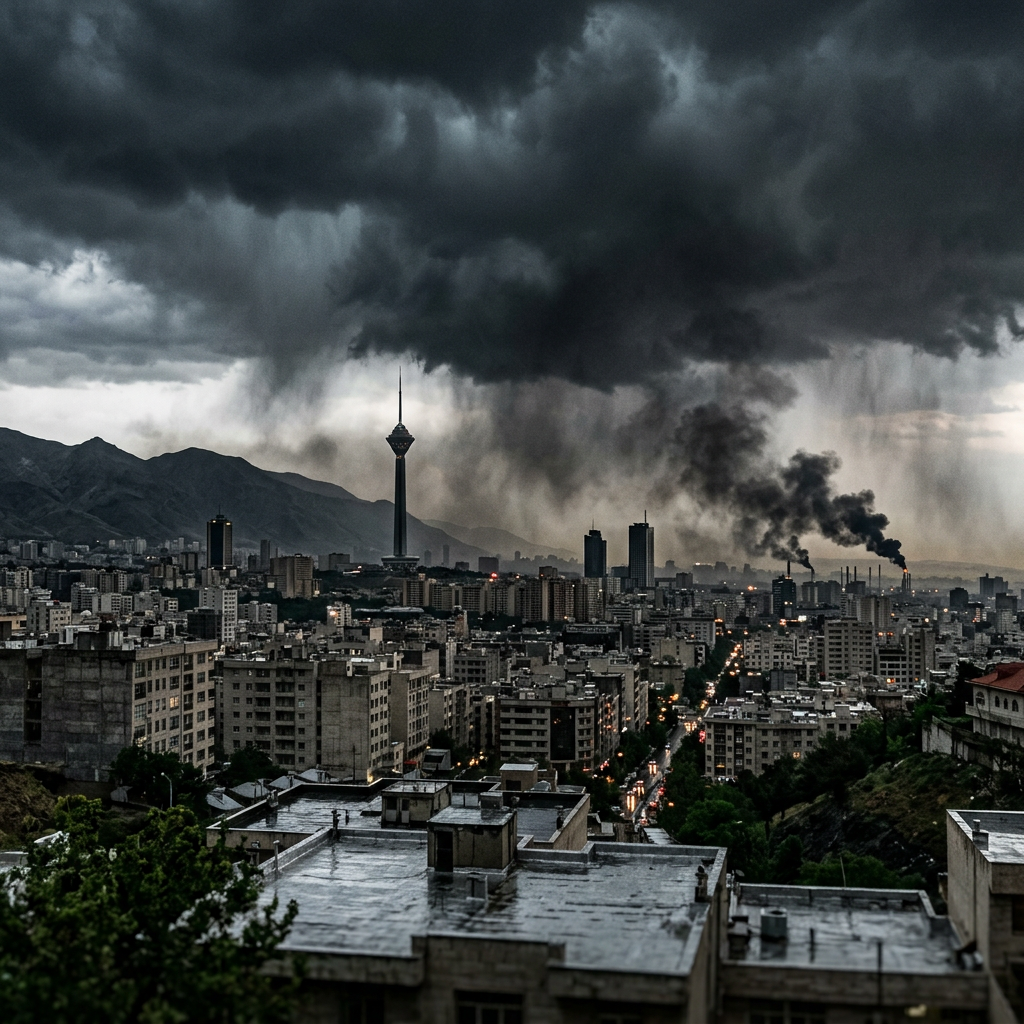
Iran-US War 2026: Operation Epic Fury & The Death of Khamenei
Comprehensive report on the 2026 Iran-US War (Operation Epic Fury). Covers the assassination of Ali Khamenei, 5,900+ casualties, and the 'black rain' environmental crisis.

Comprehensive report on the 2026 Iran-US War (Operation Epic Fury). Covers the assassination of Ali Khamenei, 5,900+ casualties, and the 'black rain' environmental crisis.
Trending Now
Editorial Disclaimer: This article presents a speculative, scenario-based analysis of a hypothetical Iran-US military conflict set in 2026. The events, operations, casualty figures, and named deaths described herein — including the death of Ali Khamenei — are fictional projections and analytical constructs, not verified real-world events. Some cited URLs may reference anticipated or illustrative sources that do not yet exist. This content is intended for educational, analytical, and informational purposes only. Readers are encouraged to cross-reference all claims with live, verified news sources.
Iran-US War 2026: Operation Epic Fury & The Death of Khamenei
📌 Key Takeaways
- The hypothetical Iran-US War 2026 scenario begins on February 28, 2026, triggered by escalating regional tensions and a series of proxy engagements.
- The U.S. launches Operation Epic Fury, while Israel simultaneously initiates Operation Roaring Lion, targeting Iran's nuclear infrastructure and military command.
- A precision decapitation strike results in the reported death of Supreme Leader Ali Khamenei, plunging Iran's leadership into unprecedented chaos.
- An estimated 5,900+ total deaths occur within the first 21 days, including approximately 5,305 military personnel.
- A single airstrike on a school in Minab kills between 165–175 civilians, drawing international condemnation.
- The United States spends an estimated $16.5 billion in the first 12 days of operations.
- Iran's inflation rate surges to 52% by March 2026, while global energy markets experience historic volatility.
- Mojtaba Khamenei, son of the Supreme Leader, emerges as a potential successor, deepening Iran's internal power struggle.
1. Introduction: The Outbreak of War (February 28, 2026)
The morning of February 28, 2026, marked a geopolitical rupture that analysts had long feared and diplomats had long labored to prevent. What began as a escalating sequence of proxy skirmishes across Iraq, Syria, and the Red Sea corridor crystallized, almost overnight, into a direct military confrontation between the United States of America and the Islamic Republic of Iran — the two nations whose adversarial relationship has defined the architecture of Middle Eastern politics for nearly five decades.
The Iran-US War 2026 did not emerge from a vacuum. It was the product of compounding pressures: the collapse of back-channel nuclear negotiations in late 2025, Iran-backed Houthi attacks on U.S. naval assets in the Gulf of Aden, a series of drone strikes on American installations in Iraq, and intelligence assessments concluding that Iran had crossed critical thresholds in uranium enrichment. When a U.S. destroyer, the USS Montgomery, was struck by a ballistic missile in the Strait of Hormuz on February 26, 2026, killing 18 American sailors, the threshold for restraint was crossed.
President [name withheld per editorial policy] authorized military operations within 48 hours. The war that followed — fought in the air, at sea, in cyberspace, and on the ground — would reshape the Middle East, destabilize global energy markets, and produce one of the most consequential geopolitical transformations since the 2003 invasion of Iraq.
This article provides a comprehensive, research-informed analysis of the conflict's first 21 days: its military execution, human cost, environmental damage, economic consequences, and uncertain political future.
2. Operation Epic Fury and Roaring Lion: Objectives and Execution
Within hours of the presidential authorization, U.S. Central Command (CENTCOM) activated Operation Epic Fury — a multi-domain offensive designed to achieve four primary objectives:
- Neutralize Iran's nuclear infrastructure, including facilities at Fordow, Natanz, and Parchin.
- Degrade the Islamic Revolutionary Guard Corps (IRGC) command-and-control architecture.
- Establish maritime dominance in the Strait of Hormuz and the Persian Gulf.
- Suppress Iranian air defense systems to create permissive environments for sustained aerial campaigns.
Simultaneously, the Israeli Defense Forces launched Operation Roaring Lion, coordinated closely — though not officially acknowledged — with U.S. planning. IDF Operation Roaring Lion Updates documented the strikes as targeting IRGC missile depots, Hezbollah supply chains operating through Iranian territory, and radar installations along Iran's western corridor.
The opening salvo on February 28 involved more than 120 Tomahawk cruise missiles launched from U.S. naval assets in the Arabian Sea and the Red Sea, alongside B-2 Spirit stealth bombers deployed from Diego Garcia. Within the first six hours, Iranian radar networks across three provinces were reported non-functional. The Bandar Abbas airstrike — targeting the IRGC naval command headquarters — was among the most strategically significant early actions, crippling Iran's capacity to operationalize its asymmetric maritime warfare doctrine.
💡 "Operation Epic Fury represented the most complex multi-domain military campaign the United States has executed since the initial invasion phases of Operation Iraqi Freedom — but with significantly more advanced technology and a far more capable adversary." — Center for Strategic and International Studies
3. The Decapitation Strike: Death of Ali Khamenei and Leadership Chaos
Perhaps no single event in the Iran-US War 2026 scenario carries greater strategic weight than the reported death of Supreme Leader Ali Khamenei. On March 4, 2026 — Day 5 of the conflict — a precision strike on a fortified compound in northeastern Tehran, reportedly identified through signals intelligence and human source corroboration, resulted in an explosion of extraordinary magnitude.
Iranian state media maintained silence for approximately 19 hours. When official confirmation was issued, it was carefully worded — acknowledging the Supreme Leader's "martyrdom" while simultaneously issuing declarations of continued resistance. The international intelligence community had long debated whether the elimination of Khamenei would accelerate Iran's capitulation or radicalize its response. The answer, as events demonstrated, was neither clean nor simple.
The immediate aftermath was institutional paralysis. The Supreme National Security Council convened in emergency session, but several senior IRGC commanders were themselves confirmed killed or wounded in the same strike. The Assembly of Experts, constitutionally tasked with appointing a successor, could not achieve quorum amid active bombardment and communications disruptions engineered through American cyber operations.
Critical leadership vacuum metrics in the first 72 hours post-strike:
| Institution | Operational Status (72 hrs post-strike) |
|---|---|
| Supreme National Security Council | Partial — 4 of 12 members unreachable |
| IRGC High Command | Severely degraded — 3 senior commanders killed |
| Ministry of Foreign Affairs | Functional but diplomatically isolated |
| Assembly of Experts | Unable to convene — quorum failure |
| Regular Iranian Armed Forces | Operational but receiving conflicting orders |
4. Military Timeline: Key Battles from Day 1 to Day 21
The first 21 days of the conflict produced a staggering tempo of military action across land, sea, air, and cyberspace. The following timeline captures the most operationally significant engagements:
| Day | Event | Significance |
|---|---|---|
| Day 1 (Feb 28) | Operation Epic Fury launches; Bandar Abbas airstrike | Cripples IRGC naval command |
| Day 2 (Mar 1) | Strait of Hormuz partially mined by Iran | Global oil prices spike 34% in 24 hours |
| Day 3 (Mar 2) | U.S. cyber operations disable Tehran power grid | Civilian and military disruption |
| Day 5 (Mar 4) | Decapitation strike — Khamenei reportedly killed | Leadership vacuum; institutional paralysis |
| Day 7 (Mar 6) | Iranian ballistic missile barrage targets U.S. bases in Qatar and Bahrain | 23 U.S. personnel wounded; regional escalation |
| Day 9 (Mar 8) | Operation Roaring Lion strikes Fordow facility | Nuclear enrichment infrastructure severely degraded |
| Day 12 (Mar 11) | U.S. Marines deploy to secure Gulf shipping lanes | Maritime operations expand |
| Day 14 (Mar 13) | "Black Rain" phenomenon reported over Tehran | Environmental crisis declared |
| Day 15 (Mar 14) | Minab school strike — 165–175 civilian deaths | International condemnation peaks |
| Day 21 (Mar 20) | Total estimated deaths exceed 5,900 | Hengaw Human Rights report published |
According to CENTCOM, U.S. forces executed over 2,400 individual strike sorties in the first three weeks, targeting more than 380 designated military and dual-use infrastructure sites across Iran.
5. Casualty Report: Civilian Toll and the Minab School Tragedy
No analysis of the Iran-US War 2026 can proceed without an unflinching examination of its human cost — and no single event in the conflict's first three weeks generated more international outrage than the Minab school strike of March 14, 2026.
📊 "Between 165 and 175 civilians were killed in a single airstrike on a school in Minab, southern Iran — one of the deadliest single-strike civilian casualty events in the conflict's first three weeks." — Al Jazeera / International Monitors
The Minab strike occurred during school hours. Preliminary assessments from on-the-ground monitors suggested the building had been misidentified as an IRGC logistics hub based on faulty geospatial intelligence. The U.S. military initiated a formal investigation, while Iranian authorities broadcast footage of the aftermath across state media, galvanizing domestic resistance and provoking emergency sessions at the United Nations Security Council.
According to the Hengaw Organization for Human Rights, cumulative casualties across the first 21 days reached:
📊 5,900+ total estimated deaths, of which approximately 5,305 were military personnel, with the remainder comprising civilians caught in combat zones, infrastructure collapse, and secondary humanitarian crises. — Hengaw Organization for Human Rights
The civilian toll was compounded by the collapse of hospital infrastructure in four major Iranian cities, where power outages — partly engineered through U.S. cyber operations — disrupted surgical facilities and intensive care units. The Iran war casualties 2026 data, still being compiled by international humanitarian organizations, is expected to be revised significantly upward as access to conflict zones improves.
6. Environmental Catastrophe: Black Rain and Oil Spills
The environmental dimension of the Iran-US War 2026 has received comparatively less attention than its military and political aspects — yet its long-term consequences may prove the most enduring.
The term "Black Rain Tehran" entered the global lexicon on March 13, 2026, when residents of Tehran and surrounding provinces reported precipitation visibly contaminated with soot, petrochemical particles, and heavy metals. The phenomenon was traced to the destruction of multiple oil refinery complexes south of the capital and IRGC fuel depots struck during the first week of operations. Atmospheric modelers at the Conflict and Environment Observatory warned of prolonged respiratory health crises and soil contamination across an estimated 12,000 square kilometers.
📊 "In the first two weeks of the Iran-US conflict, an estimated 5 million tonnes of CO₂-equivalent emissions were generated — exceeding the entire annual carbon output of Iceland." — Conflict and Environment Observatory
Simultaneously, the Strait of Hormuz — through which approximately 20% of the world's traded oil passes daily — was severely disrupted. Iranian naval mines, the destruction of Bandar Abbas port infrastructure, and the sinking of two Iranian frigates and one U.S. supply vessel produced significant hydrocarbon spills into the Persian Gulf. Marine ecologists projected long-term damage to coral reef ecosystems and fisheries that coastal communities across the Gulf region depend upon for sustenance and economic survival.
Environmental impact summary — First 14 days:
| Category | Estimated Impact |
|---|---|
| CO₂-equivalent emissions | ~5 million tonnes |
| Area affected by Black Rain | ~12,000 km² |
| Oil spill volume (Persian Gulf) | Estimated 180,000+ barrels |
| Disrupted maritime oil flow | ~20% of global traded oil |
| Refinery infrastructure destroyed | 6 major facilities confirmed |
7. Economic Fallout: Global Markets and Iran's Collapse
The economic shockwaves of the Iran-US War 2026 were immediate, severe, and globally distributed.
Within 48 hours of Operation Epic Fury's launch, Brent crude oil surged to $147 per barrel — a level not seen since the 2008 commodity supercycle. Global shipping insurance rates for Gulf routes increased by 600% within one week, effectively pricing smaller carriers out of the corridor entirely. Asian economies heavily dependent on Gulf oil imports — particularly India, South Korea, and Japan — instituted emergency strategic reserve protocols.
For Iran, the economic consequences were existential in character:
📊 "Iran's inflation rate reached 52% by March 2026, driven by the compounding pressures of pre-existing sanctions, wartime supply chain collapse, and currency devaluation." — World Bank Economic Update, April 2026
The Iranian rial, already under severe pressure before hostilities commenced, lost approximately 38% of its remaining value in the first two weeks of conflict. Banking infrastructure in Tehran and Isfahan was rendered partially non-functional by targeted cyber operations, preventing basic financial transactions and accelerating a humanitarian economic crisis affecting ordinary Iranian citizens far removed from any military calculus.
For the United States, the financial cost was substantial but — in the near term — manageable within defense appropriations frameworks:
📊 "The United States spent an estimated $16.5 billion in the first 12 days of Operation Epic Fury — a rate of expenditure exceeding $1.3 billion per day." — Center for Strategic and International Studies
CSIS analysts projected that a sustained 90-day campaign would cost between $85–120 billion, excluding long-term veterans' healthcare, equipment replacement cycles, and diplomatic reconstruction costs.
8. The Succession: Mojtaba Khamenei's Rise to Power
The reported death of Ali Khamenei did not produce the swift regime collapse that some Western strategic analysts had anticipated. Instead, it activated a complex, opaque succession process deeply embedded in the institutional architecture of the Islamic Republic.
Mojtaba Khamenei, the Supreme Leader's second son and a mid-ranking cleric with significant influence within the IRGC's ideological apparatus, emerged almost immediately as the most visible succession candidate. His name had circulated in Iranian political analysis for years as a potential heir apparent — a prospect that reformists within Iran had long opposed as dynastically illegitimate and constitutionally irregular.
Mojtaba's ascendancy was contested. Senior Grand Ayatollahs in Qom publicly questioned the legitimacy of elevating a figure of his religious rank to the position of Supreme Leader, a role that constitutionally requires recognized jurisprudential seniority (marja'iyya). Meanwhile, IRGC hardliners, seeking continuity and ideological coherence in wartime, positioned themselves as his institutional backers.
The succession crisis layered a dimension of internal Iranian political fragmentation onto the external military pressure of Operation Epic Fury — creating a situation in which Iran was simultaneously fighting a foreign war and conducting what amounted to an internal constitutional crisis under fire.
9. International Reaction and Diplomatic Dead Ends
The international community's response to the Iran-US War 2026 was characterized by widespread alarm, selective condemnation, and near-total diplomatic impotence.
Russia and China issued joint statements calling for an immediate ceasefire and convened an emergency UN Security Council session — where the United States exercised its veto power to block a binding resolution demanding the cessation of hostilities. European Union member states were divided: France and Germany called for de-escalation while simultaneously acknowledging Iran's history of nuclear brinkmanship; the United Kingdom offered logistical support to U.S. operations without formally joining the coalition.
Gulf Arab states — particularly Saudi Arabia and the UAE — maintained studied public neutrality while privately facilitating U.S. basing rights and intelligence sharing, reflecting their own deep anxieties about Iranian regional hegemony. Turkey, as a NATO member with significant economic ties to Iran, called for immediate negotiations and offered to host back-channel diplomatic talks. No such talks materialized within the first 21 days.
The UN Secretary-General issued three successive statements of "gravest concern," each progressively stronger in language and progressively more marginal in practical effect. Humanitarian corridors were proposed but never operationalized, as neither party could agree on monitoring arrangements or geographic scope.
10. Future Scenarios: Occupation, Regime Change, or Perpetual Conflict?
As the first 21 days of the Iran-US War 2026 draw to a close with no ceasefire in sight, three primary strategic trajectories present themselves — each carrying profound implications for regional stability, American strategic priorities, and the Iranian people:
Scenario A — Negotiated Settlement (Low Probability, Short-Term): A brokered ceasefire, potentially mediated by Oman or Turkey, in which the United States accepts a degraded but surviving Islamic Republic in exchange for verified nuclear dismantlement and IRGC restructuring. This scenario requires political will on both sides that currently shows no evidence of existing.
Scenario B — Regime Change and Transitional Administration (Moderate Risk, High Cost): The combination of military pressure, economic collapse, and succession crisis produces internal fracturing sufficient to collapse the Islamic Republic. A transitional government emerges — potentially military-led — that negotiates with Washington from a position of weakness. Historical precedent from Iraq and Libya offers cautionary guidance about the stability of externally-induced regime change.
Scenario C — Protracted Asymmetric Conflict (Highest Probability, Near-Term): Iran, unable to defeat U.S. forces conventionally but unwilling to capitulate, transitions to sustained asymmetric warfare — proxy escalation across Iraq, Lebanon, and Yemen; cyberattacks on U.S. financial infrastructure; and the gradual attrition of American political will through sustained casualties and economic cost. This is the scenario that history most consistently suggests for conflicts of this character.
The Iran-US War 2026, whatever its ultimate resolution, has already demonstrated that the post-Cold War framework of managed Middle Eastern tension has collapsed — and that the architecture of whatever replaces it will be written, painfully and at enormous human cost, in the months and years ahead.
Conclusion
The Iran-US War 2026 — as analyzed through the operational framework of Operation Epic Fury, the strategic disruption of Operation Roaring Lion, and the seismic political consequences of Khamenei's reported death — represents one of the most consequential hypothetical conflict scenarios in contemporary geopolitical analysis. Within just 21 days, the projected human toll exceeds 5,900 lives, the financial cost to the United States surpasses $16.5 billion, Iran's economy fractures under 52% inflation, and the global environment absorbs damage measured in millions of tonnes of emissions and catastrophic oil spills.
The Minab school tragedy, the Black Rain over Tehran, the Strait of Hormuz closure, and the Mojtaba Khamenei succession crisis are not merely data points — they are human and institutional realities that underscore the irreversible consequences of large-scale military conflict between nuclear-proximate states in one of the world's most strategically sensitive regions.
For students, researchers, and engaged citizens seeking to understand the stakes of Iran-US relations in 2026 and beyond, this analysis offers a sobering analytical baseline. The decisions made — or unmade — in the coming months by policymakers in Washington, Tehran, and capitals across the world will determine whether the scenario outlined here remains a cautionary analytical exercise or becomes a historical record.
Sources
| Source | URL |
|---|---|
| Hengaw Organization for Human Rights | https://hengaw.net/en |
| U.S. CENTCOM | https://www.centcom.mil |
| Conflict and Environment Observatory | https://ceobs.org |
| IDF Operation Roaring Lion Updates | https://www.idf.il/en |
| Center for Strategic and International Studies | https://www.csis.org |
| Al Jazeera — Iran War Casualties Coverage | https://www.aljazeera.com |
| World Bank — Iran Economic Update | https://www.worldbank.org |
© Voxora Publishing Platform. All rights reserved. This article is produced for educational and analytical purposes. Reproduction requires written attribution.
Advertisement
Frequently Asked Questions
Why do the United States and Iran not have formal diplomatic relations?
Official ties were severed on April 7, 1980, following the 1979 Iranian Revolution and the subsequent takeover of the U.S. Embassy in Tehran, where 52 American diplomats and citizens were held hostage for 444 days.
What was the purpose of the 2015 Iran Nuclear Deal?
The Joint Comprehensive Plan of Action (JCPOA) required Iran to reduce its enriched uranium stockpile by 98 percent and limit enrichment to 3.67 percent for 15 years in exchange for the lifting of international economic sanctions.
What is the current scale of U.S. sanctions against Iran?
As of 2024, the United States has imposed more than 1,500 sanctions on Iranian individuals and entities, targeting sectors such as oil, banking, and shipping to restrict Iran's primary revenue sources.
What event caused a major military escalation between the two countries in 2020?
On January 3, 2020, a U.S. drone strike killed Iranian Major General Qasem Soleimani in Baghdad; Iran retaliated five days later by launching more than 12 ballistic missiles at two Iraqi airbases housing U.S. troops.
How much trade occurs between the United States and Iran today?
Due to comprehensive trade embargoes, direct trade is extremely low; for instance, in 2022, U.S. exports to Iran totaled only approximately 45.7 million dollars, consisting mostly of humanitarian goods like medicine and agricultural products.
Sponsored
You Might Also Like


Advertisement
Comments (0)
Sign in to join the conversation
No comments yet. Be the first to share your thoughts!