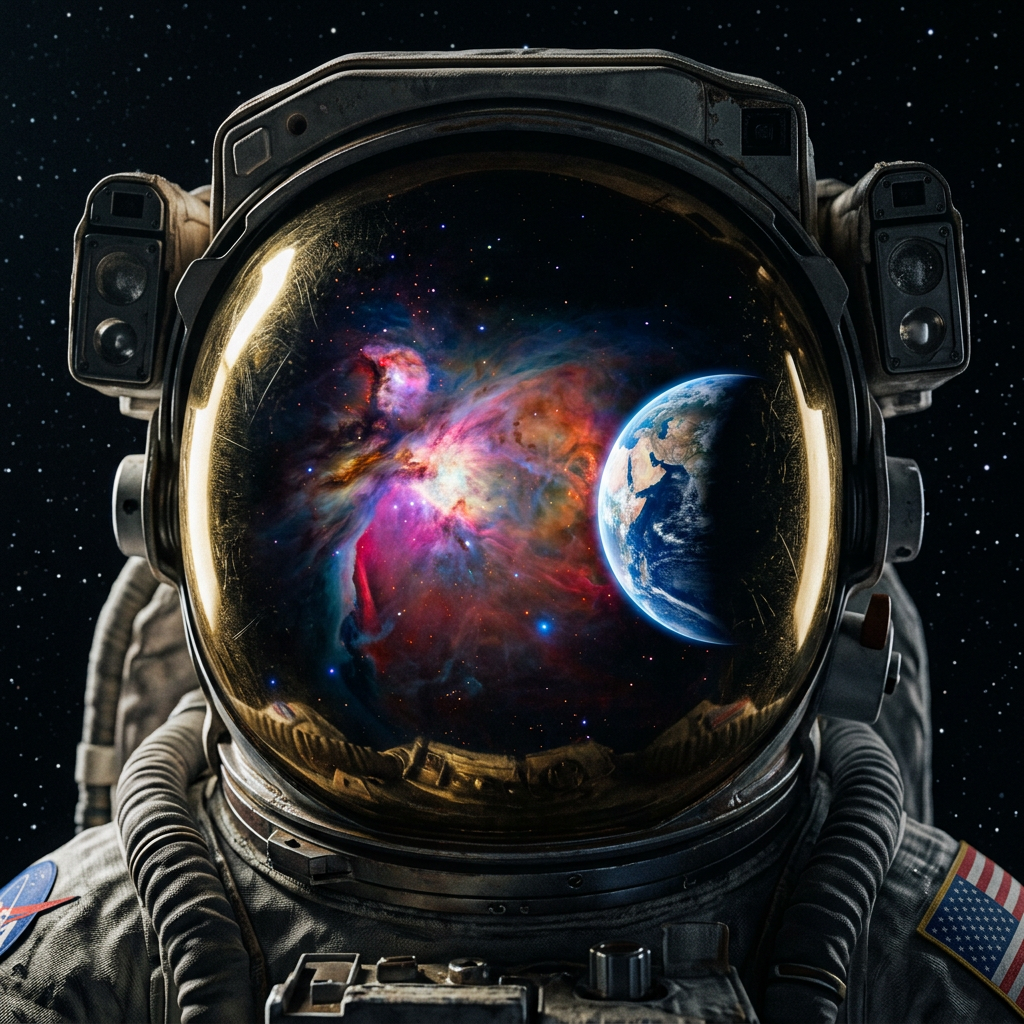
What Is Space? The Ultimate Guide for Students (2026 Updated)
What is space? It's not just empty void. Explore the physics, composition, and boundaries of the cosmos, from the Kármán line to Dark Energy.

What is space? It's not just empty void. Explore the physics, composition, and boundaries of the cosmos, from the Kármán line to Dark Energy.
Trending Now
What Is Space? The Ultimate Guide for Students (2026 Updated)
📌 Key Takeaways
- What is space — it's the vast, near-empty expanse that exists beyond Earth's atmosphere, beginning at the Kármán line (~100 km above sea level).
- Space is not completely empty — it contains gas, dust, radiation, and mysterious forms of matter and energy.
- The temperature of space sits at a frigid 2.7 Kelvin (-455°F), measured by NASA's COBE mission.
- The observable universe stretches approximately 93 billion light-years in diameter.
- The universe is made of roughly 68% dark energy, 27% dark matter, and only 5% normal matter — yes, everything you can see is just a tiny slice.
- The global space economy hit $570 billion in 2023 and is growing fast.
1. Introduction: The Final Frontier
Look up on a clear night. Past those stars, past the Moon, past everything you can see — that's space. And honestly? It's one of the most mind-bending things humans have ever tried to understand.
Whether you're a high schooler doing a science project or a college student brushing up on cosmology, you've probably asked yourself at some point: what is space, really? Not just "it's where the stars are" — but what is it, physically, mathematically, philosophically?
This guide breaks it all down in plain English. No overly technical jargon (well, maybe a little — but we'll explain everything). By the end of this article, you'll have a rock-solid understanding of space: what it's made of, how big it is, why it matters, and where humanity is headed next.
Let's launch into it. 🚀
2. Defining Space: What Exactly Is It?
At the most basic level, outer space is the expanse that exists beyond Earth's atmosphere. It's the physical universe outside of any planetary atmosphere — a region characterized by extremely low density, low pressure, and the presence of electromagnetic radiation, magnetic fields, and particles.
According to NASA Science, space isn't really a "nothing." It's more like a fabric — a three-dimensional arena where matter and energy interact, move, and evolve over time.
Think of it this way: if you removed every single planet, star, and galaxy from the universe, you'd still have something left over — the structure of spacetime itself. Space isn't just a container for stuff. It's part of the physics.
Here's a simple way to think about the types of space we study:
| Type of Space | What It Refers To |
|---|---|
| Outer Space | The region beyond Earth's atmosphere |
| Interplanetary Space | The space between planets in our solar system |
| Interstellar Space | The space between stars within a galaxy |
| Intergalactic Space | The vast space between galaxies |
| Observable Universe | Everything we can detect from Earth (light reaching us) |
Each of these regions has its own unique properties — density, temperature, radiation levels, and more. They're related but very different environments.
3. Where Does Space Begin? The Kármán Line
Okay, here's a question that seems simple but gets surprisingly complicated: where exactly does Earth end and space begin?
The internationally recognized boundary is called the Kármán line, set at 100 kilometers (62 miles) above sea level. This is the point where the atmosphere becomes too thin for conventional aircraft to generate aerodynamic lift. In other words, above this line, you need rocket propulsion to stay airborne — you're officially in space.
The Kármán line is recognized by the Fédération Aéronautique Internationale (FAI) and used by most space agencies worldwide, including ESA.
💡 Fun Fact: The United States Air Force and NASA have historically used 80 km (50 miles) as their definition of where space begins. This is why some commercial astronauts — like those flying on Blue Origin's New Shepard — technically cross both definitions.
The debate around the Kármán line matters more than you'd think. It affects things like:
- International space law (space is legally "international territory")
- Astronaut certification (who officially qualifies as an astronaut)
- Commercial spaceflight regulation
So even the definition of "where space begins" isn't totally settled. Welcome to one of the most complex fields of science and policy combined.
4. The Vacuum Myth: Is Space Completely Empty?
Here's a big one that trips up a lot of students: space is NOT a perfect vacuum.
Yes, it's extremely sparse compared to Earth's atmosphere. But it's far from empty. According to Swinburne Astronomy Online, the intergalactic medium — the space between galaxies — contains roughly:
🔬 "About 1 atom per cubic meter" — Swinburne University / Intergalactic Medium
Compare that to Earth's sea-level atmosphere, which has roughly 2.7 × 10²⁵ molecules per cubic meter. So yes, space is incredibly empty — but not perfectly so.
What's actually floating around in space?
- Gas and dust — especially hydrogen and helium, the most abundant elements in the universe
- Cosmic rays — high-energy particles zipping through the cosmos
- Electromagnetic radiation — light, radio waves, X-rays, gamma rays
- Magnetic fields — weak but widespread throughout the cosmos
- Dark matter — invisible but gravitationally influential (more on this soon)
- Neutrinos — nearly massless particles that pass through almost everything
The region of space between stars in our galaxy is called the interstellar medium (ISM). It's a mix of gas (mostly hydrogen), dust, and plasma that plays a crucial role in star formation. When gravity pulls these materials together, new stars — and eventually new planetary systems — can be born.
So while space might look empty to the naked eye, it's actually buzzing (very, very quietly) with activity.
5. The Temperature of the Cosmos: Absolute Zero vs. 2.7K
When people imagine space, they often think of it as freezing cold. And they're mostly right — but the answer is more nuanced.
The average temperature of outer space is approximately:
🌡️ 2.7 Kelvin (-455°F or -270.45°C) — NASA / COBE Mission
This number comes from something called the Cosmic Microwave Background (CMB) — the faint thermal radiation left over from the Big Bang, about 380,000 years after the universe was born. NASA's COBE (Cosmic Background Explorer) satellite was the first to measure this temperature precisely, a discovery that earned its scientists the Nobel Prize in Physics in 2006.
But here's where it gets interesting:
| Location in Space | Approximate Temperature |
|---|---|
| Cosmic void (average) | 2.7 K (-455°F) |
| Near the Sun (in orbit) | Up to 120°C (248°F) in sunlight |
| Shadowed side of Moon | -173°C (-280°F) |
| Inside a nebula | Varies wildly — 10 K to 10,000 K |
| Near a black hole accretion disk | Millions of Kelvin |
| Boomerang Nebula | 1 K (coldest known natural place) |
Temperature in space depends heavily on proximity to energy sources (like stars) and exposure to radiation. In direct sunlight, an astronaut's suit can reach scorching temperatures. In shadow, it drops dangerously low. This is why thermal regulation is one of the biggest engineering challenges in spacecraft design.
Absolute zero — 0 Kelvin (-273.15°C) — is the theoretical minimum temperature, where all atomic motion stops. Space at 2.7K is incredibly close to this, but not quite there. The CMB radiation prevents the universe from ever hitting absolute zero.
6. Composition of the Universe: Normal vs. Dark Matter
Here's where things get really wild. When scientists mapped the composition of the entire universe using data from the ESA's Planck Mission, here's what they found:
🌌 The Universe is made of: ~68% Dark Energy, ~27% Dark Matter, ~5% Normal Matter — ESA / Planck Mission
Let that sink in. Everything you've ever seen — every star, planet, galaxy, person, sandwich — is made of normal (baryonic) matter, which accounts for only 5% of the universe. The other 95% is stuff we can't directly see or touch.
So what's the difference between dark matter and dark energy?
| Dark Matter | Dark Energy | |
|---|---|---|
| What it is | Unknown particles with mass | A property of space itself (possibly) |
| How we detect it | Gravitational effects on visible matter | Acceleration of universe's expansion |
| Share of universe | ~27% | ~68% |
| Effect on cosmos | Holds galaxies together | Pushes galaxies apart |
| Direct observation | Impossible so far | Impossible so far |
Dark matter is essentially invisible — it doesn't emit, absorb, or reflect light. But we know it's there because of the way galaxies rotate and how light bends around massive objects (gravitational lensing). Without dark matter, galaxies like the Milky Way would fly apart.
Dark energy is even stranger. It's thought to be responsible for the accelerating expansion of the universe — a discovery so surprising that it earned the 2011 Nobel Prize in Physics. Scientists still debate what dark energy actually is. Some think it's a cosmological constant (a property built into spacetime), others think it's a dynamic field.
The bottom line? The universe is mostly made of things we don't fully understand yet. And that's actually kind of exciting.
7. The Scale: Observable Universe and Light-Years
Let's talk size — because nothing humbles you quite like the scale of the universe.
The observable universe — meaning the part of the universe from which light has had time to reach us since the Big Bang — has a diameter of approximately:
📏 93 billion light-years — Wikipedia / Observable Universe
A light-year is the distance light travels in one year — about 9.46 trillion kilometers (5.88 trillion miles). Multiply that by 93 billion and... yeah. Your calculator probably gives up.
What's even crazier: the universe is likely much larger than what we can observe. The observable universe is just the portion from which light has had 13.8 billion years (the age of the universe) to reach us. Space beyond that exists — we just can't see it.
Here's a quick scale comparison to make this tangible:
- 🌍 Earth to Moon: ~384,000 km
- 🌍 Earth to Sun: ~150 million km (1 AU)
- ☀️ Our solar system's edge: ~100 AU
- 🌌 Nearest star (Proxima Centauri): 4.24 light-years
- 🌌 Milky Way diameter: ~100,000 light-years
- 🌌 Nearest large galaxy (Andromeda): ~2.537 million light-years
- 🌐 Observable universe diameter: 93 billion light-years
The Cosmic Microwave Background (CMB) — that faint glow left over from the Big Bang — essentially marks the edge of what we can observe. Everything we know about cosmology, every galaxy survey, every deep-field image from Hubble or James Webb Space Telescope — it all fits within that 93-billion-light-year bubble.
8. The Physics of Spacetime: Einstein's Perspective
You can't talk about space without mentioning Albert Einstein and his game-changing theory of General Relativity (1915).
Before Einstein, space was thought of as a fixed, flat stage where events happened. Isaac Newton saw space as absolute and unchanging. Einstein flipped this completely. He proposed that space and time are not separate things — they're woven together into a single four-dimensional fabric called spacetime.
And mass? Mass bends spacetime. Imagine placing a bowling ball on a stretched rubber sheet — it creates a dip. Objects near it (like marbles) roll toward it. That's essentially how gravity works in Einstein's framework: it's not a force pulling objects, it's the curvature of spacetime guiding them.
This has been confirmed repeatedly through experiments:
- Gravitational lensing (light bending around massive objects)
- Gravitational waves (ripples in spacetime, detected by LIGO in 2015)
- GPS satellite corrections (clocks on satellites tick faster due to weaker gravity — we correct for this every day)
Understanding Einstein's spacetime is crucial for understanding black holes, the expansion of the universe, and the nature of space itself. It's not just an abstract theory — it has real-world applications that affect your daily life.
9. Current Trends: The New Space Race (2025–2026)
Space isn't just a topic for textbooks anymore. It's big business, geopolitics, and the frontier of human ambition — all at once.
According to the Space Foundation:
💰 The global space economy reached $570 billion in 2023 — and it's projected to surpass $1 trillion by the early 2030s.
Here's what's driving the new space race in 2025–2026:
🚀 Commercial Spaceflight Boom Companies like SpaceX, Blue Origin, Rocket Lab, and Virgin Galactic have transformed access to space. SpaceX's Starship — the most powerful rocket ever built — successfully completed orbital test flights and is now central to NASA's Artemis Moon program.
🌕 Artemis & the Return to the Moon NASA's Artemis program aims to land the first woman and next man on the Moon — and establish a sustainable lunar presence as a stepping stone to Mars. International partners including ESA, JAXA (Japan), and CSA (Canada) are all involved.
🛰️ Mega-Constellations SpaceX's Starlink and Amazon's Project Kuiper are deploying thousands of satellites to provide global internet coverage. This is reshaping both communication and the night sky (astronomers have concerns about light pollution).
🤖 AI and Robotics in Space Autonomous rovers, AI-driven mission planning, and robotic construction are becoming central to exploration. The James Webb Space Telescope (JWST) continues to deliver revolutionary data about the early universe, exoplanets, and galactic formation.
🌏 Geopolitical Competition China's space program (CNSA) has been rapidly advancing — landing on the far side of the Moon, operating its own space station (Tiangong), and planning crewed lunar missions by 2030. Space is increasingly an arena of national strategy.
10. Humanity's Future: Mars, Moon, and Beyond
So where is all of this heading? What's the long-term vision for what is space in terms of human civilization?
Mars is the next big target. NASA, SpaceX (with Elon Musk's stated goal of making humanity multi-planetary), and several international agencies are working toward crewed Mars missions in the 2030s–2040s. The scientific goals include searching for signs of ancient life and understanding planetary habitability.
The Moon serves as a critical proving ground. The Lunar Gateway — an orbital space station around the Moon — is being designed to support long-duration missions and eventually act as a hub for deep-space exploration.
Space tourism is slowly becoming a reality, though currently limited to the ultra-wealthy. As costs come down (SpaceX aims to drastically reduce launch costs with Starship), access could broaden.
Asteroid mining and space manufacturing are emerging industries. Some near-Earth asteroids contain minerals worth trillions of dollars. Companies are actively developing the technology to extract these resources.
Beyond our solar system? Interstellar travel remains in the realm of theoretical physics for now. But projects like Breakthrough Starshot — which aims to send tiny laser-propelled probes to Proxima Centauri within decades — show that even that frontier is being seriously explored.
Conclusion: Why Understanding Space Matters More Than Ever
So — what is space? It's the vast, awe-inspiring expanse beyond our atmosphere. It's a near-vacuum filled with gas, radiation, dark matter, and cosmic history. It's a 93-billion-light-year-wide observable bubble that contains billions of galaxies. It's a $570 billion industry and the stage for humanity's next great chapter.
But more than any of those definitions, space is a mirror. The more we study it, the more we learn about who we are, where we came from, and where we might be going. Whether you're drawn to the physics, the exploration, the philosophy, or just the sheer wonder of it — there's never been a better time to start paying attention to what's above us.
The universe is 13.8 billion years old. Humans have been looking up at it, wondering, for a tiny fraction of that time. And we're just getting started.
Sources
- NASA Science — science.nasa.gov
- NASA COBE Mission — science.nasa.gov/mission/cobe
- European Space Agency (ESA) — esa.int
- ESA Planck Mission Results — esa.int/Planck
- Wikipedia — Outer Space
- Wikipedia — Observable Universe
- Space Foundation — spacefoundation.org
- Swinburne Astronomy Online — Intergalactic Medium
Last updated: 2026 | Written for Voxora by our Science & Education Editorial Team
Advertisement
Frequently Asked Questions
At what altitude does outer space officially begin?
Most international organizations recognize the Karman Line, located 100 kilometers (62 miles) above Earth's sea level, as the boundary between our atmosphere and outer space.
Is space a total vacuum?
No, space is not a perfect vacuum. While extremely sparse, it contains a low density of particles, including hydrogen plasma, cosmic rays, and magnetic fields, averaging about 1 atom per cubic centimeter in interstellar space.
What is the average temperature of outer space?
The baseline temperature of outer space, determined by the Cosmic Microwave Background radiation, is approximately 2.7 Kelvin (-270.45 degrees Celsius or -454.81 degrees Fahrenheit).
How large is the observable universe?
The observable universe is a sphere with a diameter of roughly 93 billion light-years, containing an estimated 2 trillion galaxies, though the entire universe may be much larger or even infinite.
Why does space appear black despite having billions of stars?
Known as Olbers' Paradox, space appears dark because the universe is expanding. This causes light from distant stars to stretch into non-visible wavelengths (redshift), and the universe is not old enough for light from the most distant stars to have reached us yet.
Sponsored
You Might Also Like


Advertisement
Comments (0)
Sign in to join the conversation
No comments yet. Be the first to share your thoughts!