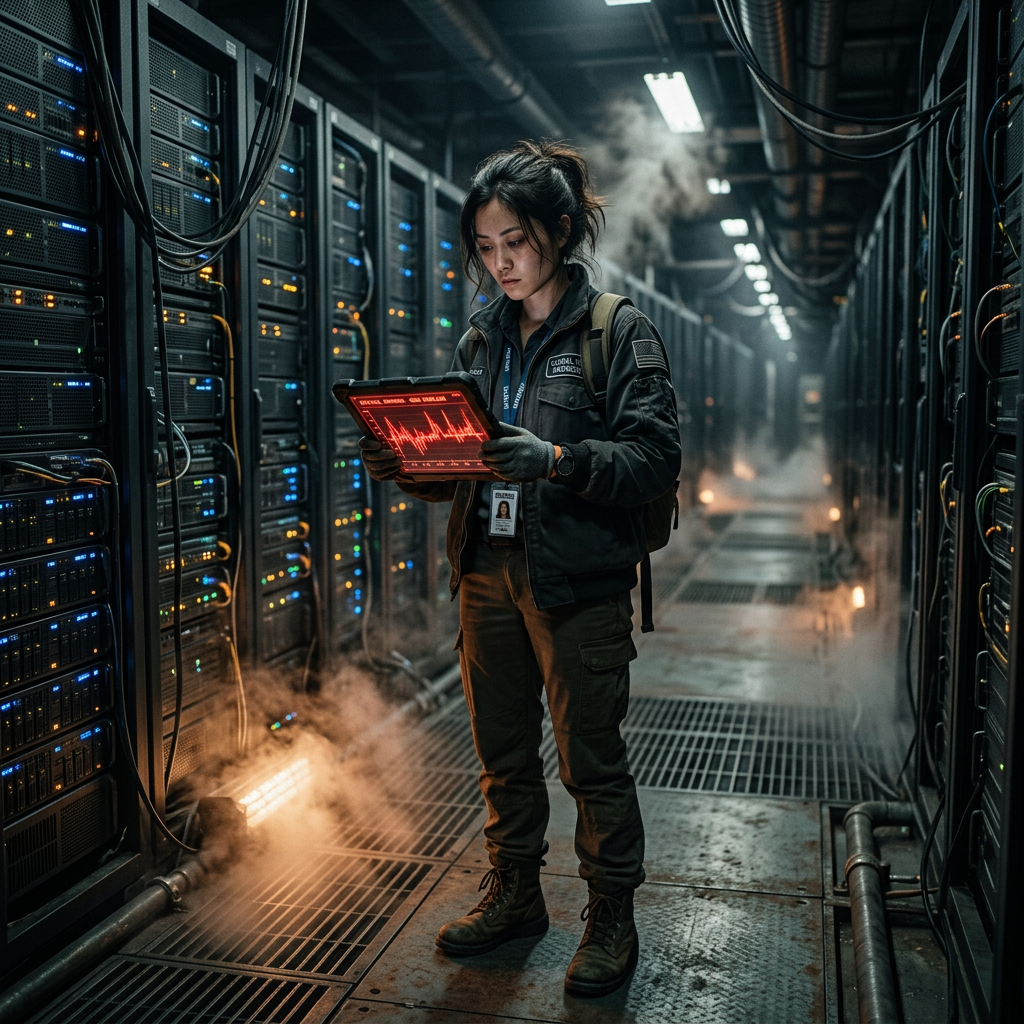
The Gigawatt War: How AI Is Reshaping Global Energy Grids | AI energy consumption
As AI consumes 3% of global electricity, tech giants race toward nuclear solutions. Explore the 2026 power crisis, from SMRs to grid strain.

As AI consumes 3% of global electricity, tech giants race toward nuclear solutions. Explore the 2026 power crisis, from SMRs to grid strain.
Trending Now
The Gigawatt War: How AI Is Reshaping Global Energy Grids
Key Takeaways
- AI energy consumption is accelerating at an unprecedented rate, with global data center electricity demand projected to reach 945 TWh by 2030 — nearly double 2024 levels.
- A single generative AI search query consumes roughly 10 times more energy than a traditional web search.
- Major tech companies including Microsoft and Google are pivoting to nuclear energy to secure reliable, carbon-reduced baseload power for AI infrastructure.
- Small modular reactors (SMRs) represent a nascent but strategically significant solution to the long-term energy demands of AI at scale.
- Grid strain is expected to reach a critical threshold by 2026, when U.S. data centers alone will consume approximately 6% of total national electricity.
- Liquid cooling and water consumption trade-offs are emerging as a secondary environmental crisis alongside carbon emissions.
The internet was never weightless. Behind every search result, streamed video, and cloud-synced document sits a physical rack of servers drawing power from a national grid — grids that were never designed to absorb this scale of demand. But the explosion of artificial intelligence — particularly generative AI — has fundamentally altered the magnitude of that problem. What was once a manageable infrastructure challenge has become a geopolitical and environmental inflection point.
This is the gigawatt war: a global contest to secure enough reliable, affordable, and ideally low-carbon electricity to sustain the AI revolution. Understanding AI energy consumption is no longer a niche concern for data engineers. It is rapidly becoming essential context for anyone who works in digital industries, creates content for online platforms, or markets products and services in a world increasingly powered by machine intelligence.
By the Numbers: The 2026 AI Power Consumption Landscape
The scale of AI's energy appetite becomes comprehensible only when placed against concrete benchmarks. According to the International Energy Agency, global data center electricity consumption is projected to reach 945 terawatt-hours (TWh) by 2030 — effectively doubling from 2024 levels. To contextualize that figure: the entire country of Germany consumed approximately 484 TWh of electricity in 2023.
The United States is leading this surge in demand. The IEA's forecast indicates that U.S. data center power demand will reach 260 TWh in 2026, consuming roughly 6% of total U.S. electricity generation. That represents a dramatic structural shift in national energy planning, one that utility companies, grid operators, and policymakers are only beginning to grapple with.
"A generative AI search query uses approximately 2.9 watt-hours of electricity, compared to 0.3 watt-hours for a traditional web search — nearly a 10x differential." — EPRI / Goldman Sachs via Reuters
The implications of that single statistic are profound. When multiplied across billions of daily queries, AI-powered search alone becomes a meaningful contributor to grid stress. And search represents only one use case among dozens — image generation, code completion, enterprise automation, drug discovery, and real-time translation all add to the aggregate load.
| Metric | Traditional Web Search | Generative AI Query |
|---|---|---|
| Energy per query | ~0.3 Wh | ~2.9 Wh |
| Relative energy cost | 1× (baseline) | ~9.7× |
| Annual scale (billions of queries) | Manageable | Grid-significant |
The Physical Weight of the Cloud: Introduction to AI Energy Intensity
The phrase "the cloud" has always been a convenient abstraction — one that obscures a decidedly terrestrial reality. Data centers are large, power-hungry industrial facilities that require uninterrupted electricity supply, sophisticated cooling systems, and physical security infrastructure. The transition from conventional software to AI-native architecture has dramatically intensified each of those requirements.
Training large language models is among the most computationally intensive activities humanity currently undertakes. According to research from MIT News, training a single massive AI model like GPT-4 can consume over 1,200 megawatt-hours (MWh) of electricity — equivalent to the annual energy usage of approximately 120 U.S. homes. This occurs before a single user has interacted with the model.
"Training GPT-4 consumed over 1,200 MWh — equivalent to the annual energy usage of roughly 120 American households." — Stanford HAI / MIT News
The generative AI environmental impact extends well beyond training, however. The more consequential — and often underreported — energy cost is inference: the computational work performed every time a user prompts a model. This distinction is critical for understanding the long-term trajectory of AI energy consumption, and it is explored in the next section.
What makes this period uniquely consequential is the convergence of several simultaneous trends: exponential model scale, rapid mainstream adoption, an expanding array of AI-powered applications, and the integration of AI into enterprise workflows that operate continuously, around the clock.
The Inference Shift: Why Using AI Costs More Than Training It
For years, the public conversation about AI's environmental cost focused almost exclusively on training — the initial, intensive process of building a model. Training a frontier model is undeniably expensive, in both computational and energy terms. But training is a one-time event. Inference — the act of running a trained model to generate outputs — occurs billions of times daily and accumulates continuously.
As AI tools have moved from research labs into consumer products and enterprise platforms, the inference workload has become the dominant driver of data center electricity demand. A model trained once will be queried trillions of times across its operational lifespan. Each query, while individually modest, contributes to an aggregate load that dwarfs the original training cost.
According to Digiconomist, AI servers alone are expected to consume between 85 and 134 TWh annually worldwide by 2028 — a range that reflects uncertainty about adoption rates, but not about the direction of travel.
| Phase | Energy Profile | Duration | Cumulative Impact |
|---|---|---|---|
| Model Training | High intensity, concentrated | Days to months | One-time cost per model version |
| Model Inference | Lower per query, massively distributed | Continuous, indefinite | Far exceeds training over time |
| Fine-tuning / Updates | Moderate intensity | Periodic | Ongoing but manageable |
This reframing is important for digital marketers and content creators who rely on AI tools professionally. Every AI-assisted draft, every automated email campaign, every algorithmic content recommendation carries a real, measurable energy cost. The carbon footprint of AI is not an abstract concern — it is embedded in the daily workflows of modern digital professionals.
The inference challenge also explains why hardware efficiency is now a primary competitive advantage in AI. Companies like NVIDIA, AMD, and a growing field of AI chip startups are racing to deliver more computation per watt, not simply more raw computational power.
The Nuclear Pivot: Microsoft, Google, and the Race for Baseload Power
Renewable energy — solar and wind in particular — has long been the preferred narrative for tech companies seeking to demonstrate environmental responsibility. But solar and wind share a fundamental limitation: intermittency. They generate power when conditions allow, not necessarily when data centers need it. AI workloads, by contrast, demand continuous, uninterrupted power delivery. This mismatch is driving the most consequential energy pivot in the history of the technology industry.
Nuclear power, with its ability to deliver dense, consistent, carbon-reduced electricity around the clock, has re-emerged as a strategic priority for major AI infrastructure investors. The most symbolically significant example to date is Microsoft's partnership to restart a generating unit at Three Mile Island — the Pennsylvania facility synonymous with America's most serious civilian nuclear accident in 1979. Under the deal, Microsoft has committed to purchasing power from the restarted Crane Clean Energy Center to supply its AI data centers.
The Three Mile Island Microsoft arrangement is not an isolated transaction. Google has announced agreements to source power from small modular reactor projects, and Meta has issued requests for proposals from nuclear developers capable of supplying between one and four gigawatts of new nuclear capacity by the early 2030s, as reported by The Guardian.
"Meta issued an RFP seeking 1–4 gigawatts of new nuclear capacity to support AI infrastructure — a procurement scale that rivals the energy planning of mid-sized nations." — The Guardian
This nuclear pivot represents a fundamental recalibration of the tech industry's energy strategy. It also introduces a new set of questions about timeline, cost, public acceptance, and regulatory complexity — none of which are easily resolved.
Small Modular Reactors (SMRs): The Holy Grail of Tech Energy?
If conventional nuclear power offers the energy density and reliability that AI infrastructure demands, small modular reactors (SMRs) promise to deliver those benefits with greater deployment flexibility, lower upfront capital requirements, and potentially shorter construction timelines.
SMRs are nuclear reactors with a generating capacity typically below 300 megawatts electric (MWe) — compared to the 1,000+ MWe output of conventional large-scale nuclear plants. Their modular design means they can be factory-manufactured and assembled on-site, theoretically reducing costs and enabling deployment closer to demand centers, including industrial parks and data center campuses.
The technology is compelling in principle. In practice, it remains largely unproven at commercial scale. As of mid-2025, only a small number of SMR projects are in advanced development globally, and several high-profile projects have faced cost overruns, regulatory delays, or cancellation. The World Economic Forum has highlighted SMRs as a potentially transformative solution for AI's energy demands while acknowledging that the path to commercial viability requires sustained policy support, regulatory streamlining, and significant private investment.
For the tech giants backing SMR development, the calculus is clear: the cost of not having reliable, low-carbon power at the scale AI requires is greater than the financial and reputational risk of backing an emerging technology. Microsoft, Google, and Amazon Web Services have all made commitments to SMR projects, effectively functioning as anchor customers whose demand guarantees could enable developers to secure financing.
"SMRs represent the most promising long-term solution for delivering always-on, low-carbon baseload power at data center scale — but commercial deployment remains a 2030s proposition for most projects." — World Economic Forum
The strategic bet being placed by the world's largest technology companies on nuclear energy — both conventional and modular — signals that the AI infrastructure investment landscape is now inseparable from energy infrastructure planning.
Gridlock: How Data Centers Are Straining National Electric Grids
Beyond the corporate boardrooms where nuclear deals are structured, the immediate reality of AI energy consumption is playing out on aging national electrical grids. The grid strain 2026 scenario is not a hypothetical — it is an active concern for grid operators across the United States, Europe, and Asia.
Data centers are no longer distributed infrastructure. They are increasingly concentrated in specific geographic clusters — Northern Virginia (the world's largest data center market), Dublin, Singapore, and emerging hubs in Texas and Arizona — creating intense, localized demand spikes that grid infrastructure was not designed to accommodate.
Utility companies in Virginia, for example, have warned that connecting new data center projects requires multi-year grid upgrade timelines. Dominion Energy, which serves a significant portion of the Virginia data center corridor, has projected the need for tens of billions of dollars in grid investment to meet anticipated demand from AI facilities through 2030.
Ireland presents a stark cautionary example. The country's grid operator, EirGrid, has imposed moratoriums on new data center connections in the Dublin area due to capacity constraints — a situation that has forced major technology companies to reconsider their European infrastructure strategies. According to Carbon Brief, data centers already account for approximately 17% of Ireland's total electricity consumption, a proportion that illustrates the concentration risk inherent in current deployment patterns.
| Country / Region | Data Center Share of National Electricity | Notable Grid Pressure Points |
|---|---|---|
| United States | ~4% (2024), ~6% projected by 2026 | Northern Virginia, Texas, Arizona |
| Ireland | ~17% | Dublin corridor moratorium |
| Germany | ~2–3% | Frankfurt hub expansion constraints |
| Singapore | ~7–9% | Temporary moratorium lifted 2022 |
The grid strain problem is compounded by the fact that many data centers require not just large quantities of power, but guaranteed reliability — typically targeting 99.999% uptime. This necessitates redundant power supplies and backup generation, often using diesel generators that undermine the sustainability commitments tech companies publicly champion.
The Water Problem: Liquid Cooling and Environmental Trade-offs
The energy debate around AI infrastructure has a less-discussed but equally serious companion issue: water consumption. As AI cooling technology evolves to handle the extraordinary heat output of modern GPU clusters, the industry is shifting from air cooling toward liquid cooling systems — and these systems carry significant water demand.
Traditional data centers use evaporative cooling towers that consume millions of gallons of fresh water annually per facility. A large hyperscale data center can consume between three and five million gallons of water per day during peak operations. As AI accelerators like NVIDIA's H100 and B200 GPUs generate substantially more heat per rack than their predecessors, cooling demands are intensifying proportionally.
Direct liquid cooling (DLC) and immersion cooling represent the leading technological responses. These approaches circulate coolant — water, dielectric fluid, or specialized refrigerants — directly across or around processor components, dramatically improving thermal efficiency. The trade-off is engineering complexity, higher upfront cost, and in water-based systems, continued freshwater demand.
The generative AI environmental impact thus operates on two axes: carbon emissions from electricity generation and freshwater consumption from cooling. In regions already experiencing water stress — the American Southwest, parts of Southern Europe, and much of Southeast Asia — siting data centers requires increasingly difficult trade-offs between economic development and environmental resource management.
"AI data centers present a dual environmental challenge: their carbon footprint from electricity demand and their freshwater footprint from cooling systems require simultaneous, integrated solutions." — MIT News
Emerging AI cooling technology solutions, including waste-heat recovery systems that redirect thermal output for district heating and industrial processes, offer partial mitigation pathways. Several European data center operators are already implementing such systems, converting what was previously a waste product into a community energy asset.
Future Outlook: Can AI Optimize Its Own Energy Usage?
The most intellectually compelling dimension of the AI energy consumption debate is also its most paradoxical: the technology consuming extraordinary quantities of energy is also among the most powerful tools available for optimizing energy systems.
AI is already being deployed to improve the efficiency of electrical grids, predict renewable energy generation, optimize demand response programs, and reduce waste in industrial energy systems. Google's DeepMind division has used AI to reduce cooling energy consumption in Google's own data centers by approximately 40% — a proof of concept with significant implications for broader deployment.
At the model architecture level, researchers are developing techniques that dramatically reduce the computational cost of inference: quantization (reducing the numerical precision of model parameters), pruning (eliminating redundant neural connections), knowledge distillation (training smaller, efficient models to replicate the behavior of larger ones), and mixture-of-experts architectures (activating only relevant portions of a model for each query). These are not marginal improvements — they represent order-of-magnitude efficiency gains that could substantially alter the long-term trajectory of AI's energy footprint.
The World Economic Forum has identified the alignment of AI advancement with energy efficiency as one of the defining sustainability challenges of the coming decade — noting that the answer likely lies not in slowing AI development, but in ensuring that efficiency innovation keeps pace with capability expansion.
For digital professionals, content creators, and marketers who use AI tools daily, this trajectory matters. The platforms and tools you rely on are subject to the same pressures reshaping global energy markets. Understanding that context makes you a more informed advocate for sustainable technology practices — and a more credible voice in conversations about the environmental responsibility of the digital economy.
The gigawatt war is not simply an infrastructure story. It is a story about how humanity navigates the tension between technological ambition and planetary limits — and whether the intelligence we are building can ultimately help us resolve that tension more wisely than we could alone.
Conclusion: The collision between AI energy consumption and the physical capacity of global power grids is one of the defining infrastructure challenges of the 2020s. From the reactivation of Three Mile Island to the race to deploy small modular reactors, from the liquid cooling revolution to the emerging science of energy-efficient model architecture, the technology industry is engaged in an urgent, multi-front effort to power its most ambitious systems without destabilizing the electrical grids that modern civilization depends upon. For writers, marketers, and digital professionals, understanding this landscape is no longer optional — it is foundational context for operating intelligently in an AI-shaped world.
Sources
- International Energy Agency – Electricity 2025 Report
- MIT News – Explained: Generative AI's Environmental Impact
- The Guardian – Meta Nuclear Power AI Deal
- Carbon Brief – AI: Five Charts on Energy Use and Emissions
- World Economic Forum – Powering the Future: The Energy Shift for Sustainable AI
- Digiconomist – AI Energy Consumption
- Reuters – AI Power Demand 2026 (EPRI / Goldman Sachs)
Published on Voxora | Research & Technology | Energy & Sustainability
Advertisement
Frequently Asked Questions
How much can AI power development improve productivity for creative writers and marketers?
Recent research, including studies from MIT, indicates that AI tools can increase writing speed by approximately 40% while improving output quality by 18%. In digital marketing, AI-driven automation can reduce the time spent on repetitive data analysis and scheduling tasks by nearly 30%.
What is the projected market growth for AI in the digital marketing and content creation sectors?
The global market for AI in marketing is projected to reach $107.5 billion by 2028, growing at a Compound Annual Growth Rate (CAGR) of 25.6% from 2021. This growth highlights the increasing demand for developers who can integrate AI into personalized consumer experiences.
Does using AI-generated content negatively impact SEO rankings for digital marketing learners?
Google's official Search guidance states that they reward high-quality content regardless of how it is produced. However, while AI can generate drafts, data suggests that 70% of top-ranking content still requires human-in-the-loop editing to meet E-E-A-T (Experience, Expertise, Authoritativeness, and Trustworthiness) standards.
What are the most powerful AI models currently used for advanced text and content generation?
GPT-4 remains a leader with an estimated 1.76 trillion parameters, making it highly effective for complex creative tasks. For creative writers handling long-form manuscripts, Claude 3 Opus is a top choice due to its 200,000-token context window, allowing it to process and reference up to 150,000 words in a single session.
How does acquiring AI skills affect the career outlook and salary for creative professionals?
Digital marketing professionals with AI competencies can see a salary premium of 20% to 30%. Specialized roles such as 'AI Prompt Engineers,' which blend creative writing with technical AI development knowledge, have seen advertised salary ranges reaching between $200,000 and $335,000 annually.
Sponsored
You Might Also Like


Advertisement
Comments (0)
Sign in to join the conversation
No comments yet. Be the first to share your thoughts!