Beyond the Tractor: The Rise of Autonomous Robots in Agriculture | agriculture technology
AgTech is revolutionizing food production through AI, robotics, and data. Discover the trends and technologies building a sustainable farming future.

AgTech is revolutionizing food production through AI, robotics, and data. Discover the trends and technologies building a sustainable farming future.
Trending Now
Beyond the Tractor: The Rise of Autonomous Robots in Agriculture
Key Takeaways
- The global smart agriculture technology market is projected to surge from $25.36 billion in 2024 to $83.72 billion by 2033, signaling a fundamental shift in how the world grows food.
- Autonomous robots, AI-driven decision engines, and ultra-precision sprayers are replacing manual labor across planting, weeding, and harvesting operations.
- Ultra-precision spraying robots can cut chemical usage by up to 95%, dramatically reducing environmental impact without sacrificing crop protection.
- 61% of North American farmers already use digital agronomy tools, and adoption is accelerating globally.
- Despite enormous promise, barriers including high upfront costs, rural connectivity gaps, and a shortage of skilled operators remain significant obstacles to mass adoption.
The combine harvester changed farming forever in the 1830s. The tractor finished what it started. For nearly two centuries, those two machines defined agriculture's relationship with technology — big, mechanical, and built for brute-force efficiency. Now, something fundamentally different is happening in the world's fields, greenhouses, and vertical farms. It's quieter. Smarter. And, in many cases, it doesn't involve a human driver at all.
Agriculture technology — broadly defined as the application of digital, biological, and mechanical innovation to food production — is undergoing its most disruptive transformation since the Green Revolution. Satellites map soil health from orbit. Robots trained on millions of crop images distinguish a weed from a seedling in milliseconds. Artificial intelligence predicts disease outbreaks before a farmer ever notices a wilting leaf. The farm of 2025 looks less like a pastoral landscape and increasingly like a data center with dirt.
This investigation examines where that transformation stands today, which technologies are actually delivering results, and what the road ahead looks like for growers, investors, and the consumers who depend on them.
1. The Dawn of Digital Agriculture: What Is AgTech?
AgTech, short for agricultural technology, is not a single invention but an ecosystem of interconnected tools. It spans precision agriculture (using data to target inputs more accurately), agricultural robotics (automating physical tasks), AI in agriculture (using machine learning to interpret farm data), controlled environment agriculture (growing food indoors or in vertical layers), and farm management software (digitizing planning, monitoring, and compliance).
What unites these disciplines is a shared objective: produce more food, on less land, with fewer resources, in a warming climate. It is an engineering challenge on a civilizational scale. By 2050, the global population is projected to reach nearly 10 billion people. The United Nations Food and Agriculture Organization estimates that global food production must increase by roughly 50% to meet that demand — while simultaneously reducing agriculture's contribution to greenhouse gas emissions, which currently accounts for approximately 19–29% of global emissions when food systems are fully accounted for.
Technology is not the only answer, but it is increasingly recognized as an indispensable part of one.
2. Global Market Overview: Key Statistics and Growth Projections in Agriculture Technology
The numbers behind the agriculture technology sector tell a story of extraordinary investor and institutional confidence.
📊 The global smart agriculture market was valued at $25.36 billion in 2024 and is projected to reach $83.72 billion by 2033, representing a compound annual growth rate (CAGR) of approximately 14.2%. — Grand View Research
That trajectory is not driven by speculative enthusiasm alone. It reflects real-world deployment across major agricultural economies. North America currently leads in adoption, but Asia-Pacific — driven by land scarcity pressures in nations like Japan, South Korea, and increasingly India — is posting the fastest growth rates.
📊 The Agriculture Technology-as-a-Service (ATaaS) market is projected to grow at a CAGR of 15.7% from 2025 to 2033, reflecting a broader industry shift toward subscription-based and cloud-delivered farm management platforms. — Cognitive Market Research
The indoor and controlled-environment segment is expanding with particular velocity. Vertical farming technology, sensor-integrated greenhouse systems, and hydroponic automation are all capturing capital at an accelerating rate.
| Market Segment | 2024 Value | Projected Value | CAGR |
|---|---|---|---|
| Smart Agriculture (Global) | $25.36 billion | $83.72 billion (2033) | ~14.2% |
| Indoor Farming Technology | ~$37 billion | ~$68 billion (2029) | ~12.9% |
| AgTech-as-a-Service | — | Significant growth | 15.7% (2025–2033) |
These figures reflect a sector that has moved well beyond pilot programs and proof-of-concept demonstrations. Agricultural robotics, AI-driven crop monitoring, and satellite-enabled precision farming are now generating measurable returns on investment for early adopters — which, in turn, is pulling mainstream farmers toward adoption.
3. Precision Agriculture: Doing More With Less
Before the robots arrived, precision agriculture laid the conceptual groundwork. The central idea is deceptively simple: instead of treating an entire field as a uniform block, treat every square meter as an individual management zone with its own soil chemistry, moisture level, and pest pressure.
GPS-guided variable-rate technology allows modern tractors to apply fertilizer, herbicide, and water only where sensors and maps indicate they are needed. The result is not just cost savings — though those are substantial — but a measurable reduction in nutrient runoff that pollutes waterways and contributes to dead zones in coastal ecosystems.
Drone-based remote sensing has become one of precision agriculture's fastest-growing tools. Equipped with multispectral and thermal cameras, agricultural drones generate detailed maps of crop stress, irrigation uniformity, and emerging disease hotspots — data that would have taken agronomists weeks to collect on foot and that now arrives on a farm manager's tablet within hours of a flight.
📊 Approximately 61% of North American farmers now use digital agronomy tools, a figure that underscores how quickly data-driven decision-making has moved from early adopter novelty to mainstream practice. — AgTech Breakthrough
Farm management software platforms such as Climate FieldView, Granular, and Trimble Ag Software aggregate this data into actionable dashboards, enabling farmers to track planting schedules, yield histories, and equipment performance from a single interface. The convergence of these platforms with AI-driven analytics is producing what industry observers call the "connected farm" — a digital infrastructure as essential to modern agriculture as irrigation.
4. The Robot Revolution: Autonomous Agriculture Technology on the Move
The most visually dramatic manifestation of modern agriculture technology is the autonomous machine operating without a human hand on the wheel. Autonomous tractors represent the most commercially mature category of agricultural robotics, with systems from John Deere, CNH Industrial, and newer entrants like Monarch Tractor now operating at commercial scale on farms across North America and Europe.
John Deere's 8R Autonomous Tractor, launched commercially in 2022 and continuously refined since, uses a combination of GPS, LiDAR, stereo cameras, and neural networks to navigate fields, avoid obstacles, and execute tillage or planting operations without an operator in the cab. The value proposition is straightforward: a machine that can work through the night, doesn't fatigue, and generates a continuous stream of operational data.
But perhaps the more revolutionary category is the lightweight, specialized robot — machines designed not for broad field operations but for tasks that have historically resisted mechanization entirely. Weeding is the defining example.
💡 Ultra-precision spraying robots can reduce crop protection chemical usage by up to 95% while maintaining full efficacy against target weeds. — Ecorobotix / StartUs Insights
Switzerland-based Ecorobotix has developed a solar-powered weeding robot that uses computer vision to identify individual plants, then delivers micro-doses of herbicide directly to unwanted vegetation — bypassing the surrounding crop entirely. Carbon Robotics' LaserWeeder takes a different approach, using high-powered lasers to destroy weeds at the cellular level with no chemicals involved at all.
Harvesting robots represent a more technically demanding frontier. Soft-bodied fruits and vegetables — strawberries, bell peppers, apples — require a delicacy that engineers have struggled to replicate mechanically. Startups like Tortuga AgTech, Agrobot, and Abundant Robotics have developed end-effectors (robotic "hands") with force-sensing capabilities designed to grip produce without bruising it. While still not matching the speed of an experienced human picker, these systems are closing the gap rapidly and operate continuously without the labor availability challenges that plague seasonal agriculture.
| Robot Category | Key Players | Primary Function | Maturity Level |
|---|---|---|---|
| Autonomous Tractors | John Deere, Monarch Tractor, CNH | Tillage, planting, spraying | Commercially deployed |
| Weeding Robots | Ecorobotix, Carbon Robotics, FarmWise | Mechanical / laser / micro-spray weeding | Commercial scale |
| Harvesting Robots | Tortuga AgTech, Agrobot | Fruit and vegetable picking | Early commercial |
| Scouting Drones | DJI AgTech, AgEagle, Trimble | Crop monitoring, mapping | Widely deployed |
| Soil Sampling Robots | Solinftec, Earthsense | Autonomous soil data collection | Emerging |
5. AI and Machine Learning: The Brains Behind the Farm
Hardware alone cannot explain agriculture's technology revolution. Behind every autonomous tractor and precision sprayer lies a computational infrastructure of remarkable sophistication. AI in agriculture is the discipline that transforms raw sensor data — soil readings, satellite imagery, weather forecasts, historical yield maps — into decisions a farmer can act upon.
Computer vision is perhaps the most impactful AI application currently deployed in fields. Machine learning models trained on tens of millions of labeled crop images can now identify more than 26 crop diseases, quantify weed coverage percentages, and estimate yield potential from aerial imagery — tasks that previously required the hands-on expertise of a seasoned agronomist.
Predictive analytics platforms are moving the industry from reactive to proactive management. Rather than responding to a disease outbreak or drought stress event, AI systems analyze historical patterns alongside real-time inputs to forecast problems seven to fourteen days in advance — often early enough for a farmer to intervene meaningfully.
Digital twins agriculture is one of the sector's most ambitious emerging applications. A digital twin is a real-time virtual replica of a physical farm — field by field, crop by crop — that allows managers to simulate the outcome of different management decisions before implementing them. Applying 20% more nitrogen to the north block versus the south block, for instance, can be modeled computationally before a single kilogram of fertilizer is purchased. Companies including Siemens, IBM, and specialist agtech firms are developing digital twin platforms tailored to agricultural operations at scale.
6. Controlled Environment Agriculture: Farming in the City
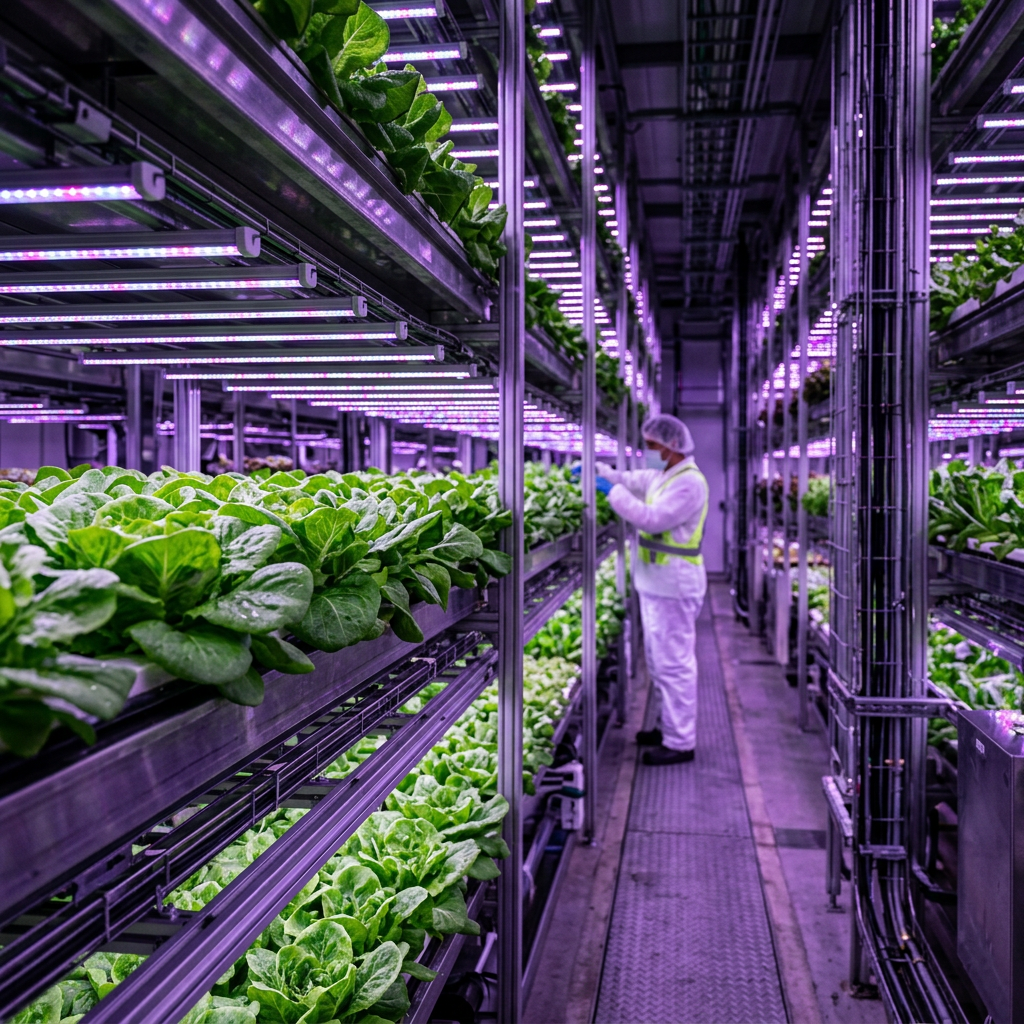
Not all of agriculture's technology revolution is happening under open skies. Vertical farming and controlled environment agriculture (CEA) represent a parallel transformation in which crops are grown in stacked layers inside climate-controlled warehouses, entirely independent of weather, seasonality, and traditional land constraints.
The indoor farming technology market reflects this momentum:
📊 The indoor farming technology market is forecast to grow from roughly $37 billion in 2024 to over $68 billion by 2029, driven by demand for locally sourced produce, water efficiency, and food security concerns. — Robovision
Vertical farms use LED lighting tuned to specific wavelengths, hydroponic or aeroponic delivery systems, and AI-managed climate control to grow leafy greens, herbs, and increasingly strawberries at yields that can exceed conventional field production by ten to twenty times per square meter. Water usage, critically, is up to 95% lower than traditional field agriculture because systems are closed-loop and recirculate virtually all moisture.
Companies like AeroFarms, Bowery Farming, and Infarm pioneered the commercial vertical farming concept, though the sector has also experienced high-profile financial turbulence, illustrating that operational economics — particularly energy costs — remain a significant challenge. Next-generation facilities are addressing this through renewable energy integration and advances in LED efficiency that continue to drive down per-kilogram production costs.
7. Sustainability and Regenerative Tech: Healing the Soil
Beyond productivity, a significant strand of agtech trends 2025 is focused on ecological restoration. Sustainable farming tech and regenerative agriculture technology converge around a central insight: healthy soil is not merely a growth medium but a complex biological ecosystem whose degradation represents one of agriculture's most serious long-term threats.
Soil health monitoring sensors, now available at price points accessible to mid-sized operations, provide continuous data on microbial activity, carbon content, compaction, and moisture — enabling farmers practicing regenerative methods to validate their impact in real time rather than waiting for expensive laboratory analysis.
Carbon farming platforms — including Indigo Ag's Carbon by Indigo and Nori — use satellite monitoring and AI verification to allow farmers who sequester carbon through cover cropping and reduced tillage to generate and sell carbon credits on voluntary markets. This creates a direct financial incentive for practices that build soil organic matter rather than deplete it.
Biological crop protection — using beneficial microbes, fungi, and insects rather than synthetic chemicals — is another technology category attracting substantial investment. Paired with AI-powered precision application systems, these biocontrol solutions offer a path toward reduced chemical dependency without sacrificing efficacy.
8. Challenges to Adoption: Cost, Connectivity, and Skills
Honest reporting demands acknowledgment that the agriculture technology revolution is neither universal nor frictionless. Three structural barriers consistently emerge in research and farmer surveys.
Cost remains the most cited obstacle. An autonomous tractor system can cost $500,000 or more when hardware, software subscriptions, and integration are fully accounted for. Even drone scouting programs represent capital expenditures that require careful return-on-investment analysis. The ATaaS model — delivering technology as a subscription service rather than an outright purchase — is designed explicitly to lower this barrier, but financing access remains unequal across farm size and geography.
Connectivity is a fundamental infrastructure problem. Many of the most sophisticated agtech tools depend on reliable broadband or 5G connectivity for real-time data transmission, remote monitoring, and cloud-based AI processing. Rural broadband penetration, despite policy efforts across the US, EU, and elsewhere, remains significantly below urban levels — creating a digital divide that disadvantages exactly the geographies where agriculture is most concentrated.
Skills and knowledge gaps represent the third dimension of the adoption challenge. Operating and interpreting the outputs of precision agriculture systems requires a combination of agronomic knowledge and digital literacy that many current farm operators — particularly in an aging global farming population — have not had the opportunity to develop. Training programs, extension services, and the design of genuinely intuitive user interfaces are all part of addressing this challenge.
9. Case Studies: Real-World Success Stories in Smart Farming
Driscoll's and autonomous harvesting: The world's largest fresh berry company has been piloting autonomous strawberry harvesting robots in California in partnership with several robotics startups. Early results show meaningful progress in pick rates and fruit quality consistency, with the company publicly committed to scaling robotic harvesting as labor costs and availability pressures intensify.
Taylor Farms and digital twin technology: One of North America's largest fresh produce companies has implemented digital twin modeling across several growing operations, using real-time data integration to optimize irrigation scheduling, predict quality outcomes, and reduce food waste before product reaches the packing shed.
Small-scale precision agriculture in Kenya: The assumption that precision agriculture is exclusively a wealthy-nation phenomenon is challenged by innovations like Hello Tractor — a platform that allows smallholder farmers in sub-Saharan Africa to access mechanization services through a smartphone-based booking system, effectively functioning as an "Uber for tractors." Satellite-based crop advisory tools from companies like aWhere and Apollo Agriculture are extending data-driven decision support to farmers who have never had access to agronomists.
| Case Study | Technology Applied | Key Outcome |
|---|---|---|
| Driscoll's (California) | Autonomous harvesting robots | Improved pick rates; reduced labor dependency |
| Taylor Farms | Digital twin modeling | Optimized irrigation; reduced post-harvest waste |
| Hello Tractor (Kenya) | Mobile mechanization platform | Smallholder access to tractor services via smartphone |
| Ecorobotix (EU) | Ultra-precision spraying | Up to 95% reduction in herbicide use |
10. The Road Ahead: AgTech Predictions for 2030 and the Future of Agriculture Technology
The convergence of autonomous robots, AI-driven analytics, controlled environment systems, and biological solutions suggests that agriculture in 2030 will be almost unrecognizable compared to the industry of a decade prior. Several developments appear highly probable based on current trajectories.
Swarm robotics — coordinated fleets of small, lightweight robots performing tasks collectively rather than through single large machines — will likely become commercially viable for field crops within this window. The advantages are significant: smaller machines cause less soil compaction, multiple units provide redundancy, and swarms can be scaled up or down based on operational need.
AI-generated crop management plans will progressively replace calendar-based and rule-of-thumb decision-making, with systems integrating satellite imagery, weather modeling, market price signals, and soil data into automated, field-specific recommendations that update continuously.
Regulatory frameworks for autonomous agricultural vehicles, drone operations, and gene-edited crop varieties are currently fragmented across national jurisdictions. By 2030, greater regulatory harmonization — particularly within the EU and between major agricultural trading partners — will be necessary for the sector to reach its potential.
Food security geopolitics will accelerate domestic investment in controlled environment agriculture and vertical farming as nations that depend heavily on food imports seek to reduce supply chain vulnerability — a trend that COVID-19 supply disruptions and subsequent geopolitical instability have already begun to catalyze.
The fundamental shift underway is from agriculture as an art guided by experience and intuition to agriculture as a managed science informed by continuous data. This does not diminish the role of the farmer — it transforms it, demanding new skills, new partnerships with technology providers, and a new relationship with the land that is simultaneously more data-driven and, in its best expressions, more ecologically aware.
The tractor is not disappearing. But it is learning to drive itself. And on the most forward-looking farms in the world, it is only one player in an increasingly complex, increasingly intelligent system that is quietly rewriting the rules of how humanity feeds itself.
Sources
- Grand View Research – Smart Agriculture Market
- Robovision – Top 5 Agricultural Technologies 2025
- EOS Data Analytics – AgriTech Trends
- AgTech Breakthrough – Future of Farming 2025
- StartUs Insights – AgTech Startups 2025
- Cognitive Market Research – Agriculture Technology-as-a-Service Market
Published on Voxora | Agriculture & Innovation | Research-backed reporting for a global readership
Advertisement
Frequently Asked Questions
What is the current economic value of the agriculture technology market?
The global agriculture technology (AgTech) market was valued at approximately $22.13 billion in 2023 and is projected to reach $54.17 billion by 2032, driven by the need for higher food production efficiency.
How much water can vertical farming save compared to traditional methods?
Vertical farming systems use up to 95% less water than traditional outdoor farming because they utilize closed-loop hydroponic or aeroponic systems that recycle water and minimize evaporation.
Can smart technology reduce the amount of pesticides used on food?
Yes, AI-powered 'see-and-spray' technologies use computer vision to identify specific weeds, allowing for targeted application that can reduce herbicide use by as much as 90%.
What role do drones play in modern large-scale farming?
Drones can scan up to 1,000 acres in a single day, using multispectral sensors to identify crop stress and nutrient deficiencies up to 10 times faster than manual scouting by humans.
How much does precision agriculture increase crop yields?
On average, the adoption of precision agriculture techniques—such as GPS-guided tractors and variable-rate seeding—can increase crop yields by 10% to 15% while lowering operational costs.
Sponsored
You Might Also Like


Advertisement
Comments (0)
Sign in to join the conversation
No comments yet. Be the first to share your thoughts!