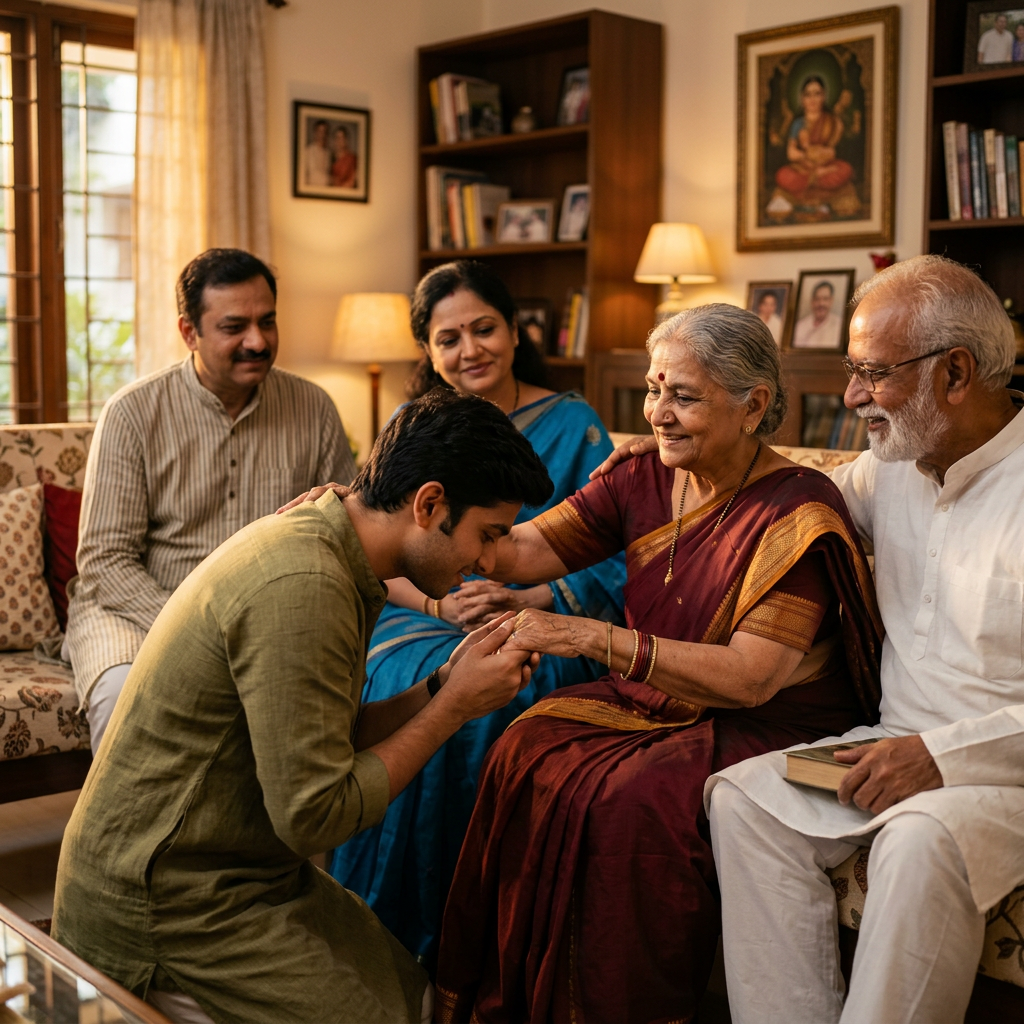
Respect for Elders: The Silent Shift From Authority to Burden
Once revered as keepers of wisdom, are elders now viewed as burdens? We explore the data, history, and modern trends reshaping intergenerational respect.

Once revered as keepers of wisdom, are elders now viewed as burdens? We explore the data, history, and modern trends reshaping intergenerational respect.
Trending Now
📌 Key Takeaways
- Respect for elders has shifted dramatically over the past century, moving from cultural reverence to quiet neglect in many parts of the world.
- Industrialization, nuclear family structures, and digital culture have all played a role in widening the generation gap.
- 1 in 2 people globally hold ageist attitudes — a problem with real, measurable health consequences.
- Eastern cultures still lean on filial piety, but modernization is testing those traditions too.
- The coming Silver Tsunami — 2.1 billion people aged 60+ by 2050 — means we can't afford to get this wrong.
- There are real, working solutions: intergenerational programs, multi-generational living, and policy reform are already making a difference.
Respect for Elders: The Silent Shift From Authority to Burden
Let's be honest — when was the last time you sat down and genuinely listened to an older person? Not politely nodded. Not scrolled your phone halfway through. Actually listened, like what they said mattered?
For most of human history, that question would've seemed strange. Of course you listened. Elders were the library. They were the decision-makers, the storytellers, the ones who knew how to survive the winter, navigate the harvest, and settle the dispute. Respect for elders wasn't a value you were taught in school — it was survival logic baked into the culture.
But somewhere between the Industrial Revolution and the iPhone era, something quietly shifted. The village elder became the "out-of-touch grandparent." The wisdom keeper became the person struggling with Zoom. And in many parts of the world — especially wealthier ones — growing old has started to feel less like an achievement and more like an inconvenience.
This article isn't here to guilt-trip anyone. It's here to take a real, honest look at how we got here, what the data says, and — more importantly — where we might be heading.
1. The Golden Age of Authority: How Elders Were Viewed in the Past
Before cities, before factories, and definitely before social media, age was currency. In hunter-gatherer societies, older individuals held the collective knowledge of generations. They knew which plants were poisonous, which seasons brought floods, which alliances kept the peace. Losing an elder wasn't just sad — it was a genuine threat to the group's survival.
This reverence showed up everywhere. In Ancient Rome, the Senate literally meant "council of elders" (from the Latin senex, meaning old man). In Confucian China, respecting your parents and ancestors wasn't just good manners — it was the foundation of social order. Indigenous cultures across Africa, the Americas, and the Pacific built entire governance structures around elder councils.
Even early Christianity and Islam placed enormous weight on honoring parents and elders — not as a cultural preference, but as a moral and spiritual obligation.
The point is: respecting elders wasn't a trend. It was the default.
2. The Great Shift: Industrialization and the Nuclear Family
So what changed? In a word: industrialization.
When economies shifted from agriculture to manufacturing, the family unit restructured around it. People moved from rural, multi-generational households to urban centers in search of work. The nuclear family — mom, dad, kids — replaced the extended family as the standard unit of society. And in that restructuring, elders quietly lost their central role.
Before industrialization, grandparents worked the farm alongside their children and grandchildren. Their experience was directly applicable and daily visible. Post-industrialization? Not so much. Factory work valued physical speed and adaptability over accumulated wisdom. Older workers were pushed to the margins, and retirement — an entirely new concept — was invented partly to free up jobs for younger workers.
According to research from the Cornell Chronicle, traditional societies view aging as a path toward greater wisdom and social authority, while modern Western societies increasingly associate it with decline and irrelevance. That's not a subtle difference. That's a complete cultural inversion.
The generation gap that followed wasn't just about music tastes or fashion. It was a structural, economic rupture — one that Pew Research Center found has only grown over time, with 79% of Americans now believing there is a major generational divide, significantly more than in the 1970s.
3. The Statistics of Silence: Measuring Respect for Elders in the 21st Century
Here's where things get uncomfortable. We don't just feel like elders are less respected — the data actually confirms it.
"1 in 2 people globally hold ageist attitudes against older people." — World Health Organization
That's not a small fringe group. That's half the planet. And the consequences aren't just social — they're deeply physical. Research cited by the WHO found that older individuals who perceive aging negatively live, on average, 7.5 years less than those with a positive self-perception of aging. Ageism, quite literally, kills.
Even more telling is what the World Values Survey found:
"60% of respondents reported that older people are not respected — with the lowest respect levels found in high-income countries." — WHO
Wrap your head around that for a second. The wealthiest nations — the ones with the best healthcare, the most resources, the most "civilized" infrastructure — are also the ones where old people feel the least respected. That's not a coincidence. It's a symptom of cultures that have come to equate worth with productivity.
| Metric | Data Point | Source |
|---|---|---|
| Global ageist attitudes | 1 in 2 people | WHO, 2021 |
| People who say elders are not respected | 60% globally | World Values Survey / WHO |
| Perception of major generation gap (US) | 79% of Americans | Pew Research Center |
| Years of life lost due to negative aging perception | 7.5 years | Yale / WHO |
| Global 60+ population by 2050 | 2.1 billion | United Nations / WHO |
4. The Digital Divide: How Technology Created a 'Relevance Gap'
One of the least-talked-about drivers of elder disrespect is technology — specifically, the speed at which it changes.
For most of human history, the pace of change was slow enough that elders could adapt and remain relevant. A grandmother who learned to cook over a wood fire could still teach her grandchildren something valuable decades later. But when technology evolves every 18 months — new interfaces, new platforms, new entire ways of communicating — that knowledge transfer breaks down fast.
We now have a phenomenon researchers are calling the Digital Divide Seniors problem. Older adults are significantly less likely to own smartphones, use social media, or navigate digital services — and as governments, banks, and healthcare systems move online, this isn't just inconvenient. It's exclusionary.
But here's what we miss when we laugh at grandpa struggling with autocorrect: we've redefined what "smart" and "capable" look like, and we've done it entirely on young people's terms. A 75-year-old who can read a room, resolve a conflict, manage grief, and grow a garden from seed has a kind of intelligence that no algorithm can replicate. We've just stopped valuing it.
The National Institutes of Health notes that social isolation in older adults — much of it now driven by digital exclusion — is directly linked to increased risks of dementia, depression, and cardiovascular disease. The digital divide isn't just a tech problem. It's a health crisis.
5. East vs. West: Is Filial Piety Surviving Modernization?
If you want to see the contrast in cultural attitudes toward aging, just look East.
Filial piety — the Confucian concept of honoring and caring for one's parents and elders — has been a cornerstone of Chinese, Japanese, Korean, and Vietnamese cultures for over two millennia. In Japan, there's literally a national holiday called Keiro no Hi (Respect for the Aged Day). In China, it's legally mandated that adult children visit and care for elderly parents.
But modernization is putting serious pressure on these traditions. Rapid urbanization, smaller family sizes, and increasing female workforce participation (the traditional caregiver pipeline) are all eroding the practical capacity for filial piety — even where the values remain strong.
| Cultural Dimension | Western Societies | Eastern/Confucian Societies |
|---|---|---|
| Elder's social role | Often seen as retired/passive | Active family and community authority |
| Primary elder care model | Institutional (nursing homes) | Family-based (filial duty) |
| Attitude toward aging | Associated with decline | Associated with wisdom |
| Legal obligations to elderly parents | Rare | Common (China, India, Singapore) |
| Multigenerational households | Declining | Still relatively common |
Still, even in East Asia, a growing body of research shows younger generations feeling the squeeze between traditional expectations and modern economic realities. The generation gap is widening globally — it's just wearing different cultural costumes depending on where you are.
6. The Economics of Aging: From Asset to Liability?
Let's talk money — because, like it or not, economics shapes culture.
For much of history, having aging parents or grandparents in the household was an economic advantage. They provided childcare, managed the home, contributed labor, and passed down land, trade skills, and social connections. They were assets.
That math has flipped in a market economy. Rising healthcare costs, longer life expectancy, and diminishing pension safety nets mean that many families now experience elder care primarily as a financial strain. This isn't a moral failing — it's a structural problem. But it absolutely shapes attitudes.
The looming Silver Tsunami makes this even more urgent. By 2050, the global population of people aged 60 and over is expected to double to 2.1 billion, according to the United Nations and WHO. That's not just a demographic shift — it's a complete restructuring of workforce ratios, healthcare systems, and intergenerational wealth dynamics.
If we don't change how we value older people — economically and culturally — we're heading toward a care crisis of historic proportions.
7. Ageism in the Workplace: The Loss of Mentorship
Here's one we don't talk about enough: ageism in the workplace isn't just unfair to older workers — it's actively making organizations worse.
When companies push out experienced employees in favor of younger, cheaper talent, they're not just losing workers. They're losing institutional memory, mentorship capacity, and hard-won judgment. The kind of knowledge that stops a company from making the same mistake twice. The kind that can't be Googled.
Studies consistently show that age-diverse teams outperform age-homogeneous ones in problem-solving and innovation. Yet ageist hiring practices remain widespread — with workers over 50 routinely facing discrimination in interviews, promotions, and layoffs.
The irony? As senior rights advocates have long argued, many of the people being pushed out are in the prime of their intellectual capability. Cognitive science tells us that while processing speed may slow with age, wisdom, emotional regulation, and strategic thinking often peak in later decades.
We're essentially firing our wisest players and wondering why we're losing games.
8. Case Studies: Intergenerational Programs That Work
Okay, enough of the grim stuff — because there are genuinely hopeful stories out there.
Providence Mount St. Vincent (Seattle, USA): A nursing home that integrated a full-scale daycare center into its facility. Kids and elderly residents interact daily — sharing meals, doing art, reading together. The results? Reduced depression among seniors, improved social skills in children, and a measurable uptick in cognitive engagement for older residents.
Humanitas (Netherlands): A Dutch care facility that offers free housing to university students in exchange for 30 hours per month of "good neighborly contact" with elderly residents — things like sharing a meal, helping with technology, or just hanging out. Loneliness rates dropped dramatically. Both groups report increased well-being.
OASIS Intergenerational Tutoring Program (USA): Older adults are trained to serve as reading tutors for at-risk elementary students. Children improve academically. Seniors gain purpose, social connection, and reduced health risks. It's a genuine win-win.
These programs work because they reject the false premise that old and young exist in separate worlds. They engineer contact, connection, and mutual value — and the data backs it up.
9. The Return of the Multi-Generational Home
If you've noticed more adult children moving back home — or aging parents moving in — you're not imagining it. Multi-generational living is making a quiet comeback, and the data is fascinating.
Pew Research has tracked a steady increase in multi-generational households in the US over the past several decades. Economic pressures (housing costs, student debt, elder care costs) are a big driver. But so is cultural shift, particularly among immigrant communities and non-Western households where this arrangement was never abandoned in the first place.
And the outcomes? Often surprisingly positive. Research consistently shows that seniors in multigenerational homes experience lower rates of depression and cognitive decline. Younger family members report feeling more grounded, more patient, and more connected to their own future.
There's something genuinely healing about regular, daily contact between generations — the kind that doesn't happen at a holiday dinner or a nursing home visit once a month. The kind where you see each other's full, imperfect humanity.
It doesn't fix everything. Multigenerational living comes with real friction — privacy, space, conflicting schedules, caregiving burnout. But the friction, it turns out, is often worth it.
10. Future Outlook: Redefining Respect for Elders in the Age of the Silver Tsunami
So where does respect for elders go from here?
Here's the honest answer: it depends on choices we're making right now.
The Silver Tsunami is coming whether we're ready or not. Two billion older adults by 2050 means that within a single generation, the question of how we treat the elderly goes from a cultural issue to an existential one. Healthcare systems, pension structures, housing markets, and labor economies will all be reshaped by this demographic wave.
We have two paths.
Path one: We double down on the productivity-equals-worth model. We warehouse elders in underfunded care homes, exclude them from technology and civic life, and treat their care as a burden to be minimized. Given the data, this path likely shortens lives, deepens inequality, and leaves us all a little less human.
Path two: We do the harder, more interesting thing. We redesign cities with age in mind. We build intergenerational programs into schools, workplaces, and communities. We legislate senior rights with the same seriousness we apply to other civil rights. We invest in closing the digital divide. We celebrate the specific, irreplaceable things that only time and experience can build.
And maybe, on a smaller scale, we just... sit down and listen. Without our phones. Like what they're saying actually matters.
Because it does. It always has.
"Older individuals who perceive aging negatively live on average 7.5 years less than those with positive attitudes toward aging." — Yale School of Public Health / WHO
The way we treat older people says everything about what kind of society we're building. And right now, we have a real chance to build a better one — not out of obligation, but out of genuine understanding that the respect we extend to elders today is the respect we're quietly reserving for ourselves tomorrow.
Sources
- World Health Organization – Ageism is a Global Challenge (2021)
- World Health Organization – Discrimination and Negative Attitudes About Ageing (2016)
- World Health Organization – Ageing and Health Fact Sheet
- World Health Organization – Ageing and Ageism Q&A
- Pew Research Center – Generations Apart (2009)
- Cornell Chronicle – Traditional vs. Modern Views on Aging (2015)
- National Institutes of Health (PMC) – Social Isolation and Aging
Advertisement
Frequently Asked Questions
How has the level of respect for elders changed statistically over time?
According to a global study by the World Health Organization, 60% of people surveyed believe that older adults are not respected. This reflects a shift from the mid-20th century when multi-generational households were more common and elders served as the primary sources of community knowledge.
What are the legal requirements for respecting elders in different cultures?
While Western respect is often social, countries like China and Singapore have codified it. China’s 2013 Elderly Rights Law mandates that children visit their parents, and Singapore’s 1995 Maintenance of Parents Act allows seniors over 60 to legally claim financial support from their children.
How does ageism affect the modern economy?
A 2020 AARP study estimated that age discrimination in the workplace cost the U.S. economy approximately $850 billion in lost GDP. This economic impact highlights how a lack of respect for elder experience leads to involuntary retirement and missed productivity.
Why was elder respect more prevalent in pre-industrial societies?
Historically, reaching old age was a rare achievement; in 1900, the average US life expectancy was only 47. Elders were seen as vital repositories of survival knowledge and tradition, whereas today's digital archives have largely replaced the oral tradition role once held by seniors.
Does the digital divide contribute to a decline in generational respect?
Technology has inverted traditional knowledge hierarchies. Although Pew Research indicates that 75% of Americans aged 65 and older are now internet users, the rapid pace of tech evolution often positions younger generations as teachers, which can diminish the traditional authority once held by elders.
Sponsored
Curious about technology, mathematics, education, and growth, I write as a learner exploring ideas in innovation, problem-solving, culture, and the questions shaping our world.
You Might Also Like


Advertisement
Comments (0)
Sign in to join the conversation
No comments yet. Be the first to share your thoughts!